• 10 min read
Google’s car assistant now depends on its data moat
Gemini Personal Intelligence makes Android Auto more useful by tying it to Gmail, Photos and Calendar—but only after drivers hand Google more context.
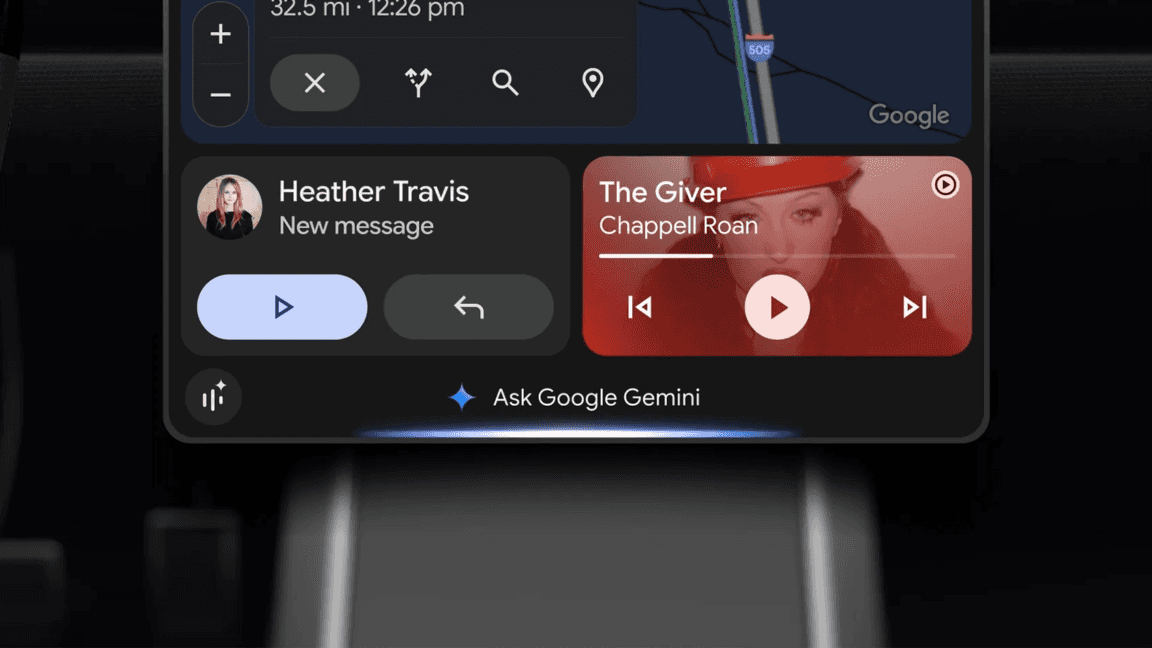
Image: Ars Technica
Gemini Personal Intelligence is rolling out to Android Auto, moving Google’s in-car assistant from a general-purpose voice interface toward one that can answer from a driver’s Gmail, Calendar, Photos, Maps, Search history, YouTube activity and Workspace data. The premise is straightforward: an assistant that knows a trip, a booking, a dietary preference or a prior conversation requires less verbal setup while a driver is on the road.
That convenience is also Google’s competitive edge. The update does not primarily add a new vehicle capability; it makes the existing Gemini experience more dependent on the personal-data graph Google already holds. A driver can ask for directions to a doctor’s appointment rather than dictate an address, ask for a flight gate and delay status in one request, or seek restaurant stops along a route that account for a vegetarian preference. Those answers depend on access to connected services, not on information the car itself supplies.
Google says the feature is opt-in, can be disabled at any time, and lets people choose the apps and services Gemini may access. The company describes the implementation and examples in its Android Auto and Google built-in announcement. The assistant becomes more helpful when it can join information that users might normally keep in separate apps.

Recommended reading
Parallel’s $100M rail bet depends on short-haul freight moving first
Sergey Kuznetsov • • 8 min read
Two rollout paths, one data layer
Personal Intelligence begins with Android Auto on October 20, 2026. Android Auto runs from a user’s phone and projects navigation, media and messaging onto a vehicle’s infotainment display, whether wired or wireless. Cars with Google built-in, by contrast, have Google’s software and services integrated directly into their infotainment systems. Google says that second group will receive the capability in the coming months.
| Vehicle platform | How Gemini reaches the car | Personal Intelligence availability |
|---|---|---|
| Android Auto | Phone-based interface projected to the vehicle display | Rolling out starting October 20, 2026 |
| Google built-in | Google software integrated into the vehicle infotainment system | Coming in the next few months |
Google built-in has often received Google’s automotive features first, despite being installed in far fewer vehicles. This time, Google is leading with Android Auto, making the data-connected feature available across a broader phone-driven footprint before the embedded-car implementation catches up.
The rollout is not universal on day one. Android Auto availability is described as global except for Switzerland, the European Economic Area, the UK and Nigeria. Google has not supplied a date for those excluded markets or a specific launch date for Google built-in vehicles. For US drivers, the immediate question is whether their Android Auto setup receives the staged rollout and whether they choose to connect the relevant services.
The company has also not stated pricing for the automotive addition. Personal Intelligence began as a feature limited to Google AI Pro and Ultra subscribers before expanding to free accounts in March 2026. The current vehicle rollout is presented as part of Gemini rather than as a separately priced automotive tier.
What the assistant can query
The useful cases rely on correlation across data sources. A flight question can pull a gate and schedule information from an email or calendar entry. A navigation request such as “take me to my doctor’s appointment” can resolve an event into a destination. A request for a dinner stop can use a route alongside preferences or restrictions inferred from connected activity. Google also says the assistant can use visual analysis to identify a location in a user’s photos and begin navigation.
This goes beyond adding natural-language phrasing to an automotive voice assistant. Gemini can also resume a prior exchange: someone who asked about a coffee shop outside the car can later ask for it again in the vehicle, and Google says Gemini can resurface the detail and create a Maps route. Android Central additionally describes a photo-based use case in which a driver asks about a car’s tires and Gemini searches their photos for relevant information.
The permitted categories described across the rollout include Google Photos, Google Maps, Search and Discovery data, YouTube and YouTube History, and Google Workspace services including Gmail, Calendar and Drive. Gmail and Calendar are particularly consequential in a vehicle because they turn a trip from a map destination into a context-rich itinerary: flight status, gate number, appointment location and timing can be retrieved without the driver searching through messages.
| Connected context | Example result Google describes |
|---|---|
| Gmail and Calendar | Flight gate, delay status, or navigation to a scheduled appointment |
| Photos | Find a pictured location and begin navigation; retrieve information from an image |
| Maps, Search and activity history | Route-aware recommendations shaped by prior preferences |
| Workspace services | Personal details from Gmail, Calendar and Drive when access is allowed |
| Prior Gemini conversations | Resume a prior query and create a route from the resurfaced result |
Google has offered product examples, not independent measures of answer accuracy, retrieval speed, connection reliability or distraction reduction. It has not said how long a multi-service request takes when a driver has weak cellular coverage, nor has it published error rates for requests that combine email, calendar and route data. In a car, a delayed answer is inconvenient, but a confidently wrong gate, destination or recommendation can create a more immediate problem.
The privacy control is granular, but the context is cumulative
The feature is off by default because it requires an explicit opt-in. Users can turn it off later and can select which apps or service groups Gemini can access. If Personal Intelligence is already enabled on a person’s Gemini profile, Google says that configuration carries into the car; a user does not need to establish the same connections again when the automotive feature arrives.
Google has previously said that Personal Intelligence processing stays within its existing secure infrastructure rather than being distributed to third-party services. It also says personal context used by the feature is not used to train foundation models, and that people can delete stored memory items such as prior Gemini conversations. Those controls separate personal context from foundation-model training.
But selective access does not make the decision trivial. A person can deny Photos while allowing Gmail and Calendar, for example, yet Gmail can still hold reservations, medical appointments, receipts, travel details and correspondence that makes the assistant’s answers highly specific. The system combines fragments: a calendar event, a confirmation email and a navigation route are more revealing together than in isolation. Drivers should treat each enabled category as an ongoing context source, not as a one-time permission for a single question.
The automotive setting also changes the social dimension of those permissions. A shared car display may expose an answer generated from an individual’s account in front of passengers. The supplied material does not explain how Gemini distinguishes a sole driver from a shared vehicle, whether separate driver profiles are required, or how much of a retrieved result is displayed versus spoken aloud. Google has said users retain control over data connections, but it has not detailed these in-car visibility controls in the rollout information.
A long-running feature reaches the car
Personal Intelligence itself is not new. Google introduced it at the start of 2026, initially as a paid Gemini capability, and expanded it to free accounts in March. One account describes that March expansion as a US rollout, while another says the feature is now in beta in global markets. The automotive deployment follows Google’s November 2025 introduction of Gemini in Android Auto.
October’s change is not a wholesale replacement of Android Auto. Gemini was already the assistant; Personal Intelligence changes the information it may use to answer. With the feature off, Gemini continues to respond from general knowledge. With it on, the assistant may incorporate the connected records that make a request like “where is my doctor?” or “is my flight still on time?” possible without a driver supplying the missing details.
That approach fits a broader pattern we covered during IFA 2026, where connected homes, appliances and computing devices were presented around increasingly personalized, local intelligence. But Google’s automotive approach is not a local-first claim. The reported value comes from joining cloud-linked services—Gmail, Calendar, Photos, Search, Maps, YouTube and Workspace—into a single conversational layer. The vehicle is another endpoint for that account context.
The reporting points to a rollout with unresolved edges
Across the five reports, the functional story is consistent: Android Auto gets an optional Gemini mode that draws from connected Google services, Google built-in follows in coming months, and a driver can choose app-level access.
The clearest operational detail is the regional limitation: the Android Auto rollout is global except Switzerland, the EEA, the UK and Nigeria. That qualification is absent from broader descriptions of a rollout beginning “today,” and availability is not equivalent to every Android Auto user receiving the feature at once. The reports also differ slightly on the earlier chronology. Some place Personal Intelligence’s initial debut at the start of 2026, while another says January; the material agrees that free users received access in March after an earlier subscription restriction.
The accounts expose the boundary between Google’s stated privacy design and unanswered operating questions. The company says access is opt-in, app-selectable, revocable and excluded from foundation-model training. None of the supplied reporting establishes independent verification of those claims, publishes a retention schedule for the personal context, or documents retrieval behavior when underlying data conflicts—for example, when an old calendar event and a changed email itinerary point to different destinations.
There is also no published comparison of response time with Personal Intelligence enabled versus disabled. The company argues that additional context should reduce follow-up questions, which could make voice interaction less distracting. Yet pulling across mail, calendar, photos and search history may add retrieval work, and the supplied material does not establish how Gemini behaves when a car has unreliable connectivity. Google has made a convenience claim, not a measured road-safety claim.
Google’s advantage is also its lock-in mechanism
Personal Intelligence is a credible improvement to the in-car assistant because its examples address the voice requests where users know the relevant information exists but cannot safely search for it while driving. Asking for a flight gate, an appointment destination or a tailored stop on a route is better than trying to reformulate an incomplete command until a general assistant understands it.
The cost is architectural, not monetary. Google has not announced a separate price, but the system’s usefulness rises with the number of Google services a driver connects. Someone who grants only Calendar gets a narrower assistant than someone who also permits Gmail, Photos, Maps, Search, YouTube history and Workspace. The assistant is differentiated less by a car-specific capability than by Google’s ability to make its existing account ecosystem act as one memory layer.
The opt-in model is the minimum, and app-level selection is better than a single all-or-nothing switch. Drivers should not mistake a toggle for a complete explanation of how a context-rich assistant behaves in a shared vehicle, under bad connectivity, or when its source data is stale. Google is shipping the integration before it has publicly answered those practical questions—or published the latency and accuracy data that would show whether the extra personal context reduces friction rather than adding another point of failure.
Frequently asked questions
When will Gemini Personal Intelligence reach Android Auto?+
Google began rolling it out to Android Auto on October 20, 2026. The rollout excludes Switzerland, the European Economic Area, the UK and Nigeria.
When will it arrive in cars with Google built-in?+
Google says Personal Intelligence will reach cars with Google built-in in the next few months. It has not given a specific date.
What data can Gemini Personal Intelligence use in the car?+
With permission, it can use connected Google services including Gmail, Calendar, Photos, Maps, Search and Discovery data, YouTube history, and Workspace apps such as Drive.
Can I turn off Gemini Personal Intelligence in my car?+
Yes. Google says it is opt-in, can be disabled at any time, and lets users choose which apps or service groups Gemini can access.

Editor-in-Chief
Sergey Kuznetsov is Head of Product at iXBT.com, one of the largest Russian-language technology media outlets, and the founder of itzine.ru. He has spent over a decade building and running tech newsrooms. At for(geeks) he sets editorial standards and reviews what ships.