• 7 min read
Parallel’s $100M rail bet depends on short-haul freight moving first
Parallel Systems has $100 million to scale autonomous battery rail vehicles, but its case rests on proving rail can win freight trips under 500 miles.
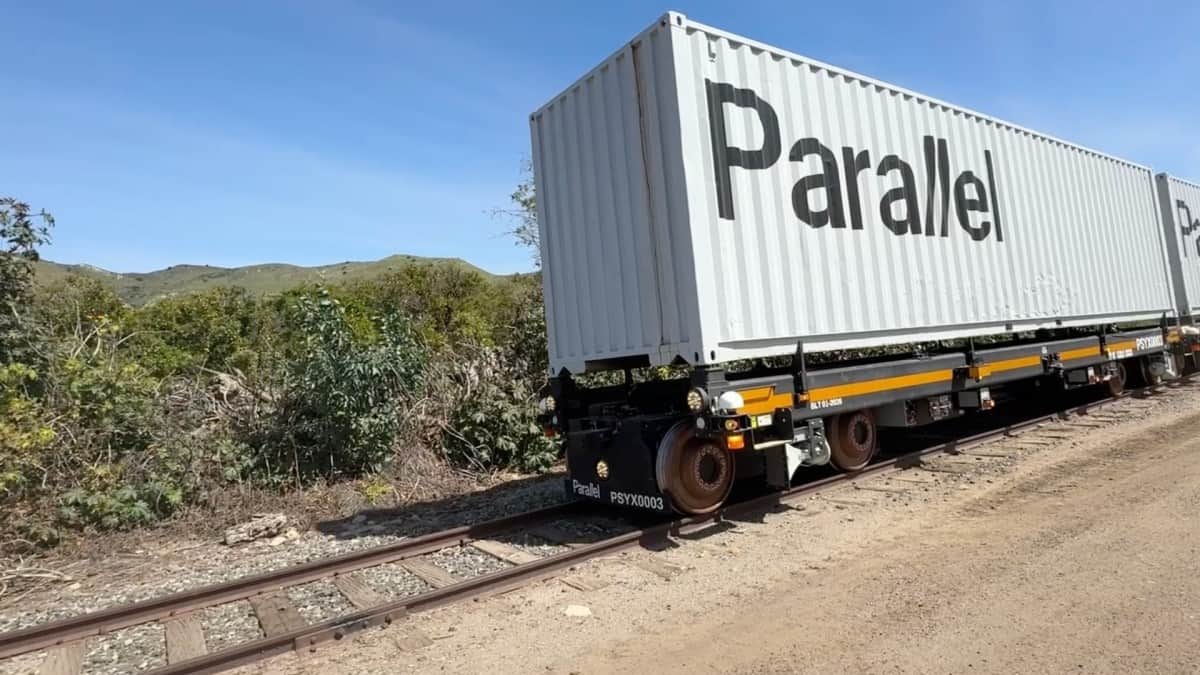
Image: TechCrunch
Parallel Systems has raised a $100 million Series C to manufacture and commercially deploy its third-generation Panther autonomous rail vehicle. The company aims to make rail economically viable for freight moves of less than 500 miles, a distance where trucking carries much of the business and conventional rail has largely pulled back.
The round was led by AVP. Hillspire, Agility Global, Cobalt Capital, Anthos Capital, Congruent Ventures, Riot Capital, and Collaborative Fund also participated. Parallel was founded in 2020 by Matt Soule and other former SpaceX employees who worked on rocket avionics systems; Soule is now the company’s co-founder and CEO.
The test is whether an autonomous rail system can fit into freight railroads' existing networks, yards, safety processes, and commercial contracts well enough to take cargo that currently travels by truck.
“Less than 500 miles is hard for railroads to do competitively. Our technology allows them to take some of that trucking, and it’s for the public’s benefit.”
Parallel says a Panther can carry several tons of freight up to 500 miles without an operator. Rather than coupling cars into one conventional train, it operates vehicles independently or as uncoupled platoons. In yards, a platoon can split apart without a person physically uncoupling vehicles, allowing individual units to head to different destinations after reaching a rail facility.
Parallel is betting that smaller, autonomous rail movements can reverse the economics that caused railroads to concentrate on high-volume corridors and scheduled, long consists.

Recommended reading
Autonomous planes move from crop fields toward cargo
Science & Mobility Desk • • 8 min read
The short-haul freight problem
Conventional railroad economics reward scale. Longer trains spread labor and other operating costs across more cargo, an approach associated with precision railroading. But the same model has made lower-volume routes and shorter trips less attractive to rail operators. Railroads focus on freight they can move efficiently in large blocks, while trucks handle a substantial portion of shorter-distance service.
Some 60% of U.S. freight trips are under 500 miles, and trucking companies handle a majority of those moves. That is the work Parallel’s system must displace or complement.
The company is also trying to sell itself to drayage operators rather than positioning rail as a direct replacement for every truck. Drayage companies move freight over short distances, including trips to and from ports. Their revenue is tied to completed loads, not the hours a truck spends stationary in port traffic. If a Panther can carry a container or other freight over a rail segment closer to a customer’s destination, the remaining truck leg could be shorter and a driver could complete more deliveries in a day.
“If you ever go to the Port of Savannah, you see the truck lines coming in and out of the port — it’s insanity.”
Parallel’s case is strongest where congestion is expensive and rail access already exists. Its vehicles run on railroads rather than public roads, so they do not add to road traffic; the company also describes them as battery-powered, avoiding diesel exhaust from the rail move itself. Freight must still enter and leave rail infrastructure. The business works only where loading, rail access, yard operations, and final delivery can be arranged with less friction than a truck-only trip.
What Panther has to automate
The Panther is designed around distributed movement rather than a locomotive hauling a coupled consist. Parallel says its platoons are generally shorter than typical trains, and its lack of couplers is meant to eliminate a manual yard task when vehicles divide. The unit of operation is an individual freight vehicle or a coordinated group, not one fixed consist.
Parallel says that once a Panther is authorized to run on a section of track, onboard sensors monitor the rail ahead for obstacles. The supplied reporting does not specify the sensor suite, braking architecture, communications method, maximum speed, battery capacity, recharge process, payload rating, or how the vehicles coordinate inside a platoon. It also does not provide independent performance or safety results. Autonomous operation on an active freight railroad must coexist with dispatching, track authority, rail-yard rules, and the operating practices of the host railroad.
The Federal Railroad Administration approved operation near the Port of Savannah, Georgia, about a year and a half before October 7, 2026. Parallel has since been operating on 160 miles of track there to validate its safety controls and operating practices in a real-world setting.
“We’ve been verifying all the safety controls and operating practices that are best evaluated in a real-world setting with a path toward our first commercial payload coming up very soon.”
The key wording is “path toward” a first commercial payload. Parallel has not provided a date for that payload, named a customer, published a per-load rate, or said when the third-generation Panther will enter volume production. The $100 million is intended to scale manufacturing and accelerate commercialization; it does not show that broad commercial service is already available.
Trucking’s financial stress is real, but it is not a contract
Federal court filings and carrier records show that at least 16 trucking, delivery, and transportation companies entered bankruptcy proceedings between late August and September 21, 2026. The cases span general freight, last-mile delivery, agriculture, construction hauling, oil-field services, and specialized freight.
Not every filing means a carrier has stopped running. Chapter 11 is intended to let a business reorganize, while Chapter 7 generally involves liquidation. The filings show cost pressure across fleets of different sizes and service types, alongside rising diesel prices and other elevated operating costs.
| Filing date | Carrier | Proceeding | Reported operation or financial detail |
|---|---|---|---|
| September 4, 2026 | Pacer Transport | Chapter 11 | Less than $50,000 in assets; $1 million–$10 million in liabilities |
| September 9, 2026 | Truckload LLC / Expedite Express | Chapter 11 | Historically 114 power units; $100,000–$500,000 in assets |
| September 15, 2026 | Globemaster Incorporated | Chapter 11 | 51 power units; $500,000–$1 million in assets and $1 million–$10 million in liabilities |
| September 16, 2026 | Xoco Transport | Chapter 11 | More than 40 tractors, about 70 trailers, and more than 65 drivers |
| September 17, 2026 | Eulogia Logistics | Chapter 7 | Three trucks and five drivers |
| September 18, 2026 | C. Pride Transport | Chapter 7 | One truck and one driver |
The recent failures should not be confused with demand migrating automatically from trucks to autonomous rail. Several of the affected companies are small fleets, and the filings cover businesses whose work may not map cleanly to a 500-mile rail corridor. Construction material, last-mile delivery, hazardous-material hauling, courier work, and local agricultural freight do not all share the same loading needs or rail access.
The data supports Parallel’s argument that truck-only operations face cost and utilization problems. For port drayage, delays reduce the number of loads a driver and truck can complete. A service that moves a middle segment by rail could be useful even to trucking companies, provided it raises throughput rather than creating a new terminal delay.
From Savannah proof point to a rail product
The Savannah program is Parallel’s only disclosed operating footprint in the supplied material. It puts the company on actual track near a major port, where congestion is visible and drayage economics are central to the pitch. It also shows the distance between a safety-validation program and a repeatable freight product.
A conventional railroad can often make a long scheduled train efficient because it consolidates cargo, crews, and fixed operations. Parallel proposes to recover service flexibility by replacing some labor and coupling work with autonomous vehicles and software-coordinated platoons. It must prove its vehicles can safely and reliably perform those tasks at commercial utilization, then persuade railroads to accommodate smaller movements that their current operating model has discouraged.
| Parallel milestone | What is established | What has not been disclosed |
|---|---|---|
| 2020 | Parallel Systems was founded by former SpaceX avionics employees | Initial production scale and early customer commitments |
| About April 2025 | Federal Railroad Administration approval for operations near Savannah | The full approval terms and operating limits |
| October 7, 2026 | $100 million Series C to scale third-generation Panther manufacturing | Panther production volume, pricing, and delivery schedule |
| Upcoming | A first commercial payload is described as coming “very soon” | Customer identity, date, route, and commercial rate |
Parallel may be most useful where rail surrendered freight because a full train was too blunt an instrument: short routes, port approaches, and cargo that needs more predictable movement than congested roads can provide.
The first commercial payload will show whether uncoupled autonomous vehicles can make a rail segment cheaper, faster, or more dependable without moving the bottleneck to a yard or the final truck leg.
Frequently asked questions
How much did Parallel Systems raise?+
Parallel Systems raised a $100 million Series C led by AVP, with participation from Hillspire, Agility Global, Cobalt Capital, Anthos Capital, Congruent Ventures, Riot Capital, and Collaborative Fund.
How far can Parallel’s Panther freight vehicle travel?+
Parallel says Panther can move several tons of freight up to 500 miles without an operator.
Is Parallel Systems commercially operating autonomous freight trains?+
Parallel has Federal Railroad Administration approval to operate near Savannah and has run on 160 miles of track there. It said its first commercial payload is coming very soon, but did not provide a date, customer, or price.
How does Parallel’s rail system differ from a conventional train?+
Its vehicles can operate independently or in uncoupled platoons. Without couplers, the company says platoons can split in a yard without human intervention.

Editor-in-Chief
Sergey Kuznetsov is Head of Product at iXBT.com, one of the largest Russian-language technology media outlets, and the founder of itzine.ru. He has spent over a decade building and running tech newsrooms. At for(geeks) he sets editorial standards and reviews what ships.