• 5 min read
Apple’s M5 Ultra puts 512GB of RAM in a Mac Studio
Apple’s M5 Ultra uses four dies, 1.2TB/s of memory bandwidth and up to 512GB of RAM. The new Mac Studio starts at $2,499.
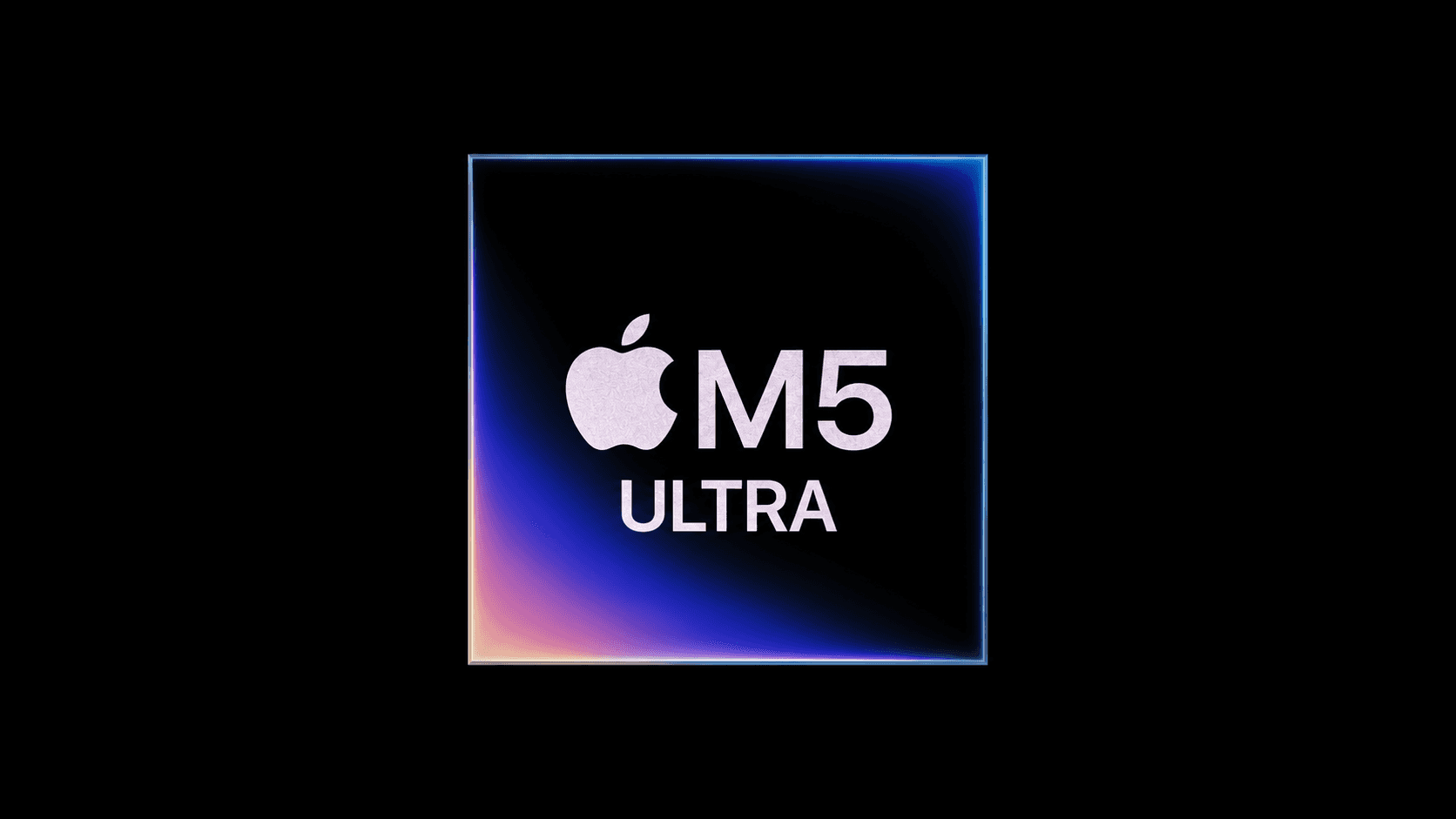
Image: MacRumors
Apple’s new M5 Ultra is the company’s first quad-die M-series system-on-chip, combining four silicon dies into one processor through a faster version of UltraFusion. The chip will power the new Mac Studio, which starts at $2,499 and begins shipping in the US on September 22, 2026.
Apple says UltraFusion provides more than 4.4TB/s of inter-die bandwidth and more than 6x higher connection density than the previous implementation. That bandwidth allows the four dies to present themselves as a single processor rather than as separate chips that software would need to schedule independently. Apple builds the design by connecting two dual-die M5 Max chips.
The top M5 Ultra configuration has a 36-core CPU, split into 12 super cores and 24 performance cores, plus an 80-core GPU. Apple claims up to 1.25x higher single-threaded performance and up to 1.3x higher multithreaded performance than the M3 Ultra. The GPU adds a Neural Accelerator to every core, a first for Apple’s Ultra-class chips, and includes second-generation Dynamic Caching, hardware-accelerated mesh shading and third-generation ray tracing.
Recommended reading
Surface Laptop Ultra is a CUDA workstation that happens to travel
Sergey Kuznetsov • • 13 min read
The chip also carries a 32-core Neural Engine and up to 1.2TB/s of unified memory bandwidth, a 50% increase over the M3 Ultra. Memory capacity reaches 512GB, giving the Mac Studio enough local memory to hold large datasets and run language models with hundreds of billions of parameters without sending the workload to a remote server. Apple ties the additional capacity and bandwidth to higher token-generation rates, though the announcement does not provide independent inference benchmarks or identify the model and workload behind those claims.
“Today, we’re debuting the next giant leap in performance and AI compute for Apple silicon with the incredibly advanced M6 and the most powerful M-series chip yet, M5 Ultra. Built using the cutting-edge 2 nm process, M6 combines a new CPU complex, two additional CPU and GPU cores, a Dual 16-core Neural Engine, and more unified memory bandwidth to power through workloads with amazing energy efficiency. And for the ultimate desktop performance and the ability to run massive AI models, M5 Ultra features a massive GPU, now with Neural Accelerators, and more unified memory bandwidth, pushing the boundaries of what a desktop can do.”
The published performance figures are not entirely consistent. One description puts the M5 Ultra’s peak AI compute at up to 4.3x the M3 Ultra and its graphics performance at up to 1.8x the previous generation. Another lists up to 4.5x higher GPU compute for AI tasks and 40% faster graphics performance than the M3 Ultra. These may represent different tests or metrics, but Apple’s supplied material does not explain the discrepancy.
Mac Studio pricing and availability
The M5 Ultra Mac Studio starts at $5,499 with 96GB of unified memory and a 1TB SSD. The lower-priced model uses the M5 Max and starts at $2,499 with 36GB of unified memory and 512GB of storage. That keeps the entry price equal to the current M4 Max Mac Studio, while the M5 Ultra raises the memory ceiling for workloads that would otherwise require a workstation cluster or a cloud GPU service.
Apple will not ship the 512GB configuration with the initial models. It says the configuration will be available in late October, and its price has not been announced. The 512GB system is expected to start well above $10,000, but its final US price remains unknown.
The M5 Ultra model can play up to 33 streams of 8K ProRes 422 at 30 frames per second simultaneously. Its media hardware includes dedicated H.264 and HEVC support, four ProRes encode and decode engines, and hardware-accelerated AV1 decode. The Mac Studio can drive up to eight displays, and it adds genlock over USB-C for production workflows that need synchronized video timing.
Storage moves to a PCIe Gen 6-based SSD architecture that Apple says is up to twice as fast as before. Connectivity includes Thunderbolt 5 with up to 120Gb/s of bandwidth, along with Wi-Fi 7 and Bluetooth 6 through Apple’s N1 chip. Apple also supports clustering multiple Mac Studio systems through Thunderbolt 5 and RDMA, allowing them to operate with a shared memory pool.
Apple says a four-system Mac Studio cluster delivers up to 3x faster AI inference than one system. Four $5,499 base M5 Ultra machines would cost at least $21,996 before storage, networking or the 512GB upgrade. The company has not supplied latency, scaling-efficiency or power figures for the cluster, so the 3x claim cannot be evaluated against the cost of distributing the workload across systems.
M5 Max fills out the lineup
The M5 Max version has an 18-core CPU with six super cores and 12 performance cores, up to a 40-core GPU, up to 128GB of unified memory, and up to 614GB/s of memory bandwidth. Storage can be configured up to 8TB, and Apple claims up to 3.9x faster AI performance than the previous generation.
The Mac Studio arrives alongside the new M6 Mac mini, which starts at $899—$300 above the 2024 M4-equipped base model—and the M5 Pro Mac mini, which starts at $1,699. The M6 is Apple’s first 2-nanometer chip and has a 12-core CPU, a 12-core GPU with Neural Accelerators, a Dual 16-core Neural Engine and up to 170GB/s of unified memory bandwidth. Apple’s official announcement positions both chips around local AI workloads, but the M5 Ultra is aimed at models whose memory footprint is too large for mainstream desktops.
Apple says its benchmark testing was conducted in August 2026 using preproduction Mac Studio systems with the M5 Ultra, M3 Ultra and M1 Ultra. The comparisons therefore come from Apple’s selected industry-standard benchmarks and specified configurations, not independent testing. For buyers considering the $5,499 machine—or waiting for the unpriced 512GB model—the missing details are memory-configuration performance, sustained power behavior and real-world scaling across the Thunderbolt/RDMA cluster.
A section byline, not a person: stories filed here by for(geeks) are held to the same editorial policy as every story we run.