• 12 min read
Surface Laptop Ultra is a CUDA workstation that happens to travel
Microsoft’s $2,599 Surface Laptop Ultra buys 24GB of unified memory and RTX Spark CUDA access, not proven all-day mobility.
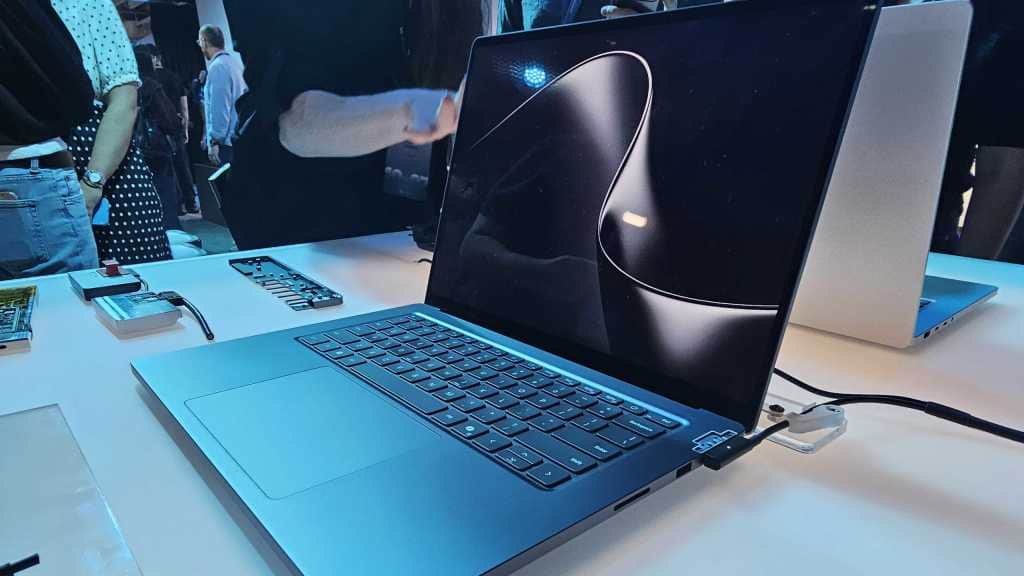
Image: PCWorld
Microsoft has put a price and ship date on the Surface Laptop Ultra: $2,599.99 to start, with U.S. shipments beginning October 16, 2026. The 15-inch machine is Nvidia’s RTX Spark platform debut on Windows, pairing an Arm-based Nvidia Grace CPU, Blackwell RTX graphics, and a shared memory pool of up to 128GB.
That differs from the small-NPU Copilot+ PC pitch. Surface Laptop Ultra targets people who need to load, run, prototype, or fine-tune substantial models locally, as well as developers who value Nvidia’s CUDA environment and creators who need GPU acceleration. Microsoft says the highest configurations can run models exceeding 120 billion parameters locally and reach up to 1 petaflop of peak AI performance. The latter is a theoretical FP4-with-sparsity figure, not a general-purpose performance result, so it says little about compilation, editing, inference latency, or game frame rates.
This is a portable CUDA workstation, priced and cooled accordingly, with laptop features around it. The company has promised a 15-inch mini-LED PixelSense Ultra touchscreen, peak HDR brightness of up to 2,000 nits, a haptic touchpad, HDMI, USB-A, three USB-C ports, a full-size SD card reader, and a magnetic USB-C charging connector. It weighs under 4.5 pounds and is under 18 mm thick.
Recommended reading
Surface Pro 12, Laptop 13 and haptic mouse cost more
Sergey Kuznetsov • • 9 min read
Those are integration claims for a device built around up to a 20-core CPU, up to 6,144 Blackwell GPU cores, and a large unified-memory pool. But Microsoft has not published the battery-life figures that would show whether this is mobile compute or a workstation that folds shut. Its specification page says battery details will come closer to availability. That omission matters more here than it would for a normal Surface Laptop: the bundled adapter is rated at 140W, and sustained local model work is likely to stress both cooling and battery capacity.
The configuration ladder is really a memory ladder
The entry configuration combines an 18-core Grace CPU, a 5,120-core Blackwell RTX GPU, 24GB of unified memory, and a 512GB SSD for $2,599.99. A second performance tier starts at $3,699.99 with the 20-core CPU, 6,144-core GPU, 32GB of memory, and a 1TB SSD. At the top end, $5,899.99 buys the 20-core/6,144-core configuration with 128GB of unified memory and a 1TB SSD. Microsoft also lists a $4,699.99 configuration with 64GB of memory and 2TB of storage.
| Surface Laptop Ultra configuration | CPU / GPU | Unified memory | Storage | U.S. price |
|---|---|---|---|---|
| Entry RTX Spark N1X | 18-core Grace / 5,120-core Blackwell RTX | 24GB | 512GB SSD | $2,599.99 |
| Higher RTX Spark N1X | 20-core Grace / 6,144-core Blackwell RTX | 32GB | 1TB SSD | $3,699.99 |
| Highest listed configuration | 20-core Grace / 6,144-core Blackwell RTX | 128GB | 1TB SSD | $5,899.99 |
Unified memory is the key part of this design. Instead of dividing capacity into system RAM and a discrete GPU’s VRAM, CPU and GPU address the same pool. For local model work, that can make a larger model feasible on a compact system because the GPU is not limited to a fixed VRAM allocation. It is also why 24GB is not a cosmetic base spec: it is the lower bound of the memory budget Microsoft expects buyers to use for this category of work.
There is a trade-off. Buyers cannot treat the storage and memory upgrades as routine spec-sheet indulgences. The price difference between the $2,599.99 entry model and the $5,899.99 top configuration is $3,300, and the higher-memory model has only 1TB of storage. Anyone selecting it for a particular local model or production workload should establish the model’s actual memory requirement before ordering; Microsoft has supplied a parameter-count claim, not a compatibility matrix or reproducible throughput tests.
Microsoft’s claim that the machine can run models above 120 billion parameters locally describes capacity, not necessarily useful performance. Parameter count alone leaves out precision, quantization, context length, runtime, and the memory reserved by the operating system and adjacent applications. The company has also not supplied a public battery test based on sustained token generation. Those data points would turn the local-AI pitch into an engineering case rather than a hardware-capacity claim.
It is a new tier above Microsoft’s Snapdragon Surfaces
This is a break from the Surface refresh Microsoft released on September 23, 2026. Those Snapdragon X2 Plus Surface Pro and Surface Laptop models began at $1,149.99 and $1,199.99 respectively, with 16GB minimum LPDDR5x memory, 80 TOPS NPU performance, and October 13 availability. The Surface Laptop Ultra arrives three days later at more than twice the entry price of that Surface Laptop, but it is not a like-for-like successor or a conventional upgrade.
The smaller Surface systems are Microsoft’s mainstream Windows-on-Arm direction: thin devices with a Copilot+ baseline and fixed LPDDR5x configurations of 16GB or 24GB. Laptop Ultra uses Nvidia’s RTX Spark architecture for large shared capacity, a Blackwell GPU, and a CUDA stack. That makes it relevant to developers and teams whose tools depend on Nvidia’s software ecosystem, rather than office users who happen to want an AI button.
Microsoft calls this split Hybrid Intelligence. In the company’s framing, work can run locally when the device is adequate and move to cloud services when it is not. Onstage, the company demonstrated an agent handling a tax-related workflow: searching folders, renaming documents, creating a zip archive, and drafting an email. The system showed a green-leaf indicator when a coding request ran locally and sent other tasks to the cloud.
That architecture is more candid than the industry shorthand of “on-device AI” suggests. The Laptop Ultra can provide a local execution target, but it does not eliminate cloud services, orchestration, or the need to decide which model gets access to which files and actions. The hardware may keep a workload off a metered cloud endpoint; it does not by itself solve agent permissions.
“One of the things we realized in the last 3-4 years is that just having a model doesn’t do much for anything. You really do need to orchestrate, and you need to have memory outside of the model. You need to have this harnessed layer that is able to take multiple models plus context, plus memory, and the action space.”
Windows 11's answer is Execution Containers, intended to confine coding agents and reduce unwanted system access. Microsoft says the capability will be available to all Windows 11 users, rather than being exclusive to RTX Spark systems. The announcement did not provide a technical boundary for the containers, a permissions model, or a detailed account of how agents can access local files while remaining confined. Given the California investigative subpoena into OpenAI that we covered on October 4, 2026, the distinction between “sandboxed” and demonstrably constrained is not a minor implementation detail.
Windows on Arm remains part of the purchase decision
Nvidia’s performance claim comes with a platform constraint: RTX Spark uses an Arm CPU. Windows supports native Arm applications and uses its Prism translation layer for existing 32-bit and 64-bit x86 software. Dell says Prism has been optimized for RTX Spark and supports AVX and AVX2 extensions, while native applications including Blender, DaVinci Resolve, Adobe Photoshop, and Adobe Premiere are available for the platform.
That is progress, but it is not identical to buying a conventional x86 Windows workstation. Microsoft and Nvidia are still working with game developers and publishers to extend native support. The companies say critical anti-cheat systems including Easy Anti-Cheat and BattlEye are supported, but that is not a claim that every game, driver, plug-in, or specialized enterprise tool behaves identically through translation. Developers considering an Arm switch should validate their own toolchains and deployment dependencies, particularly when the price begins at $2,599.99.
Gaming is evidence of the GPU’s capability, but it is not the primary buying case. Microsoft demonstrated Gears of War: E-Day, and demonstrations have shown titles including Fortnite, Alan Wake 2, and Indiana Jones and the Great Circle. No verified benchmark suite, settings list, frame-rate result, or battery-powered game test has been published in the material available here. Claims of smooth play and support for ray tracing, path tracing, DLSS, and Reflex should be read as feature compatibility, not a replacement for those numbers.
The design may support sustained performance. Microsoft says its thermal architecture delivers up to 2.5 times the thermal power capacity of current Surface laptops. The system uses dual fans and side vents that serve as both speakers and exhaust, while keeping the chassis below 18 mm. But “thermal power capacity” is not a sustained wattage figure, and Microsoft has not disclosed how long each RTX Spark tier can maintain a particular power level, fan profile, or clock behavior on battery.
Dell’s XPS provides the first real alternative
Microsoft is not alone in putting RTX Spark into a thin Windows system. Dell’s XPS 16 Creator Edition is available for preorder at Best Buy from $3,799.99, with availability on Dell.com promised later. It uses the same general RTX Spark ceiling—up to a 20-core Grace CPU, 6,144 Blackwell GPU cores, and 128GB of unified memory—but is directed more explicitly toward color-managed creative workflows.
| RTX Spark laptop | Starting price | Display emphasis | Maximum platform configuration | Connectivity details |
|---|---|---|---|---|
| Microsoft Surface Laptop Ultra | $2,599.99 | 15-inch mini-LED PixelSense Ultra touch, up to 2,000-nit peak HDR | 20-core Grace CPU, 6,144-core Blackwell GPU, 128GB unified memory | 3 USB-C, USB-A, HDMI, SD reader, magnetic USB-C charging |
| Dell XPS 16 Creator Edition | $3,799.99 | 3.2K Tandem OLED, 100% DCI-P3, Delta E<2, up to 1,000 nits | 20-core Grace CPU, 6,144-core Blackwell GPU, 128GB unified memory | 3 USB-C 4.0, HDMI 2.1b, SDXC v7.1 reader, audio jack |
Dell’s display specification is concrete: 3200-by-2000 resolution, 142 PPI, VESA DisplayHDR True Black 600, a 1,000,000:1 contrast ratio, and factory calibration to Delta E under 2 with Pantone validation. It also specifies three USB-C 4.0 ports with DisplayPort 2.1, Power Delivery, and up to 40Gbps transfers; a Kensington-compatible lock slot is integrated with those Type-C ports. Its cooling design includes larger fans and an 8 mm heat pipe in a 17.8 mm chassis.
For an AI developer, both machines lead with CUDA and shared memory. For a color-critical creator, Dell’s stated panel calibration may be more useful than Microsoft’s brightness claim. For a buyer who wants lower entry cost and the magnetic USB-C implementation, Surface is the less expensive route into RTX Spark. Dell’s account of the architecture, including the CUDA stack, Prism support, display calibration, and cooling details, is published in its XPS 16 Creator Edition announcement.
Dell is not the only rival. Its XPS 16 is joined by other RTX Spark laptops, and the Dell system’s $3,800 starting price shows that Surface’s $2,599.99 entry point is not simply a luxury tax; it is an aggressive opening price for this Windows category. But it also tells buyers something less flattering: the affordable configuration has 24GB of unified memory, while the configurations that make RTX Spark’s 128GB claim compelling cost much more.
Microsoft is also selling a Surface RTX Spark Dev Box for $5,999, scheduled to ship in November 2026. It has 128GB of unified memory, a 100W thermal envelope, and a 3D-printed anodized aluminum chassis that doubles as a heatsink. It ships with developer tooling including VS Code, GitHub Copilot CLI, WSL, and PowerShell 7. The laptop is the travel-oriented entry to the platform; the Dev Box is a fixed developer appliance for buyers who can pay nearly $6,000 for local model capacity without a screen or battery.
The reporting disagrees on base specifications
Several details in the initial coverage conflict, and Microsoft’s own configuration information supports only one set of them. Multiple accounts identify the entry model as an 18-core CPU, 5,120-core GPU, 24GB-memory, 512GB-storage system at $2,599.99. The Verge instead described the $2,599 model as having an 8-core CPU. Gizmodo wrote that the base configuration can reach 32GB of unified memory, while the configuration reporting elsewhere places 24GB in the entry model and begins the 32GB option with the $3,699.99 tier.
Display figures are also inconsistent. Tom’s Guide listed a 3270-by-2180, 120Hz panel, whereas Microsoft’s published Surface specifications described elsewhere identify a 15-inch mini-LED PixelSense Ultra touchscreen and up to 2,000-nit HDR brightness without those resolution and refresh-rate values. Until Microsoft publishes a single complete technical sheet that resolves those details, buyers should use the listed configuration page, not the conflicting recaps, to confirm a particular SKU.
Battery life is the more consequential unknown. One comparison listed 15 hours of video playback and 12 hours of active web use for Surface Laptop Ultra, yet Microsoft’s specification-page language says battery details will be shared closer to availability. That needs resolution before October 16. Video playback and web browsing would not establish endurance during the local AI or GPU-heavy workloads used to justify this machine anyway.
The laptop problem is not solved by a magnetic cable
The magnetic USB-C charging cable replaces the proprietary Surface Connect approach while leaving the port usable for normal USB-C data, video, and peripherals, and the power adapter can use a standard USB-C cable. But the magnetic connector works only with this Surface and does not transform the laptop into a broadly compatible MagSafe-style ecosystem. More importantly, it cannot overcome the practical limits of a 140W adapter in airports, aircraft, and other travel contexts where outlet power may be far lower.
Microsoft is offering up to $1,000 in trade-in credit under a “break up with your MacBook” promotion; one cited example values a comparable 16-inch M5 Pro MacBook Pro trade-in at $1,024, while a phone or Xbox Series X may bring $200. The campaign targets developers with high-memory MacBook Pros, one of the established audiences accustomed to paying for portable unified-memory capacity. Yet trade-in credit does not answer the workload question: whether a customer’s software is native on Arm, whether its model fits a chosen memory tier, and whether its runtime can operate long enough without wall power.
Microsoft has produced a Windows alternative for CUDA-dependent developers, local-model researchers, engineers, and creators who can use a large unified-memory pool and validate their Arm software before purchase. It has not made the case that the same hardware is a better laptop for ordinary Windows buyers, or a better gaming purchase than a purpose-built gaming system.
The Surface Laptop Ultra ships on October 16, 2026. The number that matters is sustained local-model performance and battery life at a stated memory tier—figures Microsoft has not yet supplied.
Frequently asked questions
When does the Surface Laptop Ultra ship?+
Microsoft says U.S. shipments begin on October 16, 2026. Preorders opened on October 7, 2026.
What is the cheapest Surface Laptop Ultra configuration?+
The $2,599.99 entry model has an 18-core Nvidia Grace CPU, 5,120-core Blackwell RTX GPU, 24GB of unified memory, and a 512GB SSD.
Can Surface Laptop Ultra run large AI models locally?+
Microsoft says select configurations with up to 128GB of unified memory can run models exceeding 120 billion parameters locally. It has not published model-by-model compatibility or throughput results.
Does Surface Laptop Ultra have battery-life ratings?+
Microsoft’s specification-page language says battery details will be shared closer to availability. Initial reports contain conflicting battery figures, and none establish endurance under sustained AI workloads.

Editor-in-Chief
Sergey Kuznetsov is Head of Product at iXBT.com, one of the largest Russian-language technology media outlets, and the founder of itzine.ru. He has spent over a decade building and running tech newsrooms. At for(geeks) he sets editorial standards and reviews what ships.