• 4 min read
Nvidia’s 748GB AI workstation costs $92,887
Supermicro’s GB300 workstation pairs 748GB of memory with 20 PFLOPS of FP4 performance, but costs nearly $93,000 before shipping.
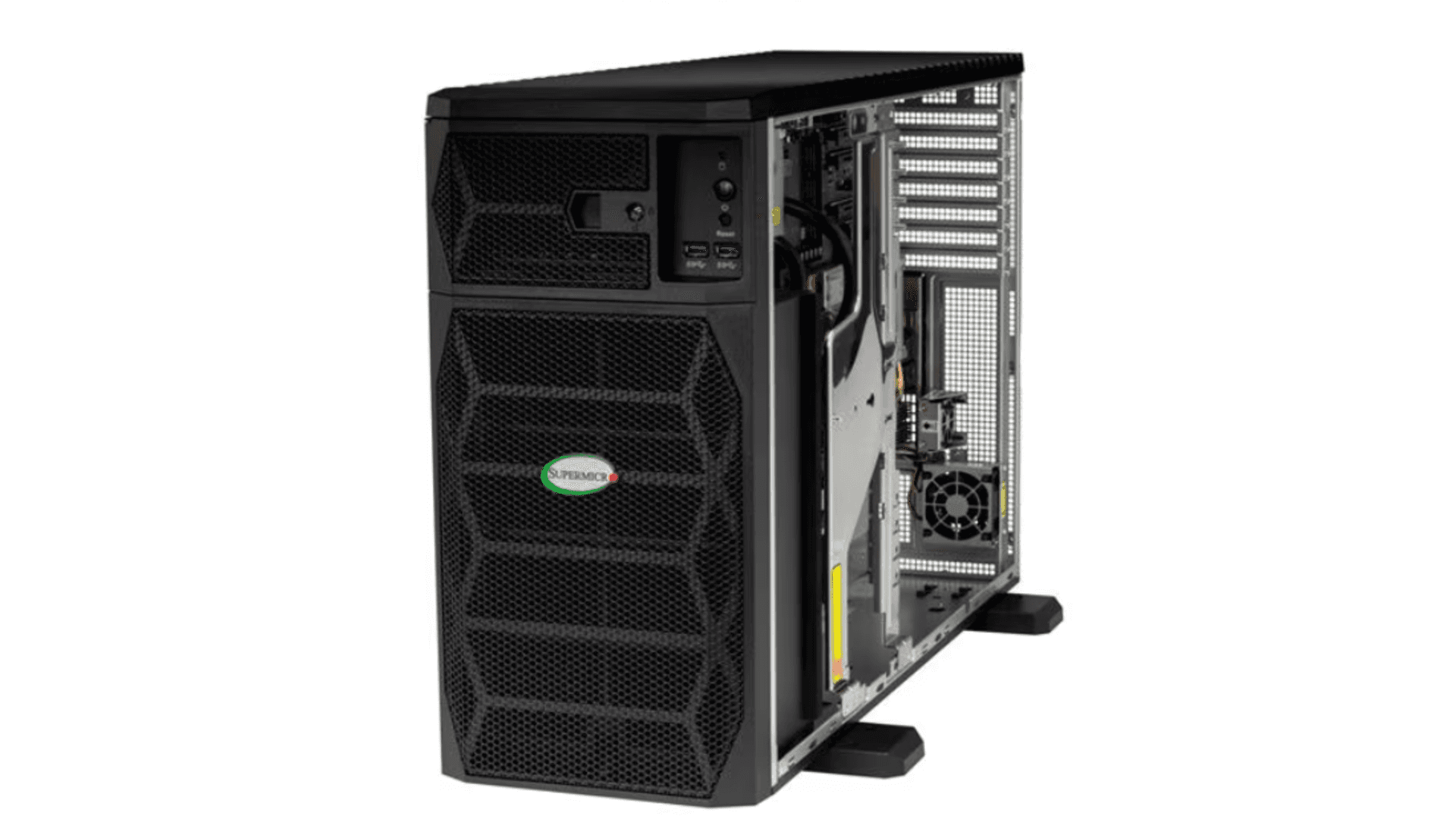
Image: TechRadar
Supermicro is selling a desktop-or-rack workstation built around Nvidia’s GB300 Grace Blackwell Ultra superchip for $92,887.47, before tax and shipping. The system combines a 72-core Grace CPU with a Blackwell Ultra GPU and 748GB of total memory, putting it in a different class from conventional professional workstations.
The price is also roughly seven times the $12,299 listed for a Mac Studio with Apple’s M5 Ultra and 256GB of memory. That comparison needs qualification: the machines use different memory architectures and target different workloads. Apple’s system is a general-purpose desktop for creative professionals, while Supermicro’s ARS-511GD-NB-LCC-01-G2 is designed for research labs and enterprises that need to run very large AI models locally.
Two very different memory systems
The Supermicro machine’s 748GB is not a single uniform pool. It consists of 496GB of system memory attached to the Grace CPU and 252GB of HBM3e attached to the Blackwell Ultra GPU. Nvidia describes the arrangement as a coherent memory architecture intended to let the platform handle trillion-parameter models locally.
Recommended reading
Surface Laptop Ultra is a CUDA workstation that happens to travel
Sergey Kuznetsov • • 13 min read
That distinction matters more than the headline capacity. HBM3e provides the high-bandwidth memory used directly by the accelerator, while the Grace-attached system memory expands the amount of model and data state the overall platform can address. Workloads that spill between the CPU and GPU pools won’t necessarily behave like workloads that fit entirely in the GPU’s HBM3e, and the supplied specifications don’t establish latency or throughput for those transfers.
| Configuration | CPU/GPU | Memory | Listed price | Intended use |
|---|---|---|---|---|
| Supermicro ARS-511GD-NB-LCC-01-G2 | 72-core Grace + Blackwell Ultra | 496GB system memory + 252GB HBM3e | $92,887.47 | Local trillion-parameter AI workloads |
| Apple Mac Studio M5 Ultra | M5 Ultra | 256GB | $12,299.00 | Creative and general-purpose professional computing |
Apple’s M5 Ultra Mac Studio can be configured with up to 512GB of RAM, and the new Studio starts at $2,499, as we reported in our earlier coverage of Apple’s M5 Ultra Mac Studio. Those figures describe different configurations from the $12,299, 256GB comparison above, so the price gap should not be read as a direct cost-per-gigabyte calculation. Supermicro is selling a specialized AI platform, not simply a more expensive desktop with more memory.
Nvidia claims 20 PFLOPS at FP4
Nvidia rates the platform at up to 20 PFLOPS of FP4 performance overall and claims that it can deliver three times the inference speed of its H200 chip. The system is also specified for continuous agent workloads at as much as 1,200 tokens per second, with no additional token cost.
Those figures are vendor claims rather than independent benchmark results in the supplied material. They also describe low-precision FP4 operation, so they cannot be directly compared with performance figures using FP8, FP16 or other numerical formats. The sources do not identify the model, batch size, context length, power state or software stack behind the 1,200-token-per-second figure—variables that would determine how useful it is for a real deployment.
The workstation includes two 1.92TB M.2 NVMe drives and two 960GB M.2 NVMe drives. Additional M.2 slots support PCIe 5.0 and PCIe 6.0, providing expansion options for local datasets and research environments. Networking is substantial for a desktop-class chassis: dual 400GbE connections run through Nvidia’s ConnectX-8 SuperNIC, with a separate management LAN port for administration.
Liquid cooling and a 1,600W power envelope
This is not a quiet, low-power tower intended for an ordinary office. Supermicro uses direct-to-chip liquid cooling alongside internal fans, and the system is powered by a single 1,600W supply rated for 94% Titanium-level efficiency. The unloaded chassis weighs about 88 pounds, reflecting the cooling and component density required by the platform.
Connectivity includes USB ports, mini DisplayPort output and IPMI support for remote diagnostics and monitoring. The combination of IPMI, dedicated management networking and 400GbE links points toward lab or server-room deployment, even though the product is sold in a tower or rack-mount chassis.
Pricing and availability
Supermicro has begun selling the Gold Series workstation under model number ARS-511GD-NB-LCC-01-G2. A new-customer discount of 3% is available for the Gold Series model, bringing the listed price to approximately $90,101.05 before tax and shipping. Volume customers can request separate quotes, so the public price is not necessarily the final price for research institutions buying multiple systems.
The source headline describes the workstation as costing “almost $91,100,” while the detailed listing gives $92,887.47 before tax and shipping. The detailed price is the more specific figure; the difference appears to reflect the headline’s rounding or discount framing. Shipping costs and delivery timing are not provided.
For buyers that need to keep trillion-parameter models on-site, the machine combines CPU/GPU memory capacity, accelerator throughput and high-speed networking. For workloads that can use cloud infrastructure or smaller local models, the nearly $93,000 entry price, along with the additional power, cooling and deployment requirements, makes it a specialized infrastructure purchase rather than a faster replacement for a Mac Studio.
Frequently asked questions
How much does the Nvidia GB300 workstation cost?+
Supermicro lists it at $92,887.47 before tax and shipping. A 3% new-customer discount reduces the price to approximately $90,101.05.
How much memory does the GB300 workstation have?+
It has 748GB total: 496GB of system memory connected to the Grace CPU and 252GB of HBM3e on the Blackwell Ultra GPU.
What performance does Nvidia claim for the GB300 workstation?+
Nvidia claims up to 20 PFLOPS of FP4 performance, three times the inference speed of its H200, and up to 1,200 tokens per second for continuous agent workloads.
When does the Supermicro GB300 workstation ship?+
Supermicro has begun selling the workstation, but the supplied information does not provide a shipping date or delivery estimate.
A section byline, not a person: stories filed here by for(geeks) are held to the same editorial policy as every story we run.