• Updated • 5 min read
IFA 2026: TP-Link shows Wi-Fi 8 routers built for stability
TP-Link unveiled the Archer 9 Ultra and Deco 8 Ultra at IFA 2026, with a focus on interference handling and range over raw speed.
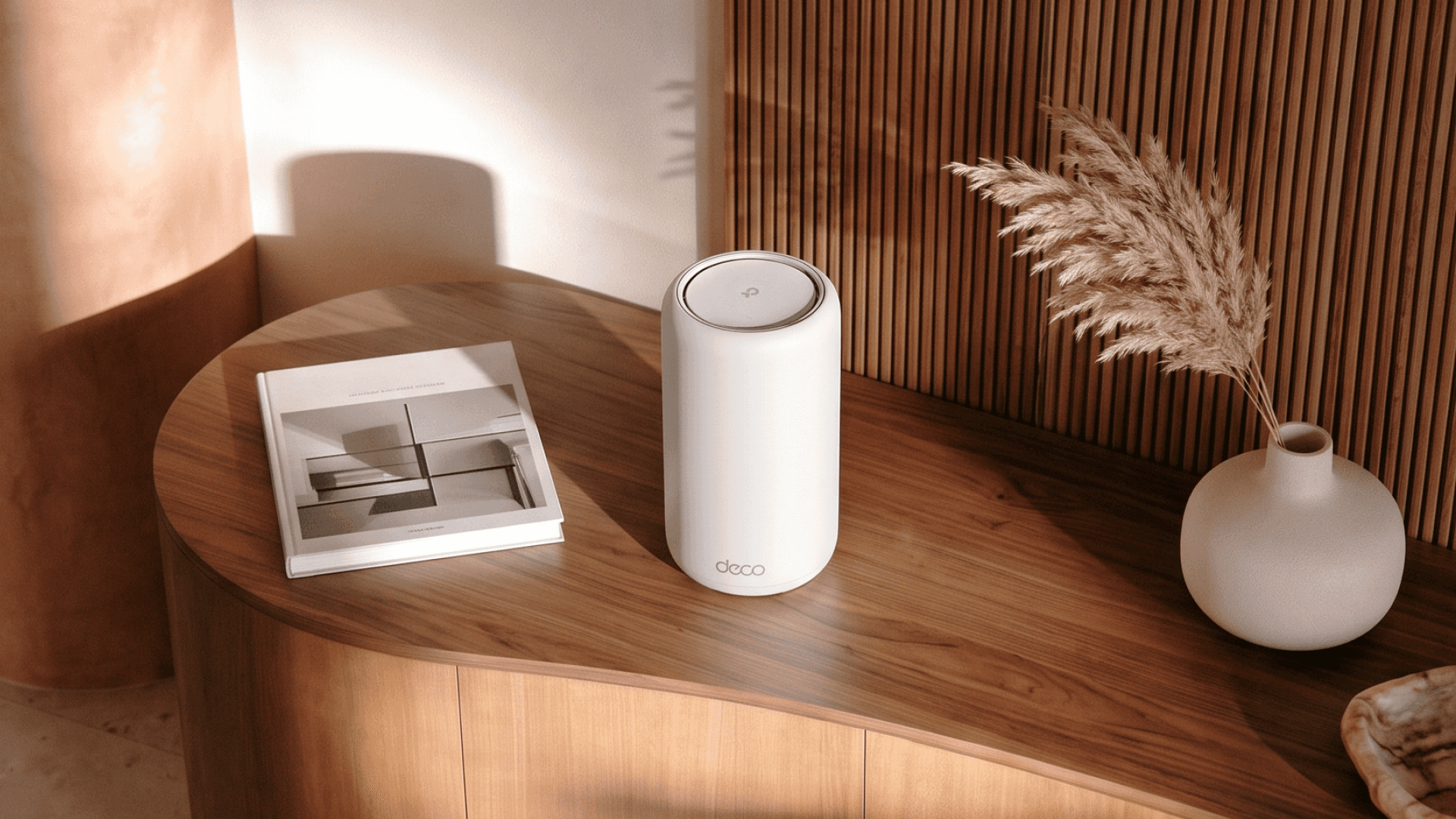
Image: TechRadar
TP-Link showed what it calls the world’s first Wi-Fi 8 router lineup at IFA 2026: the Archer 9 Ultra, a conventional router, and the Deco 8 Ultra, a tri-band mesh system. Both use TP-Link’s StabilityEngine to prioritize connection reliability, interference handling and performance at the edge of a network rather than simply increasing peak throughput.
The Deco 8 Ultra is rated for 22Gbps across its tri-band design, including 6GHz, although the European figure is 19Gbps. A three-unit kit is rated to cover up to 9,800 square feet and support more than 200 devices. The Archer 9 Ultra is rated at 19Gbps, uses 18 antennas, and covers up to 3,600 square feet in the US; TP-Link lists 3,000 square feet for Europe.
| Model | Network design | Advertised throughput | Antennas | Rated coverage | Device capacity |
|---|---|---|---|---|---|
| Archer 9 Ultra | Tri-band router | 19Gbps | 18 | 3,600 sq. ft. | Not specified |
| Deco 8 Ultra | Tri-band mesh, three-pack | 22Gbps; 19Gbps in Europe | Not specified | 9,800 sq. ft. | 200+ devices |
Those throughput figures don’t represent a clear raw-speed advantage over Wi-Fi 7. The systems are designed to degrade more gracefully when many clients compete for airtime, when neighboring networks create interference, or when a device is near the edge of coverage.
Recommended reading
Surface Laptop Ultra is a CUDA workstation that happens to travel
Sergey Kuznetsov • • 13 min read
How TP-Link says the Wi-Fi 8 system works
The StabilityEngine combines several traffic-management and radio features. Dynamic Sub-band Operation (DSO) assigns each connected device only the bandwidth it needs, leaving more spectrum available for other traffic. Non-Primary Channel Access (NPCA) can open a second channel when the main channel becomes congested.
That approach is aimed at crowded homes with phones, laptops, televisions, cameras and other connected equipment competing simultaneously. It may reduce contention, but TP-Link has not supplied independent measurements showing how much latency or throughput improves under a defined client load.
The routers also use new modulation technology intended to reduce the impact of nearby Wi-Fi networks and other interference sources. Enhanced Long Range (ELR) extends the usable range, while Distributed Resource Units (DRU) concentrate a client’s limited uplink power into a narrower band so the access point can receive it more clearly at a distance. The practical targets are uploads, calls and camera feeds that would otherwise become unstable near the coverage boundary.
TP-Link describes the intended behavior this way:
“ELR extends the router’s usable range, while DRU concentrates a device’s limited uplink power into a narrower band so it can be heard clearly from far away. Uploads, calls, and camera feeds hold where they used to stutter.”
The industrial design is part of the launch pitch. TP-Link says the hardware is meant to be displayed rather than hidden in a cabinet, on the theory that placing a router in the open improves its real-world position and therefore its coverage.
“We stopped building a piece of networking equipment and started designing for the home. When a router’s design becomes something people want to display, it ends up exactly where it performs best.”
Draft standard limits the immediate payoff
Wi-Fi 8 is still a draft and has not been finalized. The first phones and laptops with Wi-Fi 8 support are expected in 2027, and the source material indicates that availability will initially be limited. Existing Wi-Fi 7 and earlier devices will work with the new routers through backward compatibility, but they will not receive Wi-Fi 8-specific benefits.
Some traffic-management and interference-reduction features could still improve network behavior for older clients, but buyers in 2026 are primarily purchasing future compatibility. A Wi-Fi 8 router cannot make a Wi-Fi 7 client use the unfinished standard, and the advertised coverage figures do not establish performance through walls, across floors or under heavy concurrent load.
TP-Link has not announced US prices or an exact release date for either model. The company is expected to ship both later in 2026, but that timeline is not a dated launch commitment. Until compatible client hardware becomes common and independent testing measures the effect of DSO, NPCA, ELR and DRU, the Archer 9 Ultra and Deco 8 Ultra are better understood as early Wi-Fi 8 hardware than as an immediate speed upgrade.
Update, 31 August 2026 — Archer 8 Ultra pre-orders start September 30
A Rutlandherald report carrying TP-Link’s release puts the first availability marker on its Wi-Fi 8 hardware: Archer 8 Ultra pre-orders will begin September 30, 2026, in select regions. TP-Link says it will provide the full Archer 8 Ultra and Deco 8 Ultra details at a global online launch event that day. This is a pre-order date, not a shipping date.
The release also names the conventional router Archer 8 Ultra, rather than Archer 9 Ultra as in the earlier announcement covered above. It lists a Deco 8 mesh system for Q1 2027, followed by the Roam 8 travel router and Wi-Fi 8 range extenders and adapters in Q2 2027. TP-Link says those plans and specifications can vary by market and may change.
Update, 1 September 2026 — Archer 8 lists 10Gbps wired networking
Turkey Breaking reports says the Archer 8 Ultra will support up to 10Gbps over wired connections, alongside its stated 19Gbps wireless rate. The report also says TP-Link identified Broadcom, Qualcomm and MediaTek as the chip suppliers for its Wi-Fi 8 devices.
TP-Link said the products use US-led hardware and software engineering as it addresses the effect of the US ban on routers manufactured overseas. The report expects final Wi-Fi 8 certification no earlier than May 2028, while describing the IEEE 802.11bn standard as still unfinished.
Frequently asked questions
How much will the TP-Link Archer 9 Ultra cost?+
TP-Link has not announced US pricing for the Archer 9 Ultra.
When will TP-Link’s Wi-Fi 8 routers ship?+
The Archer 9 Ultra and Deco 8 Ultra are expected to ship later in 2026, but TP-Link has not provided an exact release date.
Will Wi-Fi 7 devices work with these routers?+
Yes. The routers are backward compatible with Wi-Fi 7 and earlier devices, although those clients won’t receive Wi-Fi 8-specific benefits.
How many devices does the Deco 8 Ultra support?+
TP-Link rates a three-unit Deco 8 Ultra system for more than 200 devices.
A section byline, not a person: stories filed here by for(geeks) are held to the same editorial policy as every story we run.