• 6 min read
AMD’s agent rack turns AI deployment into a facility project
AMD’s Helion rack combines 32,768 CPU cores, 16 accelerators and 102 Tbps networking, but AMD has not disclosed power, cooling or facility costs.
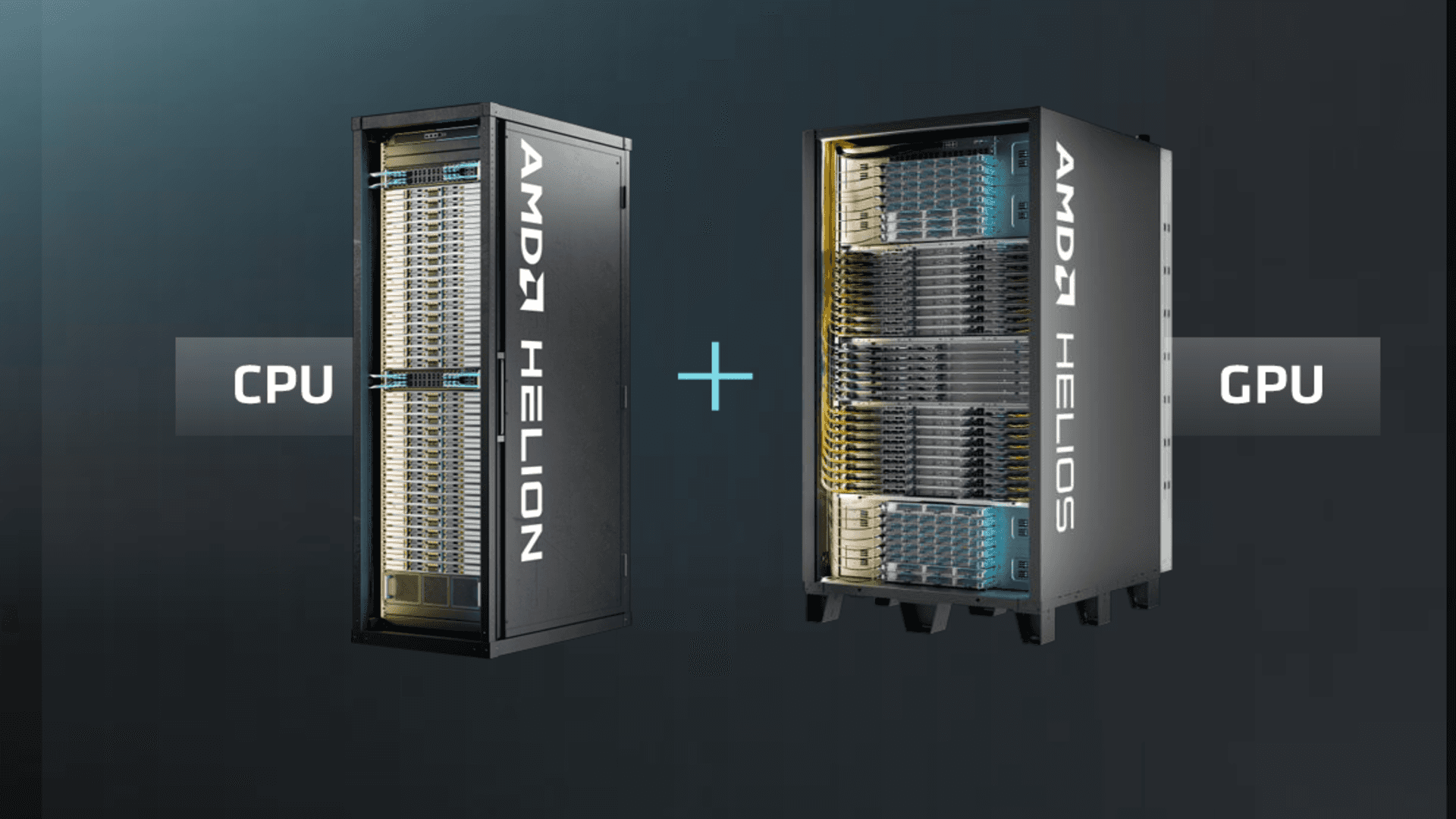
Image: TechRadar
AMD is proposing a rack-scale system that treats AI agents as an infrastructure workload rather than a GPU cluster with a chatbot attached. Helion Agentic AI Rack can combine up to 32,768 Zen 6 x86 CPU cores, 16 Instinct MI350P accelerators, and 74 petaflops of FP4 performance, alongside up to 102 Tbps of networking bandwidth.
The system is scheduled to become available in November 2026. AMD has not published pricing, total rack power consumption, cooling requirements, or the cost of adapting an existing facility. A deployment that pairs dense 256-core CPUs with accelerators and high-frequency processors is not a drop-in replacement for a conventional enterprise rack.
AMD’s design premise is that agent deployments have three different profiles. Personal assistants prioritize CPU density and efficiency; enterprise systems need capacity for a mix of agent execution and inference; technical workloads prioritize high-frequency processing. Helion changes the processor mix, power envelope, and node roles for each category rather than using one fixed reference architecture.
Three agent designs, not one rack recipe
AMD’s personal-agent configuration centers on 256-core Venice processors rated at 400W. The enterprise version keeps the 256-core Venice CPU but raises its rating to 600W and adds MI350P accelerators. Technical computing uses 96-core high-frequency Venice processors, trading core density for clock-oriented performance; AMD did not state a power rating for that configuration.
Recommended reading
Maia 300 turns Azure inference into Microsoft-only capacity
Sergey Kuznetsov • • 8 min read
| Agent workload | CPU configuration | Stated CPU power | Rack role |
|---|---|---|---|
| Personal agents | 256-core Venice | 400W | Dense, energy-efficient server capacity |
| Enterprise agents | 256-core Venice plus Instinct MI350P | 600W | Agent execution, inference, and general computing split across nodes |
| Technical computing | 96-core high-frequency Venice | Not disclosed | Processing speed prioritized over core density |
The enterprise design separates the control and execution portions of an agent service from inference and conventional infrastructure. CPU sandbox nodes run agents, MI350P accelerators handle inference, and separate general-purpose servers cover databases, storage, and technical computing.
Operators will have to provision and manage several node types in the same deployment rather than scale a homogeneous fleet. AMD says the rack includes an integrated token router to direct model requests among frontier and open-source models, but it has not specified its routing policy, latency behavior, supported model interfaces, or whether the router is required for all inference traffic. The claimed 74-petaflop figure is specifically FP4 performance, not a published end-to-end agent throughput measure.
The rack uses programmable networking, an open-source software ecosystem, and ORv3 44OU hardware compliant with Open Compute Project specifications. Those choices may make the physical platform easier to fit into OCP-oriented operations, but they do not establish that a site has the power delivery, cooling plant, switching capacity, or software stack required to operate it at AMD’s stated scale.
The 102 Tbps claim shifts the bottleneck outward
A maximum of 102 Tbps of networking bandwidth is part of the Helion proposition. The system’s token router is intended to steer requests across multiple model families, while the enterprise configuration splits agent execution from inference. Network design therefore becomes part of application behavior: the data path must support traffic among sandbox nodes, accelerator-backed inference nodes, storage, databases, and model-routing software.
AMD has not broken down how that 102 Tbps is allocated among front-end traffic, east-west rack traffic, storage, and accelerator-related flows. It also has not identified the switching configuration or compatible network equipment. A maximum bandwidth number alone does not say what a given deployment can sustain once agent state, retrieval, databases, and model requests contend for the same fabric.
The same uncertainty applies to performance. AMD has stated a peak FP4 figure, core counts, and accelerator count, but no agent benchmark, model latency result, tokens-per-second result, concurrent-agent count, or power-per-workload measurement. For buyers evaluating a system aimed at agent execution, those measurements would show whether the CPU-heavy architecture performs as intended outside a peak-compute specification.
Data-center planning is part of the product
Helion comes as AI infrastructure planning expands beyond buying servers. In August 2026, we reported that AI data centers are becoming integrated power campuses, combining gigawatt-scale power planning, liquid cooling, microgrids, and permitting earlier in the project cycle. AMD’s rack description fits that pattern: it combines compute density, accelerators, and a network fabric that many traditional facilities were not designed to host together.
Its mixed hardware profiles also complicate capacity planning. A site designed around identical legacy servers can use repeatable power and thermal assumptions from rack to rack. Helion instead asks an operator to select among 400W 256-core CPUs, 600W 256-core CPUs, high-frequency 96-core CPUs, and accelerator-equipped nodes, then allocate the right mix to its chosen agent workloads. AMD calls this modularity; for facilities teams it also means less standardization.
That concern is already visible in U.S. infrastructure disputes. Our August 2026 reporting found Texas auditing more than 1,800 grid-connection projects, about 90% of them data centers, while a proposed 330 MW California data center pursued 287 million gallons of water from fallowed farmland. Helion is not tied to either project, but it is aimed at the same class of compute expansion where rack specifications increasingly depend on grid access, cooling capacity, and permitting as much as processor selection.
AMD does not say whether Helion requires liquid cooling, how much heat any configuration rejects, or whether the 16-accelerator maximum can coexist with the maximum 32,768-core CPU count in a single supported design. It also has not disclosed a rack power ceiling. Until those details appear, a facility operator cannot turn AMD’s peak component counts into a power, cooling, or floor-space plan.
A modular pitch with missing deployment economics
The agent categories are workload labels, but they do not yet amount to a capacity model. Personal, enterprise, and technical deployments can differ in model choice, request rates, context size, storage behavior, and the degree of isolation required for agent execution. AMD provides hardware roles for those distinctions, yet has not published the sizing guidance that would connect an application profile to a particular Helion configuration.
The rack also creates a potential procurement split. Its OCP-aligned mechanical format and programmable network may appeal to operators already standardizing on open rack infrastructure. Others could face parallel changes to compute hardware, power distribution, cooling, switching, and operational software before they gain the benefit of AMD’s modular architecture. That is a much larger decision than selecting a new CPU or accelerator generation.
The key Helion specification is not the 32,768-core headline. It is the explicit admission that agent infrastructure will be heterogeneous: CPU sandboxes, accelerator inference, conventional databases and storage, and routing between different models. AMD has described that topology, but it has not provided the data required to price it, cool it, or compare it with an existing deployment. The November 2026 availability date does not resolve those facility-level questions.
Frequently asked questions
When will AMD Helion Agentic AI Rack be available?+
AMD has scheduled Helion Agentic AI Rack availability for November 2026.
How many CPU cores and accelerators can AMD Helion support?+
The rack supports up to 32,768 Zen 6 x86 CPU cores and 16 Instinct MI350P accelerators.
What does AMD Helion cost?+
AMD has not disclosed pricing, facility-upgrade costs, total rack power consumption, or cooling requirements.
What performance benchmarks has AMD published for Helion?+
AMD states up to 74 petaflops of FP4 performance, but the supplied information includes no agent throughput, latency, tokens-per-second, or concurrent-agent benchmarks.

Editor-in-Chief
Sergey Kuznetsov is Head of Product at iXBT.com, one of the largest Russian-language technology media outlets, and the founder of itzine.ru. He has spent over a decade building and running tech newsrooms. At for(geeks) he sets editorial standards and reviews what ships.