• 6 min read
Autonomous planes move from crop fields toward cargo
Pilotless fixed-wing aircraft are already spraying crops and flying military missions, but passenger service still faces certification and airspace hurdles.
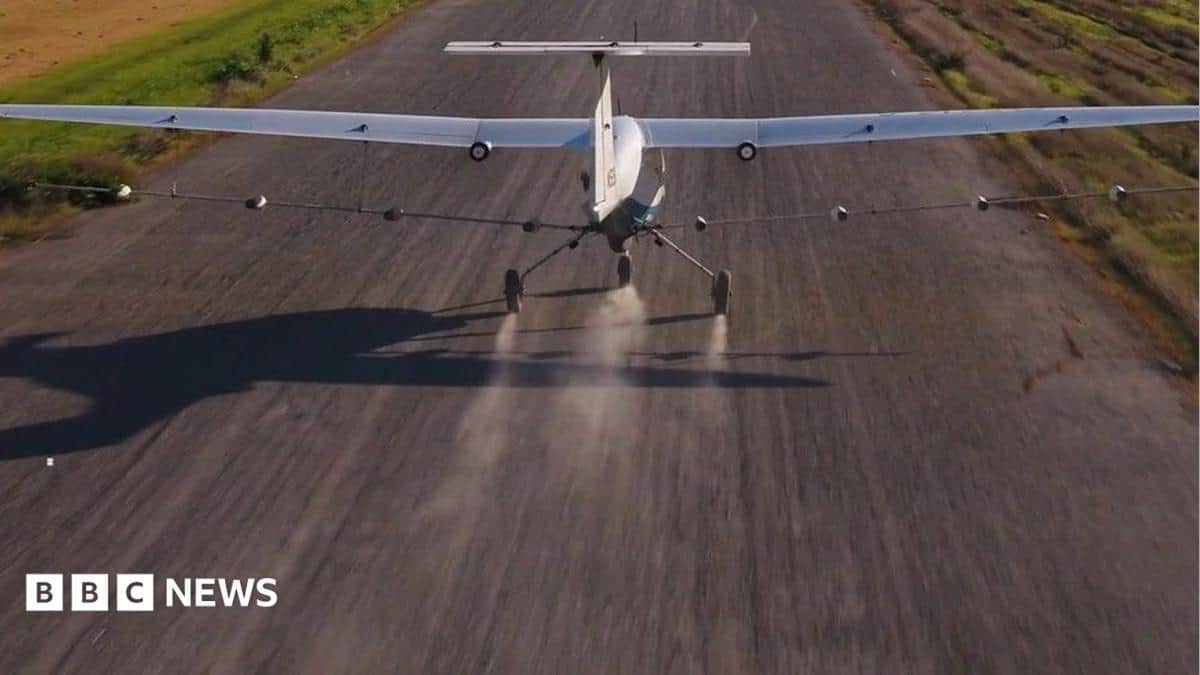
Image: BBC News
A pilotless crop-spraying plane is flying just above an alfalfa field in California’s San Joaquin Valley, operating low enough to reduce spray drift without anyone onboard. The aircraft is one of a small number of autonomous fixed-wing designs moving toward commercial service, initially in agriculture and cargo rather than passenger transport.
Pyka, the California startup behind the aircraft, says its plane can fly lower than a human pilot safely could. Its system plans a route from a digital map of the field, accounting for obstacles such as power lines, then handles takeoff, flight and landing. When the aircraft detects that its tank is nearly empty, it lands for a manual refill and battery swap before resuming the job at the point where it stopped.
That operating model is already being used outside the United States. About a dozen Pyka aircraft are in Brazil spraying cotton and soybeans, and the company says it currently produces around two dozen aircraft a year. It plans to reach 1,000 aircraft annually by 2030. Each aircraft sells for $550,000, with customers trained to operate it.
The plane is substantially larger than the “drone” label suggests: its wingspan is 11.5 meters. It is fully electric, carries its battery in the nose, flies for about 35 minutes and holds as much as 300 liters of spray in a central tank. US approval currently covers a tightly defined agricultural operation that requires both a ground operator and a visual observer; Brazil has granted similar approval under more permissive rules.
Recommended reading
Parallel’s $100M rail bet depends on short-haul freight moving first
Sergey Kuznetsov • • 8 min read
Autonomous flight is not the same as an aircraft autopilot. An autopilot assists a human pilot, much like cruise control or lane keeping in a car. An autonomous flight system is intended to process sensor data and control the aircraft through the complete flight, including takeoff and landing, with little or no human intervention.
Cargo is the next commercial test
Cargo may be the next near-term market. British company Windracers is seeking permission for an autonomous service to remote parts of the Shetland and Orkney islands. Its aircraft are also flying missions in Ukraine, where the company is among the UK suppliers benefiting from a government package announced in 2026.
The UK government’s official announcement says the package will provide Ukraine with at least 120,000 drones during 2026, including long-range strike, intelligence and reconnaissance, logistics and maritime systems. The document names Windracers, Tekever and Malloy Aeronautics among the UK-based companies receiving investment, and says deliveries began in September 2026. The same announcement says Russia launched approximately 6,500 one-way attack drones against Ukraine in March 2026.
Windracers describes its proposed service as a heavy-lift cargo operation rather than a small-drone delivery network. Its founder and chairman, Stephen Wright, calls it potentially the first such service in the UK and possibly anywhere, but the UK has not yet approved the longer-term operation.
Autonomous cargo aircraft could address pilot shortages, remove people from hazardous work and let one operator supervise multiple aircraft. The commercial case depends on those labor savings surviving the requirements for observers, remote pilots, maintenance staff and air-traffic-control support. Pyka’s current US approval, for example, is not an unattended operation with no human oversight.
Three approaches to autonomy
Companies are making different choices about the airframe, onboard sensing and the role of AI. Those choices affect both the certification burden and how much human supervision remains necessary.
| Company | Aircraft and target use | Autonomy and sensing approach | Current status described here |
|---|---|---|---|
| Pyka | Purpose-built, 11.5-meter-span electric aircraft for crop spraying; future passenger concept | Lidar for trees, vehicles, large birds and terrain; plans AI cameras to classify distant objects | US agricultural authorization; similar approval in Brazil; about a dozen aircraft operating in Brazil |
| Reliable Robotics | Retrofitted Cessna 208B Grand Caravan for cargo; payload of about 1,360 kilograms over hundreds of kilometers | Avoids AI for certification reasons; forward-looking air-to-air radar detects aircraft more than 8 kilometers away; fixed-rule responses | Testing the autonomous system on the single-pilot aircraft |
| Merlin Labs | Retrofitted military aircraft, including the Lockheed Martin C-130J; eventual multi-crew cargo | AI-powered cameras for object detection and classification; plans generative AI for air-traffic-control communications | Testing on the C-130J and pursuing commercial multi-crew cargo applications |
| Windracers | Purpose-built autonomous cargo aircraft for remote areas | Specific onboard architecture is not given in the supplied material | Seeking UK approval for Shetland and Orkney service; flying missions in Ukraine |
Reliable Robotics' strategy is to retrofit an aircraft that already has certification, leaving the company to concentrate on proving the autonomous system rather than certifying an entirely new airframe. Its co-founder and CEO, Robert Rose, says the company has added air-to-air radar that can detect another aircraft more than eight kilometers ahead, with software using fixed rules to determine the response.
“It is better than a pilot’s eyeballs.”
Merlin Labs is taking a different position on AI. It is developing what its founder and CEO Matt George describes as a common autonomy system that can transfer between aircraft, and it is applying that system to the two-pilot C-130J military transport. Merlin intends to reduce staffing in stages—from two pilots to one, and eventually to none—rather than attempt an immediate transition to fully unattended flight.
“It is a common autonomy brain that can transition between different aircraft.”
Pyka’s initial design avoids the retrofit problem by building autonomy into the aircraft from the start. Its lidar handles nearby terrain and objects, but the company plans to add AI-powered cameras because lidar has limited range. Detecting a nearby tree is more constrained than determining whether a tiny distant image is another aircraft.
“For a lot of things there’s no need to use AI…but for figuring out that six pixels in the distance are an airplane versus some other smudge, it is perfect territory.”
Detecting aircraft is only half the problem
Detect-and-avoid systems are among the hardest parts of autonomous aviation because an aircraft must identify other traffic and maneuver with almost no tolerance for an incorrect decision. Companies are adding different sensor types and duplicating conventional systems for backup, but the supplied reporting does not establish a common performance benchmark for any of them.
Air-traffic-control communications create a separate certification problem. Reliable Robotics plans to use a remote pilot—initially one with full training—to interpret radio instructions and make safety-critical decisions. Merlin wants generative AI trained on thousands of hours of recorded exchanges to interpret and answer those instructions itself. Pyka is not yet committing to a solution for shared airspace, saying it is content to let other companies establish the operating model.
“Our problem is harder… but we want to move beyond remote piloting.”
The military market is helping these companies accumulate flight experience while civilian approvals remain narrow. The UK’s 2026 package places autonomous-aircraft makers inside a broader procurement program that includes strike, reconnaissance, logistics and maritime drones, while civilian operators still need permission for specific routes, aircraft and supervision models.
Passenger service is the long-term ambition, not the current product. Pyka CEO Michael Norcia envisions fleets with enough capacity for minibus-like regional travel and believes that possibility could arrive before urban air-taxi operations mature. The company has not announced a passenger aircraft, price, service launch date or approval for such operations.
Pilots' organizations remain opposed to removing pilots from commercial aircraft. The US Air Line Pilots Association calls it “a serious gamble with safety and a step too far,” while the National Agricultural Aviation Association says small uncrewed aircraft can be difficult for pilots to see and that conventional aircraft can spray larger areas faster.
The technology is advancing through constrained jobs where the route, payload and operating area can be tightly controlled. The unresolved question is whether the same systems can safely handle shared airspace, radio instructions and traffic at commercial scale without retaining enough human supervision to erase the expected cost advantage.
Frequently asked questions
How much does Pyka’s autonomous aircraft cost?+
Each Pyka crop-spraying aircraft sells for $550,000, and customers are trained to operate it.
Are autonomous passenger planes available in the US?+
No passenger service is described as available. Pyka’s US authorization is limited to a defined agricultural operation requiring a ground operator and visual observer.
Where are Pyka’s autonomous planes operating?+
About a dozen Pyka aircraft are operating in Brazil to spray crops such as cotton and soybeans. The company is also testing in California.
What is Windracers seeking approval for?+
Windracers is seeking UK permission for an autonomous cargo service to the Shetland and Orkney islands. Approval has not yet been granted.
A section byline, not a person: stories filed here by for(geeks) are held to the same editorial policy as every story we run.