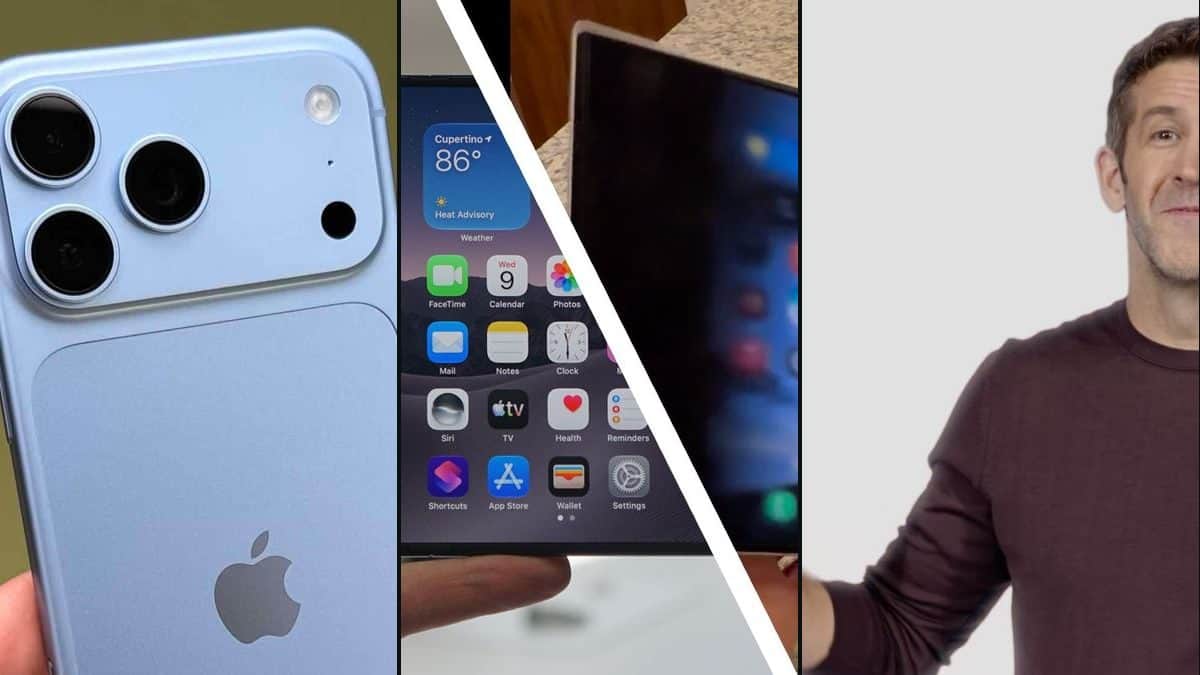
• 8 min read
iPhone Duo vs Galaxy Z Fold 8: Apple’s $1,999 foldable tested on paper
Apple’s iPhone Duo arrives October 23 at $1,999, with a 7.6-inch display, eSIM-only connectivity and a heavier design than Samsung’s Galaxy Z Fold 8.
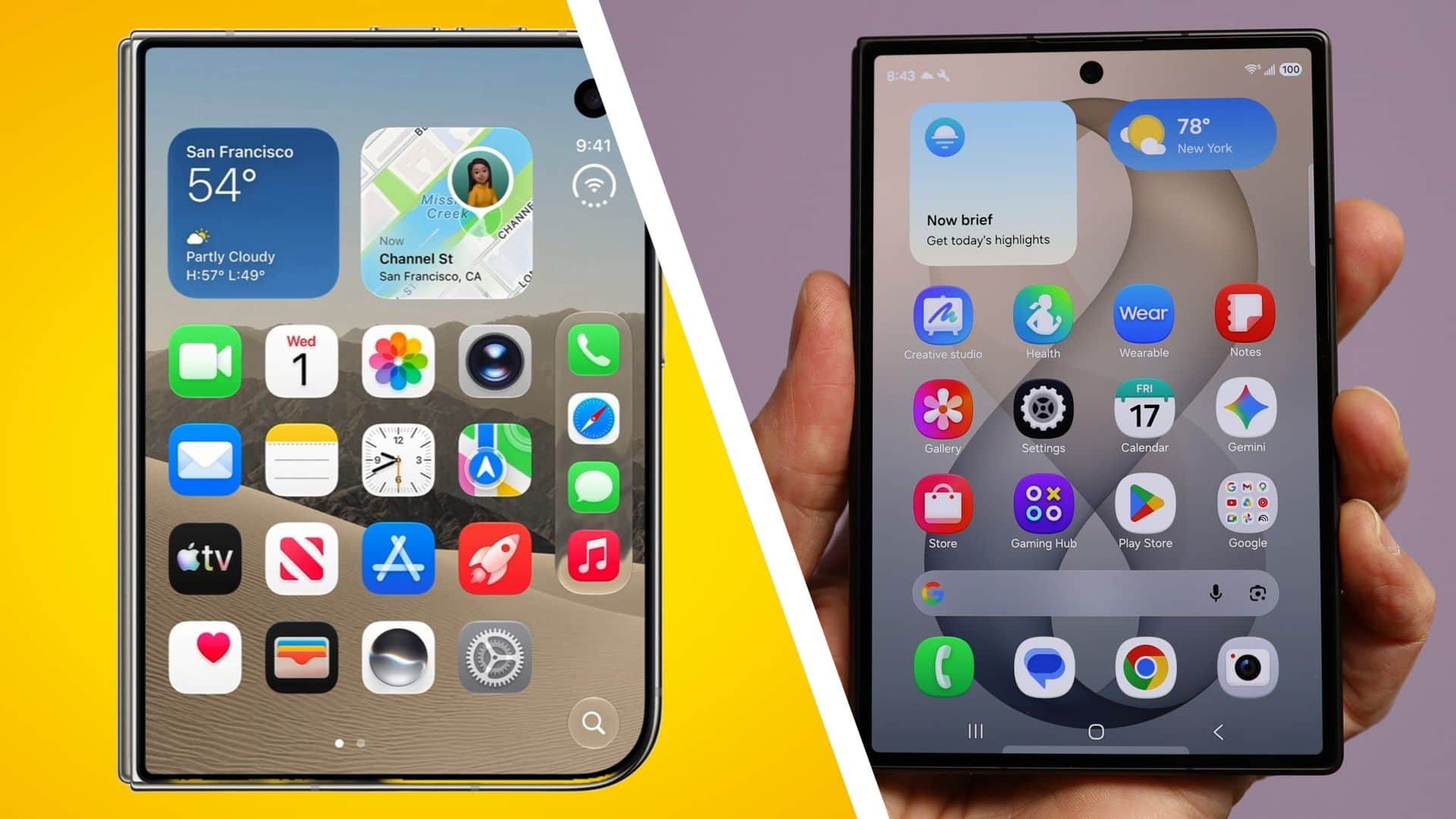
Image: TechRadar
Apple announced the iPhone Duo at Apple Event 2026, giving the Galaxy Z Fold 8 its first direct competition from Cupertino. The foldable phone starts at $1,999 in the US, opens to a 7.6-inch display, supports Apple Pencil USB-C input on both screens and is scheduled to ship on October 23, 2026; preorders open October 16.
Apple’s phone costs more than Samsung’s Galaxy Z Fold 8, which starts at $1,899 or $1,899.99 depending on the quoted US price. Both models begin with 256GB of storage and use a passport-like design, but they make different hardware and software trade-offs. Samsung’s phone is lighter, thinner and more flexible as a workstation; Apple’s has IP68 protection, higher stated charging power and a larger top-end storage option.
Apple is entering a category Samsung has spent years refining. Previous coverage found that the Fold 8's 7.6-inch inner display makes the large screen easier to use, while camera performance, cooling, durability and price remain important compromises. The iPhone Duo changes the comparison, but it does not remove those questions. Its A20 Pro processor has not yet been independently benchmarked against Samsung’s Snapdragon 8 Elite Gen 5 for Galaxy.
Two similar screens, different materials
The iPhone Duo has a 7.6-inch, 1878 × 2670 inner OLED panel with a refresh rate of up to 120Hz. Its outer display measures 5.4 inches and runs at the same maximum refresh rate. The Galaxy Z Fold 8 has a similarly sized 7.6-inch inner panel, but its cover screen is slightly larger at 5.5 inches.
Recommended reading
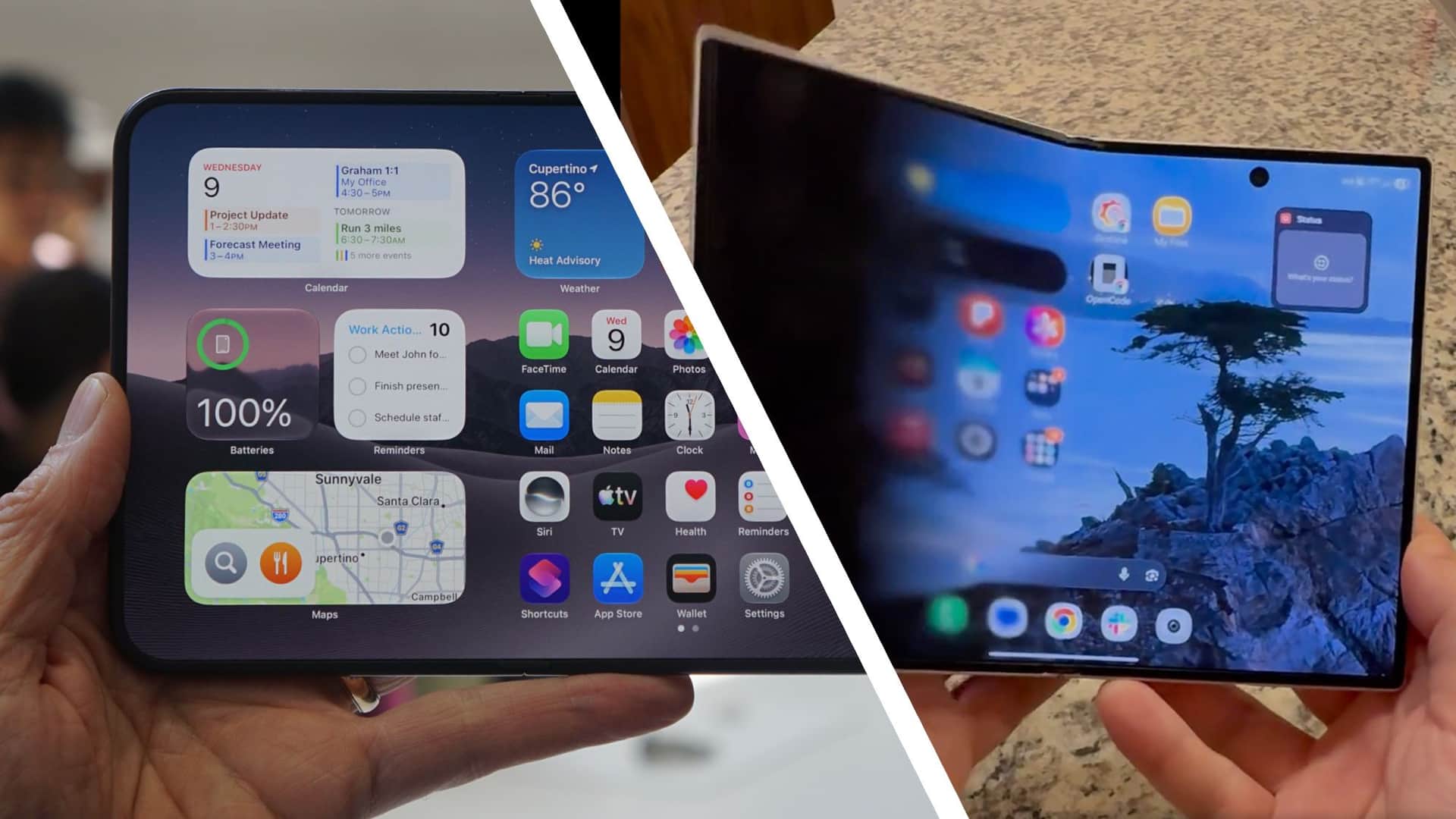
iPhone Duo, Galaxy Z Fold 8 get the same folding animation
Eli Navarro • • 3 min read
The devices also use different approaches to glare and durability. Apple uses a matte-like nano-texture layer on the Duo’s inner display, while Samsung uses an anti-glare treatment. Apple’s front panel is protected by Ceramic Shield 2 and its rear panel by the original Ceramic Shield. Samsung uses Gorilla Glass Ceramic 3 on the front and Gorilla Glass Victus 2 on the back.
The foldable hinge and inner display reportedly leave the Duo’s crease difficult to see, including when the phone is partially folded. The device can also run some apps in that partially folded position. That is a design detail rather than a raw specification, and the available reporting does not establish how many apps support it.
| Specification | iPhone Duo | Galaxy Z Fold 8 | Pixel 11 Pro Fold |
|---|---|---|---|
| Inner display | 7.6-inch OLED, 1878 × 2670 | 7.6-inch Dynamic AMOLED, 1848 × 2448 | 8-inch OLED, 2076 × 2152 |
| Cover display | 5.4-inch OLED, 1398 × 2034 | 5.5-inch Dynamic AMOLED, 1248 × 1972 | 6.5-inch OLED, 1080 × 2342 |
| Maximum refresh rate | 120Hz | 120Hz | 120Hz |
| Folded thickness | 11.3mm | 9.7mm | 10.1mm |
| Unfolded thickness | 5.2mm | 4.5mm | 5mm |
| Weight | 254g | 201g | 239g |
| Water and dust rating | IP68 | IP48 | IP68 |
The size difference is more noticeable in the hand than the near-identical inner-screen diagonal suggests. At 254g, the iPhone Duo is 53g heavier than the 201g Fold 8. It is also 1.6mm thicker when closed and 0.7mm thicker when open. Apple uses polished titanium rails; Samsung uses matte aluminum.
The Duo includes Apple’s Camera Control key in addition to its side controls, while the Fold 8 has a power button and volume controls. Apple offers two finishes, Star White and Night Sky. Samsung offers Lavender, Graphite, Cream and Pistachio, although color availability can vary by market.
Apple wins some hardware categories; Samsung offers more flexibility
The iPhone Duo is eSIM-only worldwide. The Galaxy Z Fold 8 supports both a physical nano-SIM and eSIM, a distinction that matters to US customers who change carriers, travel with local SIM cards or use a carrier that makes eSIM transfers difficult.
Samsung also retains several practical features that Apple has not matched. The Fold 8 can run three apps at once in split-screen mode, open additional apps in resizable pop-up windows, and save recurring combinations as App Pairs. Its taskbar is designed for rapid app switching. The iPhone Duo supports Split View for two apps side by side, but the supplied reporting does not describe an equivalent to Samsung’s three-app layout or App Pairs.
Samsung DeX creates a larger difference. Connected to a monitor or TV, the Fold 8 can provide a desktop-style interface with resizable windows, a taskbar and keyboard-and-mouse support while the phone continues to operate independently. DeX can also work wirelessly with compatible smart TVs. The Duo supports DisplayPort output or mirroring at up to 4K HDR, but it does not provide a comparable desktop environment.
Samsung’s other hardware conveniences include Wireless PowerShare for charging compatible earbuds and phones from the Fold 8's battery. The feature cannot charge Galaxy Watches launched in 2024 or later, limiting its usefulness inside Samsung’s own accessory ecosystem. Apple’s foldable does not offer reverse wireless charging.
Authentication is another small but concrete split. Both phones use a fingerprint sensor in the side button. The Fold 8 also supports camera-based face recognition, though it lacks the dedicated 3D sensing hardware associated with Apple’s Face ID. The iPhone Duo has no facial recognition feature.
Battery claims are not directly comparable
Apple does not disclose the Duo’s battery capacity in the supplied material. Instead, it claims up to 31 hours of video playback on the inner screen and 44 hours on the outer screen, plus all-day battery life under general use. A separate comparison table lists the Duo as offering “up to 24 hours,” creating a material inconsistency that cannot be resolved from the available reporting.
Samsung’s stated figure is 26 hours of video playback. These numbers are not a controlled head-to-head test: the display used, video format, brightness, network conditions and test procedure are not specified. They should not be treated as proof that the iPhone Duo lasts longer.
Charging claims are similarly difficult to line up. Apple says the Duo can reach 50% in 20 minutes using a compatible wired charger, or in 30 minutes over MagSafe or Qi2. The comparison data lists 40W wired charging and 25W wireless charging. Samsung claims a 63% wired charge in 30 minutes, while the comparison table lists 45W wired and 20W wireless charging.
The conflicting battery-duration figure and different charging baselines cannot be resolved without testing both phones under the same conditions. The published claims establish manufacturer targets rather than a reliable winner.
Camera hardware favors Samsung for resolution and video
Apple uses a 48-megapixel main camera and a 48-megapixel ultrawide camera on the rear. Samsung uses two 50-megapixel rear cameras, one wide and one ultrawide. Apple has a 12-megapixel outer selfie camera and an under-display inner camera whose resolution has not been disclosed. Samsung uses 10-megapixel cameras on both the inner and outer displays.
The more important difference for some buyers is video. The Galaxy Z Fold 8 can record 8K video at 30 frames per second using its wide and ultrawide rear cameras. The iPhone Duo tops out at 4K, although Apple’s listed capability reaches 4K at 120fps. Samsung’s front cameras record up to 4K at 60fps, while the reported Duo specification gives the outer camera the same 4K-at-60fps ceiling.
The 8K option does not establish better overall image quality. Higher resolution consumes more storage, and the supplied reporting does not provide independent camera samples or a video-quality comparison. Apple’s under-display inner camera is another unresolved point: it preserves more screen area, but its image quality has not been established.
A20 Pro versus Snapdragon 8 Elite Gen 5
Apple’s A20 Pro is new to the Duo, while Samsung uses the Snapdragon 8 Elite Gen 5 for Galaxy. The available comparison does not include benchmark results, CPU or GPU specifications, RAM capacity for the iPhone Duo, or sustained-performance measurements.
Storage is clearer. Both phones are available with 256GB, 512GB and 1TB capacities, while Apple also offers a 2TB Duo configuration. Samsung’s 1TB Fold 8 model is paired with 16GB of RAM; the other listed Fold 8 configurations have 12GB. Apple has not disclosed the Duo’s RAM capacity.
| Capability | iPhone Duo | Galaxy Z Fold 8 |
|---|---|---|
| Rear cameras | 48MP wide, 48MP ultrawide | 50MP wide, 50MP ultrawide |
| Maximum rear video | 4K at 120fps | 8K at 30fps |
| Front cameras | 12MP outer; inner resolution not disclosed | 10MP inner and outer |
| Wired charging listed | 40W | 45W |
| Wireless charging listed | 25W | 20W |
| Maximum storage | 2TB | 1TB |
Pricing, availability and the US buying decision
The iPhone Duo starts at $1,999 for 256GB, with 512GB, 1TB and 2TB versions also available. The Galaxy Z Fold 8 starts at $1,899 in two reports and $1,899.99 in the detailed comparison table. That is a $100 difference using the rounded price, or $99.01 using $1,899.99; either way, Apple is the more expensive starting point in the US.
| Model | Starting storage | Reported US starting price | Availability date in the supplied reporting |
|---|---|---|---|
| iPhone Duo | 256GB | $1,999 | Preorders October 16, 2026; ships October 23, 2026 |
| Galaxy Z Fold 8 | 256GB | $1,899 to $1,899.99 | Already presented as Samsung’s current model |
| Pixel 11 Pro Fold | 256GB | $1,899 | Included as a comparison model |
The iPhone Duo combines IP68 protection, Apple Pencil support on both displays, a 2TB storage tier and 4K high-frame-rate video with a heavier chassis, eSIM-only connectivity and no desktop mode comparable to DeX.
Samsung’s advantages are more concrete for power users: three-app multitasking, resizable windows, App Pairs, DeX, reverse wireless charging, a physical SIM slot and 8K recording. The Fold 8 is also 53g lighter and thinner in both configurations. Its disadvantages include the lower IP48 rating, no S Pen support, and a camera and cooling package that still warrant scrutiny; our earlier review coverage identified those areas as compromises, while a recent developer demo showed the Fold 8 sharing a foldable transition effect with the iPhone Duo without changing the underlying hardware gap.
Performance remains untested. Apple’s A20 Pro, the Duo’s under-display camera and the conflicting battery figures all need independent testing before the $1,999 price can be judged against Samsung’s established foldable platform. Until then, the Fold 8 remains the more capable multitasking machine, while Apple’s display treatment, ecosystem and first-party hardware integration are the main arguments for its extra cost.
Frequently asked questions
How much does the iPhone Duo cost?+
The iPhone Duo starts at $1,999 in the US with 256GB of storage. Apple also offers 512GB, 1TB and 2TB configurations.
When does the iPhone Duo ship?+
Preorders open October 16, 2026, and the iPhone Duo is scheduled to ship on October 23, 2026.
Is the iPhone Duo heavier than the Galaxy Z Fold 8?+
Yes. The iPhone Duo weighs 254g, compared with 201g for the Galaxy Z Fold 8, a difference of 53g.
Does the iPhone Duo support a physical SIM card?+
No. The iPhone Duo is eSIM-only worldwide. The Galaxy Z Fold 8 supports both a physical nano-SIM and eSIM.
Gadgets Editor
Eli is obsessed with the tangible future. He reviews phones, wearables, and everything with a battery. Known for his rigorous testing protocols and unabashed teardowns, Eli has broken more review units than he cares to admit, all in the name of discovering the truth about durability and repairability.