• Updated • 4 min read
IFA 2026: JMGO brings 4K 120Hz to laser projectors
JMGO’s IRIS Ultra and Ultra Max projectors bring 4K at 120Hz, triple-laser optics and gaming features to US buyers this fall.

Image: Techaeris
JMGO showed its IRIS Series at IFA 2026 in Berlin. The two-projector lineup targets gaming, sports and action-heavy video, and the company claims it is the first projector lineup to deliver true 4K output at 120Hz.
The launch includes the flagship JMGO IRIS Ultra Max and the less expensive JMGO IRIS Ultra. Both support Variable Refresh Rate (VRR), Auto Low Latency Mode (ALLM), Dolby Vision at 4K/120Hz and 4K/120Hz MEMC motion smoothing. Preorders open September 4, with shipments scheduled to begin October 19.
The timing places the projectors in the US buying window for IFA 2026, which runs September 4–8. JMGO initially rolled out the series in China earlier in 2026, where the company says it sold thousands of units.
Two models, one high-refresh architecture
Running 4K at 120Hz through a projector requires more than accepting a faster HDMI signal. JMGO says the IRIS models use a dual-DLPC architecture paired with a proprietary HyperPulse Actuator that shifts at 480 times per second. The company says this preserves edge definition during fast motion rather than relying on a lower effective resolution.
Recommended reading
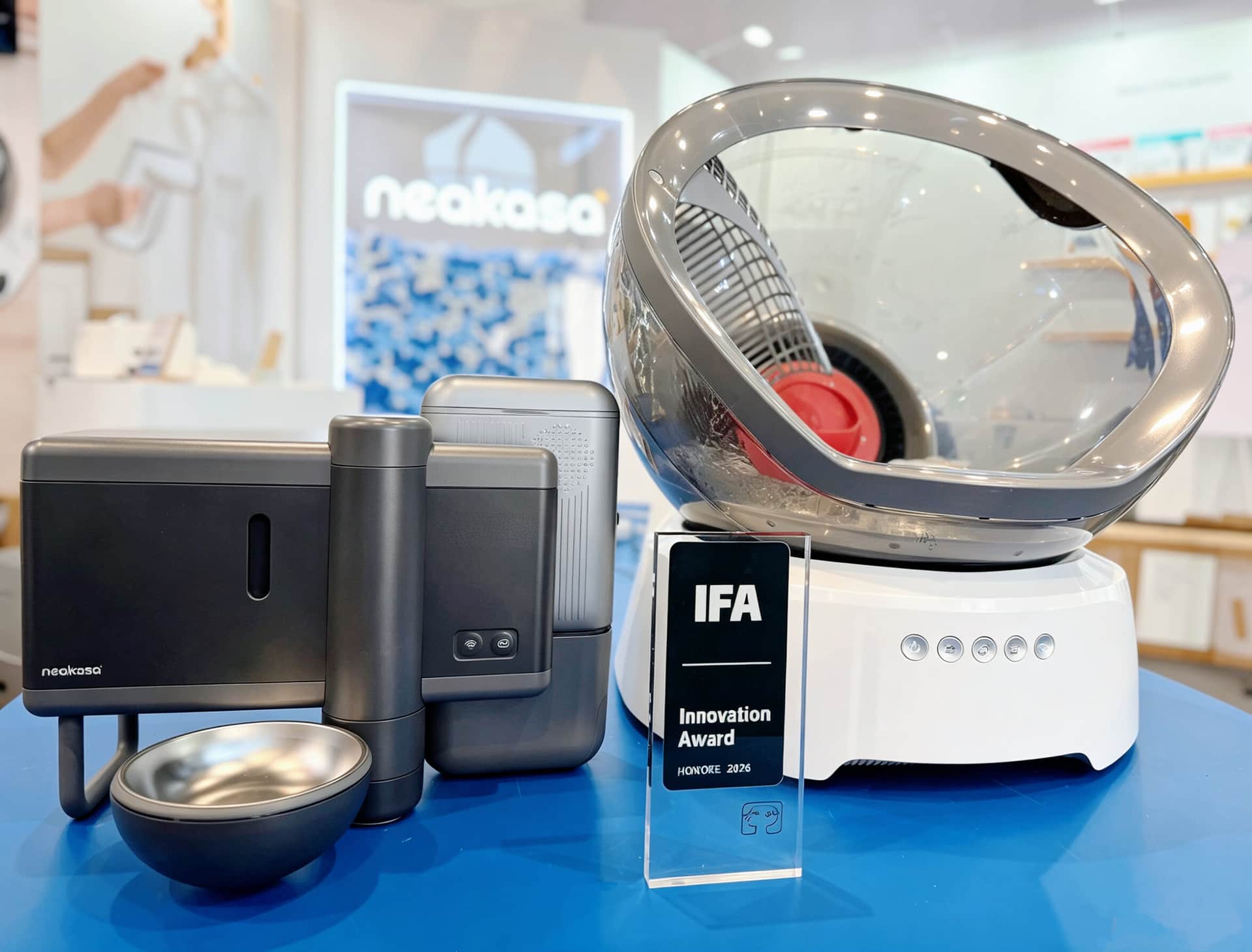
IFA 2026: Neakasa Riko and M9 automate cat feeding and cleaning
Sergey Kuznetsov • • 5 min read
The gaming feature set goes beyond a “120Hz-compatible” projector claim. VRR is intended to synchronize the projector with changing game frame rates, while ALLM can switch the display into a lower-latency mode when a console or PC starts sending gameplay. Dolby Vision also operates at 4K and 120Hz, according to the company’s specifications.
JMGO is also addressing a limitation associated with single-chip DLP projection: visible color fringing, commonly called the rainbow effect. Its hardware-level Anti-RBE system is designed to suppress that artifact without increasing fan activity, though the supplied material does not provide independent measurements of latency, noise or image quality with the feature enabled.
The disclosed figures for the two configurations are:
| Model | Light output | Native contrast | Optical positioning | Early price | Regular retail price |
|---|---|---|---|---|---|
| JMGO IRIS Ultra Max | 6,500 ISO lumens | 10,000:1 | 0.88–1.7:1 zoom, four-way lens shift, motorized gimbal | $2,999 | $3,499 |
| JMGO IRIS Ultra | 4,500 ISO lumens | 7,000:1 | 0.88–1.7:1 zoom, four-way lens shift | $1,899 | $2,399 |
Both versions use JMGO’s MALC 6.0 Triple-Laser Engine, with claimed coverage of 110% of the BT.2020 color space and calibrated color accuracy of roughly Delta E 0.7. That color-space figure is unusually broad on paper, but the announcement does not identify the measurement method, test window or whether the result applies equally across brightness modes.
The Ultra Max adds mechanical installation range
The Ultra Max’s main hardware advantage is its higher brightness and contrast ratio, along with the motorized gimbal and optical adjustments. This gives installers more freedom when the projector cannot be mounted directly in front of the screen.
Its optical zoom ranges from 0.88 to 1.7:1. The four-way physical lens-shift system reaches 130% vertically and 53% horizontally, while the integrated gimbal supports 360-degree panning and 150-degree tilt. Software adds automatic screen fitting and spatial-position memory, allowing the projector to retain alignment parameters for different walls or screen locations.
The standard Ultra keeps the optical zoom and four-way lens shift but drops the motorized gimbal. Buyers with a fixed, well-positioned mount may have less reason to pay for the Ultra Max’s additional mechanics.
Both models use a 15-blade dual-iris system with six adjustment levels. JMGO says the design cuts internal stray light by 11.34% compared with older 12-blade mechanisms. An AI-based deep-black algorithm performs real-time image tuning, balancing shadow detail while attempting to keep skin tones natural.
Pricing and availability
US pricing starts at $1,899 for the IRIS Ultra during the early-bird period and $2,999 for the Ultra Max. Those prices are temporary launch figures: regular retail pricing is listed at $2,399 and $3,499, respectively. The source material does not specify how long the early-bird promotion will last, which retailers will carry the projectors in the United States, or whether the listed prices include any bundled accessories.
Preorders begin September 4, 2026, and shipping begins October 19, 2026. The event is part of a broader IFA push toward local AI, automated home hardware and thinner devices, but the IRIS launch is primarily a display-hardware play rather than an AI product story.
At these prices, JMGO is asking buyers to trade some of the simplicity of a flat panel for a much larger projected image and more flexible placement. The technical pitch depends on several claims that still lack independent verification in the supplied information—notably the “true 4K” behavior at 120Hz, the practical effect of Anti-RBE, and the projector’s performance in its brightest operating modes. Those measurements will matter more than the headline refresh rate once the projectors begin shipping on October 19.
Update, 7 September 2026 — Ultra Max listed at $2,999
Homecrux reports that the JMGO IRIS Ultra Max is currently listed at $2,999 and can produce an image up to 300 inches. The $2,999 figure matches the early price in the original announcement, while that announcement listed regular retail pricing at $3,499; Homecrux does not explain the difference or say whether the lower price is promotional. Its report also describes the projector as a long-throw model on a motorized 360-degree gimbal, with the 300-inch maximum as the new size detail.
Frequently asked questions
How much do the JMGO IRIS projectors cost?+
Early-bird pricing is $1,899 for the IRIS Ultra and $2,999 for the IRIS Ultra Max. Regular retail pricing is listed at $2,399 and $3,499.
When do JMGO IRIS projector preorders open?+
Preorders open September 4, 2026, with shipments scheduled to begin October 19, 2026.
What is the difference between the IRIS Ultra and Ultra Max?+
The Ultra Max has higher brightness and contrast, plus a motorized gimbal with 360-degree panning and 150-degree tilt. The Ultra retains the zoom and four-way lens shift but omits the gimbal.
A section byline, not a person: stories filed here by for(geeks) are held to the same editorial policy as every story we run.