• 5 min read
Databricks cut AI coding costs by 70%
Databricks says routing, cheaper models, caching, and spend controls cut its AI coding costs by 70% without hard usage caps.
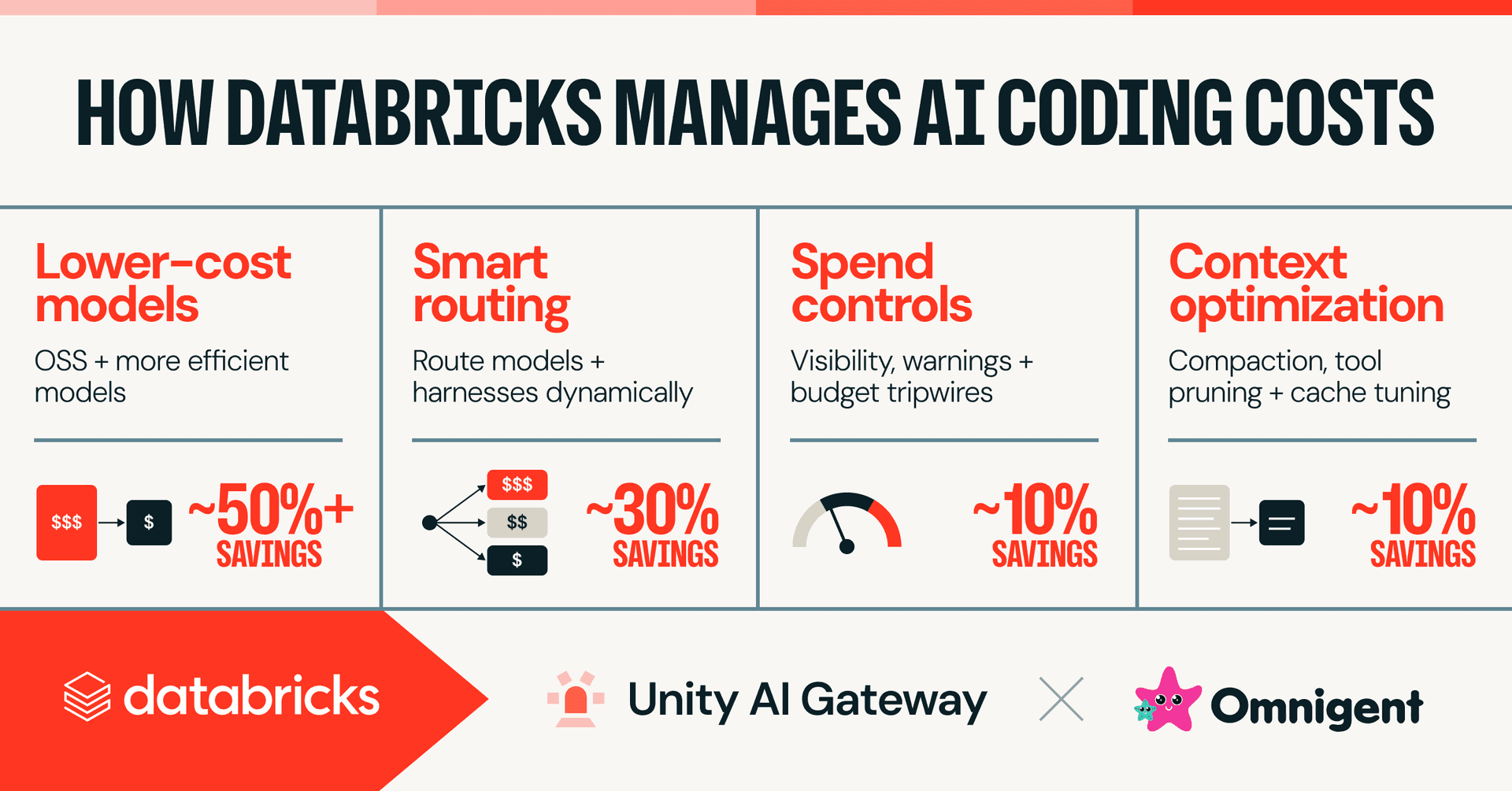
Image: Hacker News
Databricks says it cut its AI coding spend by 70% while continuing to give developers broad access to coding agents. The company’s account of that result points to a less glamorous but increasingly important part of enterprise AI: routing requests, controlling context growth, and making model costs visible without simply shutting users off.
The company says agentic coding has improved every velocity metric it tracks and produced order-of-magnitude output gains in some teams. But unrestricted usage also created an unsustainable cost curve. Databricks says its approach was shaped by its own experience and conversations with teams at Stripe, Coinbase, Uber, and Ramp.
Choosing models on an efficiency frontier
Databricks' central argument is that enterprises should optimize for an efficiency frontier, not simply the most intelligent available model. The relevant question for routine software engineering is which model delivers the required quality at the lowest price—not which model leads on difficult mathematics or cybersecurity problems.
The company says this frontier is advancing faster than peak model intelligence, with new releases arriving almost weekly that offer better intelligence per unit of cost. Rapidly evaluating and adopting those models is described as the largest available cost lever.
Public benchmarks are not enough for that decision, Databricks argues, because they often fail to represent a company’s real development workload. Teams therefore build internal evaluations. Databricks says one such evaluation showed competitive price-performance from GLM models, prompting an internal rollout.

Recommended reading
Adobe puts 70-plus creative tools inside Slack
Business Desk • • 7 min read
The evaluations can also prevent costly upgrades. Stripe found that Opus 4.7 did not meaningfully improve quality over Opus 4.6 while increasing cost, and declined to offer the newer model internally. Databricks reports a similar cost regression when comparing Opus 5.0 with 4.8.
Meta-harnesses and model routing
Switching models is difficult when developers are tied to a particular coding harness. Databricks names Claude Code, Codex, and Cursor as examples of tools that users may otherwise need to switch between. That friction can turn the harness into a form of lock-in around a model family.
A meta-harness offers a common interface while dispatching work to different underlying harnesses and models. Databricks uses its open-sourced Omnigent meta-harness as the default mode for developers who use it. The company also says other organizations have built similar internal systems.
Databricks describes three routing patterns:
- Request-level routing: A stateful proxy sends each inference request to the least expensive model capable of handling it, while accounting for server-side caching and the high cost of cold cache hits on large contexts. Examples cited include Cursor Router, OpenRouter’s AutoRouter, Ramp’s Router, and Databricks' Smart Routing in Unity AI Gateway.
- Task-level routing: A meta-harness classifies a complete task—such as a simple rename versus an open-ended latency investigation—and assigns it to a suitable harness and model.
- Escalation or delegation: One model handles the main workflow and calls on a cheaper or more capable model when needed. Databricks cites Claude’s Advisor Tool and Cognition’s Devin Fusion as examples of opposite versions of this pattern.
Databricks says internal results show its Smart Router reduces average task cost by more than 30% while roughly matching the quality of the most expensive model in its working set.
Budgets without cutting developers off
Databricks argues that hard monthly token caps are a poor default. Cutting off access when a developer hits a limit can damage productivity, while some high-spending users may also be generating exceptional amounts of useful output.
Instead, the companies surveyed use escalating controls:
- Visibility: Developers receive near-instant feedback on spending across their AI tools, often with guidance on using cheaper models.
- Spend gates: Users see warnings or must obtain approval as spending crosses defined thresholds. Databricks says self-clearing gates help prevent accidental spikes.
- Downshifting: Users who cross a threshold can be moved to a cheaper model rather than losing access altogether.
- Suspension: Full suspension remains available as a temporary last resort.
Context is a major hidden cost
A short developer request can trigger extensive codebase searches, tool calls, system instructions, and accumulated context. Databricks says the user’s original prompt often represents only a negligible share of the data eventually sent for inference.
The company lists several ways to reduce that overhead: compacting active context more frequently, using less chatty harnesses, reducing verbosity in tools, and breaking large tasks into smaller units. Prompt caching can also lower the cost of repeated large contexts, although cache writes still carry a charge and the best settings depend on the workload.
Databricks says simple harness and caching changes reduced generated tokens and associated costs by almost 50%, with no observed degradation in developer quality.
The proposed answer is an AI Gateway: a central layer for model access, capacity management, model mixing, budget tracking, enforcement, and observing or compressing tool-generated context. Databricks says it has open-sourced or made freely available Omnigent and Unity AI Gateway.
The reporting does not establish the timeframe, baseline spending, or methodology behind the headline 70% reduction; the savings figures in the post are described as directional, based partly on an informal survey. That gap matters, but the underlying position is clear: for large coding-agent deployments, cost control is less about restricting access than building the infrastructure to move work to cheaper models and eliminate wasteful context.
A section byline, not a person: stories filed here by for(geeks) are held to the same editorial policy as every story we run.