• Updated • 9 min read
Apple’s M6 Mac mini jumps to $899 as Mac Studio goes Ultra
Apple’s new M6 Mac mini and M5 Ultra Mac Studio bring 2nm silicon, quad-die scaling and local AI performance—but at sharply higher prices.
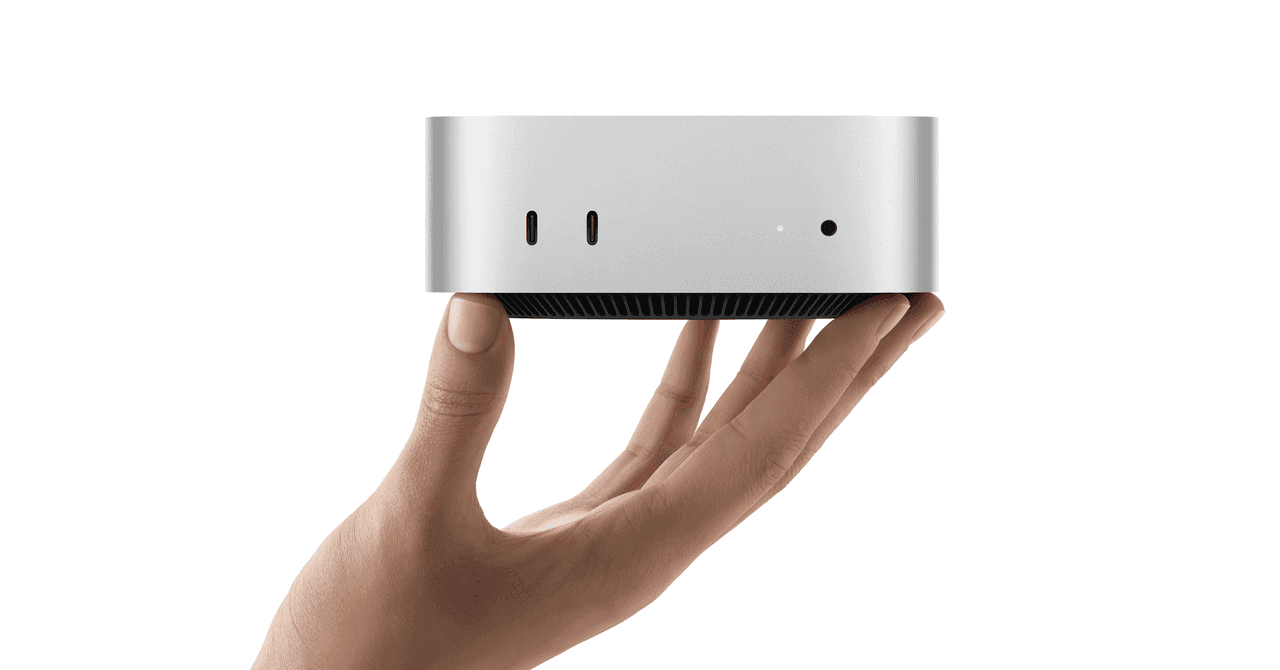
Image: Wired
Apple is bringing its desktop Macs back into stock with a new M6 Mac mini and an updated Mac Studio built around the M5 Max and M5 Ultra. The hardware designs are unchanged, but the silicon upgrade is substantial: the M6 is Apple’s first 2-nanometer chip, while the M5 Ultra is the company’s first processor built from four dies.
Both desktops are available to preorder in the US on August 25, 2026. They will begin arriving on September 22, with macOS 27 preinstalled. Apple says the Mac Studio configuration with 512GB of unified memory will follow in late October. The company’s official announcement and configuration details confirm US pricing and availability.
The M6 Mac mini skips a generation
The Mac mini moves from the M4 directly to the M6; Apple never released an M5 version of the small desktop. The new chip has a 12-core CPU comprising two super cores, four performance cores and six efficiency cores. Apple says the M6 is 20 percent faster than the M5 in multithreaded performance and 40 percent faster than the M4, though those claims are vendor measurements rather than independent testing.
Its 12-core GPU adds two cores over the previous design and puts Neural Accelerators in every GPU core. The M6 is also the first Mac mini with those accelerators, which originally appeared in the M5 generation. Apple claims up to twice the gaming performance and up to four times the AI-processing performance of the M4 Mac mini. The chip has a dual 16-core Neural Engine—32 Neural Engine cores in total—and Apple says that doubles peak AI performance compared with the M5.
Recommended reading
Surface Laptop Ultra is a CUDA workstation that happens to travel
Sergey Kuznetsov • • 13 min read
Memory and bandwidth remain more constrained than the Mac Studio’s. The M6 Mac mini supports up to 32GB of unified memory and up to 170GB/s of memory bandwidth. The optional M5 Pro model, priced at $1,699, supports up to 64GB and 307GB/s, with an up-to-18-core CPU and 20-core GPU. That option also gets rear Thunderbolt 5 USB-C ports, while the M6 model uses Thunderbolt 4.
The M6 Mac mini starts at $899 with 16GB of unified memory. The reports disagree on how that compares with the prior model: Wired described the increase as $200, while Engadget reported it as $100 over the previous price and said the machine is $300 more expensive than older Mac mini systems that started at $599. Engadget also reported that the base configuration includes only 256GB of storage, making the price increase more consequential for buyers who need local model files, media projects or development environments.
The enclosure itself is unchanged. Standard upgrades include Wi-Fi 7 and 2.5Gbps Ethernet, but buyers choosing the M6 rather than the M5 Pro also give up Thunderbolt 5 connectivity. The $899 model is more capable for on-device AI than its predecessor but has less bandwidth and expansion than the $1,699 Pro configuration.
M5 Ultra turns Mac Studio into a four-die system
The Mac Studio now starts at $2,499 with M5 Max and $5,499 with M5 Ultra. The M5 Max configuration has an 18-core CPU, up to a 40-core GPU with Neural Accelerators in every core, and up to 128GB of unified memory. Apple says its memory bandwidth reaches 614GB/s, and its GPU is up to 50 percent faster than the previous generation.
The M5 Ultra uses a four-die design. Earlier Ultra chips joined two Max dies with Apple’s UltraFusion interconnect. The M5 Max itself now contains two dies, so the M5 Ultra combines four dies into one package. A new UltraFusion connection provides more than 4.4TB/s of inter-die bandwidth, allowing the array to operate as a single CPU rather than forcing software to manage four separate processors.
The chip scales to a 36-core CPU—12 super cores and 24 performance cores—and an 80-core GPU. It is also the first Ultra chip to add Neural Accelerators to the GPU. Apple claims up to 1.3 times the multithreaded CPU performance of the M3 Ultra, up to 1.8 times the graphics performance and up to 4.3 times the peak AI compute performance. The M5 Ultra supports up to 512GB of unified memory, which allows the model and its working data to reside in one shared memory pool instead of being split across system RAM and discrete GPU memory.
Apple says the M5 Ultra Mac Studio can run large language models entirely on-device. It also describes connecting multiple Mac Studios over Thunderbolt 5 to distribute AI inference; four systems can share memory and, in Apple’s briefing, run models with more than one trillion parameters. Apple’s release says clustering can deliver up to three times the performance of a single system for distributed AI inference. Those figures describe Apple’s software and hardware claims, not an independently verified benchmark, and the reporting does not establish the model sizes, quantization or sustained power conditions used in the demonstrations.
Storage, displays and pro connectivity
Both Mac Studio configurations gain a next-generation SSD architecture based on PCIe Gen 6, with Apple claiming up to twice the storage performance of the previous generation. Thunderbolt 5 provides up to 120Gbps of bandwidth for external storage, PCIe expansion chassis and other peripherals. Wi-Fi 7 and Bluetooth 6 arrive on Mac Studio through Apple’s N1 wireless chip.
The desktop supports up to eight displays, including up to four Studio Display XDR panels running at 5K and 120Hz. It also adds genlock over USB-C for synchronizing a display with professional camera capture, including an iPhone 17 Pro. The M5 Max and M5 Ultra retain hardware media support for H.264, HEVC, ProRes and AV1 decoding, while the M5 generation adds third-generation hardware-accelerated ray tracing.
Apple’s application-specific comparisons are aggressive. For M5 Max, it claims up to 10.7 times faster LLM prompt processing in LM Studio than an M1 Max Mac Studio and 3.9 times faster than M4 Max. For M5 Ultra, Apple claims up to 9.8 times faster prompt processing than M1 Ultra and up to four times faster than M3 Ultra. It also reports up to 15.4 times faster CopyCat ML training in Foundry Nuke than M1 Ultra and up to 3.3 times faster than M3 Ultra. The company says its testing was conducted in July 2026; no independent results are included in the supplied reporting.
The price split is now difficult to ignore. The M6 Mac mini offers a cheaper path to local AI experimentation, but its 32GB memory ceiling, 170GB/s bandwidth and 256GB base storage limit how far that configuration can scale. The M5 Pro mini costs nearly twice as much, while the $5,499 M5 Ultra Mac Studio targets workflows where 512GB of shared memory, four-die compute and high-throughput expansion matter more than compact-desktop value. Apple also offers US leasing from $48.99 per month for the M5 Max and $110.10 per month for the M5 Ultra over 36 months, excluding taxes and trade-in credit.
Update, 22 September 2026 — Mac mini and Mac Studio reach stores
MacRumors reports that the new Mac mini and Mac Studio began selling on September 22 in 30 countries and regions, including the U.S. Same-day pickup is available at many Apple Store locations for standard configurations, marking the transition from preorders to retail availability.
Apple Store pickup orders are paid online and may require a government-issued photo ID and the order number at collection. MacRumors says custom configurations with upgraded specifications ordered through Apple’s online store are not eligible for same-day pickup.
Update, 23 September 2026 — Mac mini loses removable storage upgrades
MacRumors reports that NAND storage on M6 and M5 Pro Mac mini models is soldered to the logic board, ending the removable-storage option available on the M4 and M4 Pro versions. Expand Mac mini, which sells replacement SSD modules for the earlier machines, said support for the new models now looks unlikely. Apple has not commented on the change.
MacRumors also reports that 256GB configurations use one NAND chip, while 512GB and larger configurations use two. In AAPL Ch.'s Blackmagic Disk Speed Test results, an M6 mini with 256GB recorded 3,216.8 MB/s reads and 3,000.2 MB/s writes, versus 6,371.5 MB/s reads and 6,577.4 MB/s writes for a 512GB M6 model. The 256GB M6 still tested faster than the earlier 256GB M4 configuration in those results.
Update, 23 September 2026 — Amazon discounts new Mac mini and Mac Studio
MacRumors reports that Amazon has begun discounting select new Mac mini and Mac Studio configurations by as much as $49. The M5 Max Mac Studio with 36GB of memory and a 512GB SSD is listed at $2,449.99, down from Apple’s $2,499 price.
The base M6 Mac mini with 16GB of memory and 256GB of storage is listed for $879.99 rather than $899, while the 16GB/512GB configuration is priced at $1,069.99, down from $1,099. These are retailer discounts, not revised Apple list prices.
Update, 5 October 2026 — Base M6 Mac mini falls to $779.99
The Verge reports that Amazon has cut the base M6 Mac mini to $779.99 as part of its October Prime Day offers. The configuration has 16GB of RAM, 256GB of storage, a 12-core CPU and a 12-core GPU; the outlet describes it as the model’s first price drop.
For comparison, The Verge says Best Buy recently restocked an M4 Mac mini with the same storage capacity for $799. The Amazon offer is a retailer promotion rather than a change to Apple’s list price.
A section byline, not a person: stories filed here by for(geeks) are held to the same editorial policy as every story we run.