• 4 min read
IFA 2026: Nvidia links gaming PCs into a local AI cluster
Nvidia’s free RTX PAIR app distributes local AI agents across GPUs on a home network, cutting a demo task from over 18 minutes to just over 9.
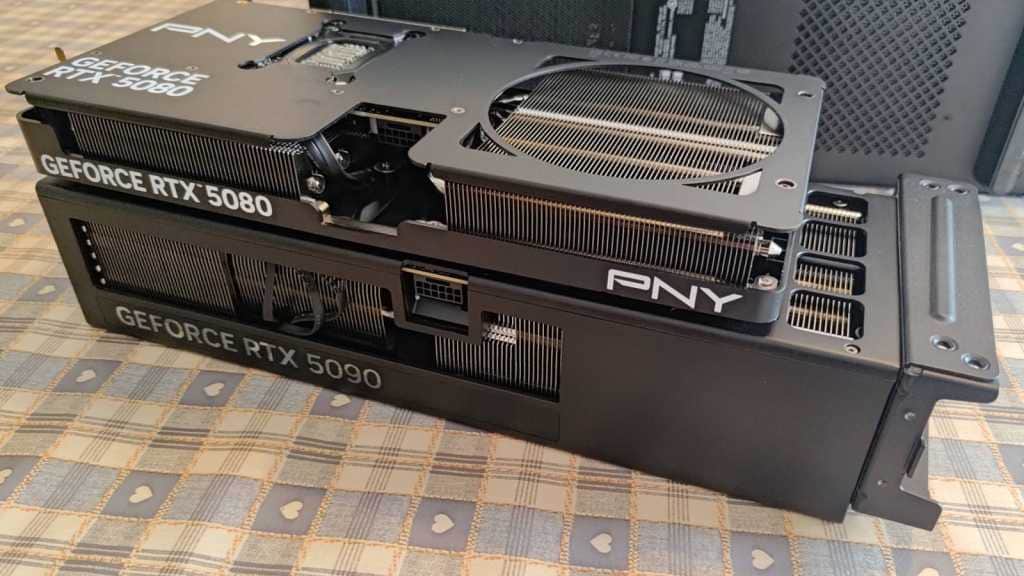
Image: PCWorld
Nvidia showed RTX PAIR at IFA Berlin 2026 on September 3. The free app combines the GPUs already installed in a household’s gaming and AI PCs. It routes AI agents and subagents across a local network instead of leaving one machine to process the entire workload.
Nvidia calls the application Personal AI Router, shortened to PAIR. It detects compatible devices over the LAN, pairs them automatically, and assigns work to the GPU that can handle each task. The result is a small, opportunistic inference cluster rather than a conventional local chatbot running on one PC.
The initial software support covers Ollama and LM Studio, both of which can run multiple open models locally. Nvidia’s demonstration used Ollama to execute a person’s typical “Sunday morning” checklist, with PAIR distributing individual agent tasks as they appeared.
Recommended reading
Meta’s Muse Voice Transcribe handles real-time speech
Ava Chen • • 6 min read
Nvidia says RTX PAIR works across the local network but recommends hardwired Ethernet connections. A home Wi-Fi network may connect the PCs, but the application must move task data and coordinate inference without network latency becoming the bottleneck. Nvidia has not provided throughput, latency, model-size, or network-bandwidth requirements for the release.
Nvidia’s demo cut completion time in half
In the IFA demonstration, three RTX-powered PCs completed the checklist in just over nine minutes with RTX PAIR. Running the same task on a single PC took over 18 minutes.
| Processing setup | Demo completion time |
|---|---|
| One PC | Over 18 minutes |
| Three PCs with RTX PAIR | Just over 9 minutes |
That result is a workload demonstration, not an independent benchmark. The supplied figures don’t identify the GPUs, models, token counts, network hardware, or whether the single-PC and distributed runs used identical scheduling conditions. The numbers show the potential of parallel agent execution, but they don’t establish a general performance gain for every Ollama or LM Studio workload.
PAIR’s scheduling model also limits what the result means. It distributes agents and subagents as they spawn; it isn’t described as splitting one model layer-by-layer across several GPUs. Independent agents can often run concurrently, while a single model with a large memory footprint may still need to fit on one device unless the supported software provides a separate model-parallel mechanism. Nvidia has not specified whether RTX PAIR can distribute model weights, KV cache, or other inference state across machines.
The company says it has tested RTX PAIR with as many as 18 devices on one local network. Nvidia also says there is theoretically no limit to the number of connected PCs, but that is a design claim rather than a published capacity figure. The practical ceiling will depend on the workload, available GPU memory, network conditions, and how many agents can run in parallel; Nvidia has not published those limits.
Rival GPUs are supported, but the boundaries are unclear
Despite the RTX branding, Nvidia says the application should work with rival GPUs as well as GeForce and Nvidia professional graphics cards. It hasn’t identified which competing GPU architectures, drivers, operating-system combinations, or acceleration backends are supported. That leaves a compatibility question unresolved for households with mixed hardware.
The software will be available for Windows, Linux, and macOS, and Nvidia says it is launching as a free download on September 3, 2026. It will also be open source under the Apache 2.0 license. The initial application support remains limited to Ollama and LM Studio.
RTX PAIR arrives alongside Nvidia’s work on dedicated local-AI hardware. The company and its partners plan to roll out new RTX Spark-powered devices in October, including a processor with powerful integrated graphics. Nvidia is positioning PAIR as complementary infrastructure: buyers of those systems could add their existing GPU-equipped PCs instead of treating the new machine as an isolated inference box.
Distributing work across a home network can increase aggregate compute without buying a single larger accelerator, but it adds device-management and networking requirements. Every participating PC needs to be available, connected, and supported by the local software stack. A mixed fleet may be useful for independent agents, while workloads that require a single large model or tightly synchronized computation may not benefit in the same way.
For US users, RTX PAIR is free, launches on September 3, supports Windows, Linux, and macOS, and is intended for local networks rather than a cloud service. Nvidia has not explained how the router handles model placement, memory pressure, failures, privacy between machines, and heterogeneous GPUs. Nvidia has shown a nine-minute demo and tested up to 18 devices; it has not yet published the workload and systems data needed to turn those figures into a reproducible performance baseline.
Frequently asked questions
When can I download Nvidia RTX PAIR?+
Nvidia says RTX PAIR launches as a free download on September 3, 2026.
Which apps work with RTX PAIR?+
The initial release supports Ollama and LM Studio, which can run multiple open models locally.
Does RTX PAIR require Nvidia GPUs?+
Nvidia says it should work with rival GPUs as well as GeForce and Nvidia professional graphics cards, but it has not specified the supported competing hardware and drivers.
How many PCs can RTX PAIR connect?+
Nvidia says it has tested up to 18 devices on one local network and describes the total number as theoretically unlimited. Practical limits have not been published.
AI Editor
Ava covers the rapidly evolving world of artificial intelligence, from foundational models and research labs to the real-world economics of intelligence. With a background in computational linguistics, she cuts through the hype to find out what actually works. She firmly believes that benchmarks are just marketing until reproduced in the wild.