• Updated • 7 min read
IFA 2026: LG puts AI agents and tighter appliances on display
LG announced ThinQ Claw, Homey energy coordination and space-saving appliances at IFA 2026, with several products aimed at Europe.
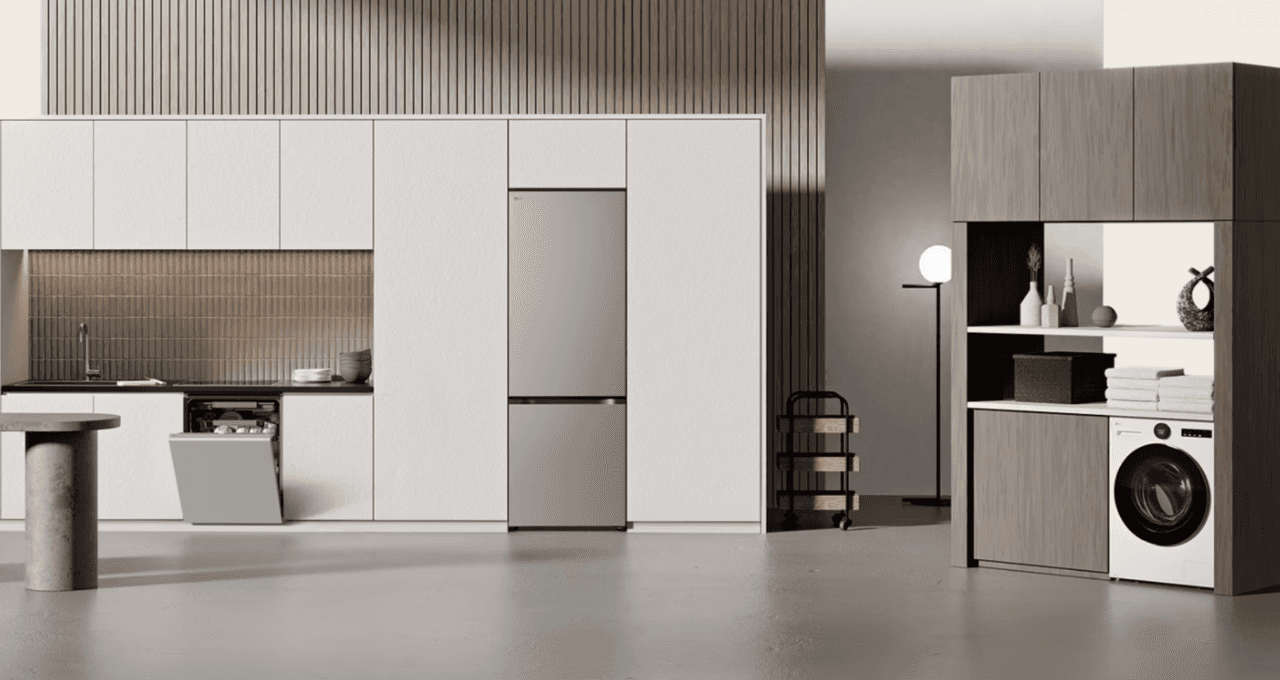
Image: Biz Heraldcorp
At IFA 2026 in Berlin, LG presented appliances that occupy less space and consume less energy alongside an AI Home system that can coordinate devices around a user’s routines. The company announced and showed the products at the event, including its new text-based ThinQ Claw agent, an expanded Homey-connected ecosystem and the Fit & Max built-in appliance range.
The event’s physical-product focus is especially European. LG is targeting the continent’s built-in appliance market, where kitchens have commonly been designed around integrated appliances since the 1920s and older housing can leave little spare room. The company introduced Fit & Max refrigerators in 2025 and is now extending the approach to washing machines and dishwashers.
Fit & Max uses product-specific door panels and hinge mechanisms to reduce the gap between an appliance and adjacent walls or cabinets. LG says its washing machines use a slide-in installation design and internal structural changes to increase drum capacity without increasing the appliance’s exterior dimensions. The new dishwashers are designed to align with standard kitchen cabinetry.
| Product category | What LG showed at IFA 2026 |
|---|---|
| Washing machines | Slide-in installation, reduced protrusion and greater drum capacity within the same external dimensions |
| Dishwashers | Cabinet-aligned design and reduced water consumption, with nearly all models qualifying for an EU A rating |
| Refrigerators | Fit & Max built-in designs carried forward from the lineup introduced in 2025 |
| Dryers | A mass-premium model planned for the second half of 2026, improving its rating from B to A |
LG is also moving energy-saving technology beyond its flagship products. The flagship washing machine shown at the fair reaches efficiency up to 70 percent above the EU’s A rating, while the new dishwasher’s lower water consumption reduces the energy required to heat water. LG says nearly all models in that dishwasher range qualify for an A rating.
“The future of home appliances isn’t about having more — it’s about using space and energy more efficiently. That belief is shaping the innovations we’ll be bringing to IFA 2026.”
“I believe energy efficiency should be an everyday benefit, not a premium feature for the few. That’s why we’re extending advanced energy-saving technology across a broader range of products.”
ThinQ Claw treats chat as a control layer
The software announcement is ThinQ Claw, a text-chat-based agent built on the concept of OpenClaw and optimized for LG AI Home. Instead of processing each user message as an isolated command, LG says the system can interpret it alongside schedules, routines, home conditions, appliance usage and remembered preferences.
Recommended reading
Google Home MCP makes the $20 plan the gatekeeper for rival AI agents
Sergey Kuznetsov • • 10 min read
ThinQ Claw is intended to coordinate actions rather than simply switch individual devices on or off. A user could tell it that guests are coming, for example, and the system could help prepare cooking appliances. It can also monitor indoor air quality and temperature before the user arrives home, or suggest entertainment and relaxation experiences based on the situation. Calendars and other connected services are part of the same interaction model.
Users provide plans or status updates through chat instead of building automation rules manually. ThinQ Claw can remember likes and dislikes, allowing LG to personalize later recommendations. The supplied material does not specify the model running the agent, its supported languages, whether processing is local or cloud-based, or whether it can execute actions without confirmation.
LG describes the broader AI Home upgrade as a system that analyzes context across devices and services, then recommends or helps initiate actions. The company’s official IFA 2026 announcement also frames the platform as an ecosystem rather than a single appliance feature.
Homey connects devices, energy and shared spaces
The interoperability layer is Homey, the smart-home platform developed by Athom, which LG acquired in 2024. Homey lets users manage products from multiple manufacturers and service providers in one place. At IFA, LG is using it to demonstrate connected living, kitchen and rest areas in which appliances and other devices respond to common routines.
The same layer supports an AI-powered Home Energy Management System. It connects smart meters, solar panels, home batteries and electric-vehicle chargers with LG appliances, then coordinates energy generation, storage and consumption in real time. Where dynamic energy pricing is available, LG says the system can adjust behavior to help reduce household electricity bills.
That savings claim has practical limits: results depend on usage, energy tariffs and local conditions. LG has not provided a modeled savings figure, tariff assumptions or technical details about the control interfaces used to connect third-party meters, batteries or chargers. For US households, the absence of a stated rollout plan also leaves availability unresolved; the appliance strategy described at the show is explicitly centered on Europe.
LG is extending the same platform beyond individual homes with the European debut of ThinQ Pro, an AI-powered solution for multi-family residential and commercial environments. ThinQ Pro is designed to help manage connected devices and facilities in shared or professional spaces, suggesting a business model that reaches property operators as well as consumers.
Security is part of the pitch, but details are limited
LG says its LG Shield security framework applies across the AI Home ecosystem to protect connected appliances, services and customer data. That is a broad platform claim rather than a disclosed security specification: the company has not described the threat model, encryption methods, update policy, vulnerability-response process or the boundary between local and cloud processing in the supplied material.
The architecture LG demonstrated at IFA has three layers: Fit & Max addresses the physical constraints of European kitchens; Homey provides cross-brand device and energy coordination; and ThinQ Claw supplies a conversational interface for context-aware actions. ThinQ Pro applies the same general approach to shared and commercial properties.
LG did not announce US pricing, consumer launch dates or availability for ThinQ Claw, the HEMS integration, ThinQ Pro or the new appliance models. The dryer is the one product with a stated timing window: its release is planned for the second half of 2026. Until LG publishes regional availability and technical requirements, the IFA demonstrations establish the direction of the platform—not what US buyers can order.
Update, 31 August 2026 — LG details its AI TV lineup and webOS support
Donanimgunlugu reports that LG’s 2026 AI TV range uses the third-generation α11 AI Processor, which the company says delivers a 5.6-fold improvement in NPU performance. The processor supports AI Dual 4K Upscaling and AI Sound Pro, while the TVs add voice-based profile switching, an AI chatbot for troubleshooting and an AI Concierge that recommends content and settings through webOS 26.
The report also supplies implementation details absent from LG’s broader LG Shield description: the TV security system covers data storage and transfer, authentication, software integrity, secure updates and security-incident detection. LG Shield received a cybersecurity award at the CES 2026 Innovation Awards, while the α11 processor received a Tom’s Guide AI Award. LG says the TVs will receive free webOS upgrades for up to five years.
Update, 3 September 2026 — Dishwasher launches in the UK this month
Biz Heraldcorp reports that LG will launch the new dishwasher in the UK in September, with global sales planned for early 2027. The report says the model uses 30 percent less energy than the top-rated benchmark, adding a performance figure to LG’s earlier description of reduced water use and an A rating across much of the range.
The same report says ThinQ Claw accepts photos and tables as inputs and can receive commands through KakaoTalk and Telegram. LG demonstrated those interfaces by applying power-saving settings during travel and adjusting temperature and humidity based on an arrival time.
Frequently asked questions
When will LG ThinQ Claw be available in the US?+
LG has not announced a US launch date or regional availability for ThinQ Claw.
What is LG ThinQ Claw?+
It is a text-chat-based AI agent for LG AI Home that interprets user context and coordinates relevant appliances and connected services.
Does LG’s energy management system work in the US?+
The announcement does not specify US availability. LG says savings depend on household usage, energy tariffs and local conditions.
When will LG’s new dryer launch?+
LG plans to release the mass-premium dryer in the second half of 2026.
A section byline, not a person: stories filed here by for(geeks) are held to the same editorial policy as every story we run.