• Updated • 10 min read
IFA 2026: Acer’s 1,000Hz monitor leads a broad PC push
Acer showed a 1,000Hz esports monitor, repairable Vero 16, new Swift laptops and a Predator gaming handheld at IFA 2026.
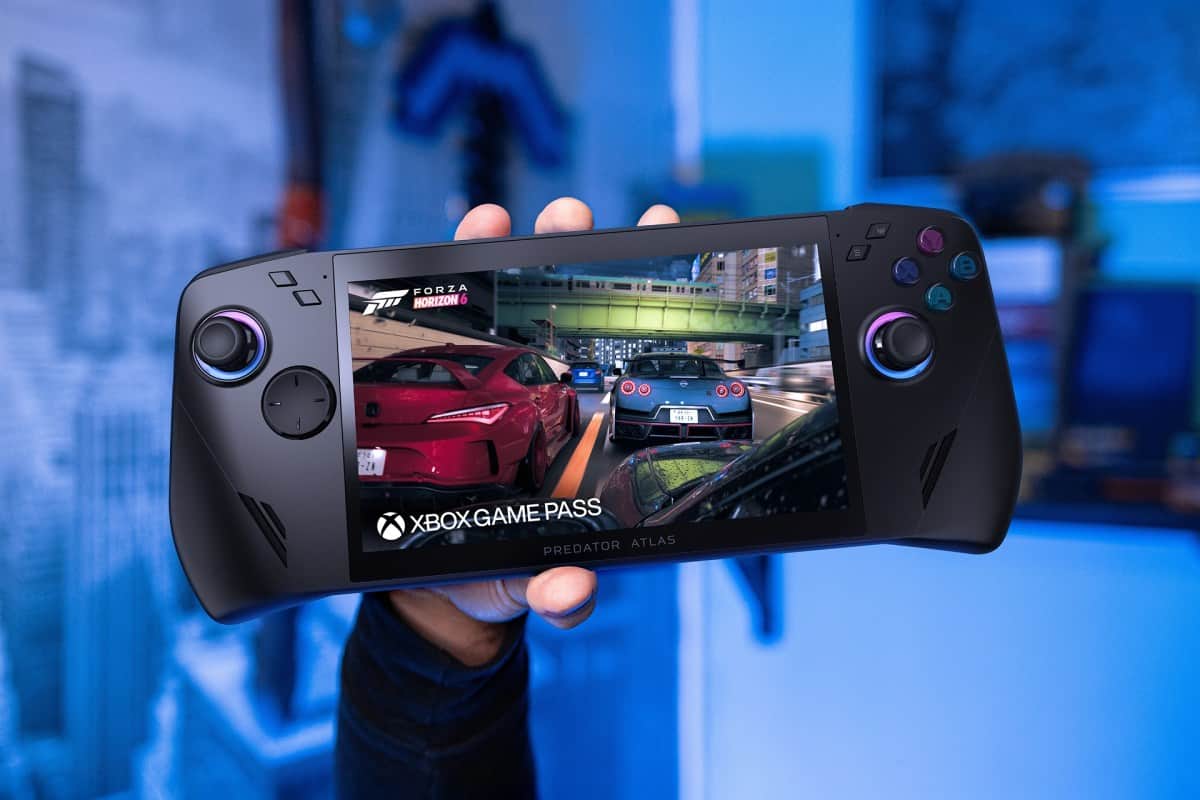
Image: Androidguys
Acer announced and showed new PCs, gaming hardware and displays at IFA 2026. The highest specification is a 24.5-inch 1080p gaming monitor with a 1,000Hz refresh rate. The company also introduced the Predator Atlas 7 handheld, a fourth-generation Vero 16 designed for easier repairs, and two thin Swift laptops aimed at different kinds of mobile work.
The announcements cover several hardware categories: Intel-based Copilot+ PCs, local AI workstations, a premium handheld, repairable laptops and monitors tuned for esports or color-sensitive production. US shoppers will have to wait for some of the products, and Acer has not disclosed pricing for the Vero 16 or either new Swift model.
Predator Atlas 7 targets high-end handheld gaming
The Predator Atlas 7 is a 7-inch gaming handheld with a 120Hz, FHD touchscreen rated at 500 nits. Acer says it can be configured with up to an Intel Arc G3 Extreme processor and up to Intel Arc B390 graphics, although the supplied announcement does not identify the exact CPU core configuration, memory capacity or storage options.
Its controls include optional tunneling magnetoresistance (TMR) sensors for the joysticks, a design intended to improve precision and reduce drift, while the analog triggers use Hall-effect sensing. Two Thunderbolt 4 ports provide high-bandwidth connectivity, and an 80Wh battery supplies the system. Acer is using a dual-fan cooling system to sustain performance during longer gaming sessions.
That battery is large for a handheld, but the sources don’t establish the Atlas 7's weight, dimensions, operating-system configuration, launch date or price. An 80Wh pack can support longer play, but its effect on portability depends on how much mass the cooling system, display and discrete graphics hardware add. Acer has not said when US buyers can order it.
Repairability is the Vero 16's main hardware change
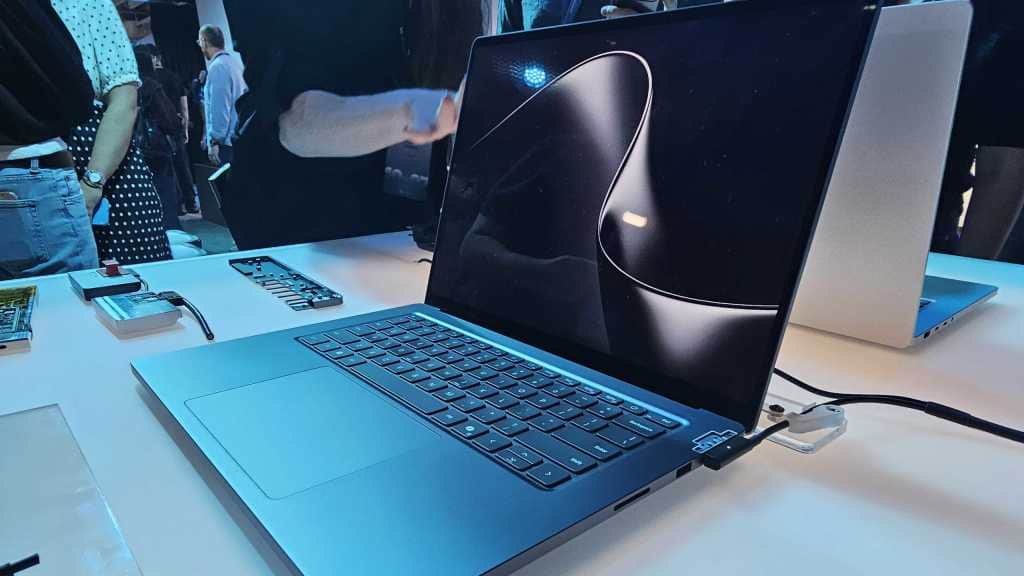
The fourth-generation Acer Vero 16 is designed to make routine service less dependent on a repair shop. Its bottom access latch allows tool-free entry, while the battery and SSD are replaceable. Acer also says the hinge is detachable and the I/O port covers can be removed, giving owners more direct access to parts that can otherwise complicate repairs.
A visual repair guide is engraved on the chassis. The guide is intended to show owners where and how basic component swaps begin. The sources also describe support for processor upgrades over the next two generations, though Acer has not supplied the upgrade path, compatible parts or the conditions under which those upgrades would be available.
The Vero 16 uses a mix of recycled and lower-carbon materials. Acer specifies 50% post-industrial recycled aluminum and 50% low-carbon aluminum for the top and palm-rest covers, plus 60% post-consumer recycled plastic for the bottom cover.
The published technical details vary by account, apparently reflecting different configurations or a broader product announcement. Acer’s specifications include an Intel Core Ultra X9 388H processor, integrated Intel Arc B390 graphics, up to 32GB of LPDDR5x memory and 512GB of storage. The Vero 16 is also described as a Copilot+ PC with up to 180 platform TOPS and a 16-inch 3K OLED WQXGA+ display; another configuration description lists 2.8K OLED and 2K OLED panels, with the 1,920-by-1,200 version optionally adding touch input.
| Vero 16 component | Published configuration details |
|---|---|
| Processor | Up to Intel Core Ultra X9 388H |
| Graphics | Integrated Intel Arc B390 |
| Memory | Up to 32GB LPDDR5x |
| Storage | Up to 512GB |
| Display options | 3K OLED WQXGA+; also reported as 2.8K and 2K OLED |
| Serviceable parts | Battery, SSD, hinge and I/O port covers |
The Vero 16's repair details are clearer than its US launch plan. Acer has not announced a price, North American availability or the cost of replacement components. Without those details, it isn’t possible to determine whether the repairable design will translate into lower ownership costs or simply make a more expensive laptop easier to maintain.
Swift Air 16 favors screen size over minimum weight
The Swift Air 16 is an all-aluminum 16-inch laptop with a 3K OLED display option running at up to 120Hz. It weighs 3.3 pounds (1.5kg) and measures between 13.3mm and 13.5mm thick, according to the reported specifications. Acer will offer Elemental Blue, Sage Green and Sandstone Gold finishes.
The laptop uses Intel Core Series 3 “Wildcat Lake” processors, topping out at the Intel Core 7 350, with up to 16GB of LPDDR5x memory. Storage includes up to 512GB onboard, with SSD upgrades supported up to 1TB. A 1,920-by-1,200-pixel IPS touchscreen is available alongside the higher-resolution OLED configuration.
Acer lists up to 40 platform TOPS for the Core 7 350 configuration. That figure is not the same as 40 dedicated NPU TOPS: the reported configuration is described as falling below the dedicated-NPU threshold for Copilot+ certification. Acer’s announcement still positions the machine around AI-enhanced Windows 11 features, but the sources do not establish it as a Copilot+ PC.
The rest of the system is built for general productivity and media work: a quad-speaker array with DTS Virtual:X, a 1080p FHD IR webcam with Windows Hello support, two Thunderbolt 4 ports, one USB Type-A port and a 3.5mm combo jack. Its 70Wh battery can fast-charge to 50% in 30 minutes.
The Air 16 is scheduled to launch in EMEA in December 2026, with North American availability planned for early 2027. Acer has not announced US pricing. That makes the Air 16 the more concrete US prospect of the two Swift launches, although “early 2027” is still a window rather than a specific shipping date.
Swift Blade 14 is lighter, but US availability is unresolved
The Swift Blade 14 takes the opposite approach. It weighs 799 grams (1.76 pounds) and is 12.9mm thick, using a magnesium-aluminum alloy keyboard deck with carbon-fiber top and bottom covers. Acer is targeting mobile productivity and visual work, with an OLED panel reaching 2,880 by 1,800 pixels at 90Hz and covering 100% of the DCI-P3 color gamut.
The Blade 14 uses the same general Intel Core Series 3 family as the Air 16, with up to an Intel Core 7 350, but its other configuration details differ: 12GB of LPDDR5 memory and up to 1TB of PCIe Gen 4 SSD storage. It has three USB 3.2 Gen 1 Type-C ports, an FHD webcam, dual digital microphones and a physical side-mounted camera switch. A 50Wh battery supports fast charging.
| Specification | Swift Blade 14 | Swift Air 16 |
|---|---|---|
| Weight | 799g / 1.76lb | 1.5kg / 3.3lb |
| Thickness | 12.9mm | 13.3–13.5mm |
| Processor ceiling | Intel Core 7 350 | Intel Core 7 350 |
| Display ceiling | 14-inch 2,880×1,800 OLED, 90Hz | 16-inch 3K OLED, up to 120Hz |
| Memory | 12GB LPDDR5 | 16GB LPDDR5x |
| Storage ceiling | 1TB PCIe Gen 4 SSD | 512GB onboard; SSD support up to 1TB |
| Battery | 50Wh | 70Wh |
The Blade 14 is due in EMEA in December 2026 in Marshmallow White and Marshmallow Blue. Acer has not listed North American availability or pricing. American buyers may not get the lighter laptop at all.
The Blade prioritizes mass and chassis materials, while the Air provides a larger display, a bigger battery, more memory and a broader port mix at substantially greater weight. Neither model has a US price yet, so the key trade-off can’t be evaluated against competing ultraportables.
Acer’s monitor push peaks at 1,000Hz
Acer’s most notable display is the Predator XB253Q U1, a 24.5-inch TN monitor with a 1,000Hz refresh rate and 1080p resolution. It is aimed at esports rather than high-resolution gaming. The smaller 24.5-inch format and lower resolution are intended to keep the entire competitive scene visible while allowing a GPU to produce very high frame rates.
The monitor includes Acer’s Visual Response Boost Pro technology to address motion blur and ghosting associated with TN panels. It supports both FreeSync and G-Sync Compatible variable-refresh technologies, and Acer says its Circular Polarizer reduces glare and eye strain during long sessions. The panel is rated for a 1ms response time.
The price is $1,099, with launch planned for the first quarter of 2027. The refresh-rate claim is more notable than the value proposition: the supplied reporting places a 24.5-inch 360Hz 1080p monitor at around $350 and a 240Hz model at $150 or less. Those are not Acer prices or like-for-like product comparisons, but they show how much of the XB253Q U1's cost is attached to its extreme refresh target.
At 1,000Hz, each refresh interval is 1ms. The reported comparisons put 60Hz at 16.67ms, 120Hz at 8.33ms, 240Hz at 4ms and 360Hz at 2.78ms. The numerical improvement continues, but the reporting does not include independent measurements of input latency, motion clarity or actual esports performance for Acer’s monitor. A high refresh rate also requires a game and graphics system capable of generating frames quickly enough to use it.
Acer is also showing QD-OLED, Mini LED and dual-frame-rate Predator and Nitro monitors, along with the ProDesigner PE270X P, a 27-inch 5K monitor with wide-gamut coverage and factory calibration. The sources don’t provide prices or launch dates for those models, so the XB253Q U1 is the only display in the lineup with a confirmed US price and shipping window.
More local AI hardware and accessories
Acer’s broader IFA 2026 lineup includes the compact Veriton RI 110 AI Mini Workstation. It supports AI models with up to 120 billion parameters, uses an Intel Core Ultra X7 processor 358H and Intel Arc B390 graphics, and can be configured with up to 96GB of LPDDR5X memory. Acer is also showing an RTX Spark compact desktop design based on NVIDIA’s next-generation RTX Spark superchip.
The company is adding several peripheral and mobile products as well: Iconia tablets, the EP130K ePaper monitor, the PD163Q P3 triple-screen extender and the Connect D5P 5G dongle. The Aspire G 3D 16 laptop uses eye-tracking cameras to render ordinary 2D content in 3D without requiring native 3D material or a discrete GPU.
For US customers, Acer’s announcements fall into three levels of certainty: the $1,099 Predator monitor has a first-quarter 2027 launch; the Swift Air 16 is planned for North America in early 2027; and the Swift Blade 14 and Vero 16 have no confirmed North American availability in the supplied details. Pricing remains unknown. Without it, Acer’s repairability pitch and the Blade’s extreme weight reduction can’t yet be weighed against their likely compromises or alternatives.
Update, 2 September 2026 — Geekzone reports new Atlas and display details
Geekzone reports that the Predator Atlas 7 runs Windows 11 and includes Gorilla Glass Victus, UHS-II microSD support, Wi-Fi 7, a fingerprint reader and dual 2W speakers. The earlier announcement details did not establish the handheld’s operating system or those additions. Geekzone also describes a separate Project DualPlay Mini concept: an 8-inch device that flips between a handheld console and a small laptop with a backlit physical keyboard.
The display specifications differ as well. Geekzone calls the Predator XB253Q U1 an IPS panel with a 0.3ms response time, while the earlier announcement details on this page list a TN panel and 1ms response time. The newer report also identifies the Predator XB273K V7 as a 4K monitor that can switch to 1080p at 500Hz, and gives the 31.5-inch Predator X32 V3 a 4K 180Hz QD-OLED panel.
Frequently asked questions
When will the Acer Predator XB253Q U1 launch?+
Acer plans to launch the 1,000Hz, 24.5-inch 1080p monitor in the first quarter of 2027.
How much does Acer’s 1,000Hz monitor cost?+
The Predator XB253Q U1 will cost $1,099 when it launches.
Will the Swift Blade 14 be sold in the US?+
Acer has confirmed an EMEA launch in December 2026 but has not announced North American availability or pricing.
When will the Swift Air 16 be available in North America?+
Acer plans a North American launch in early 2027. Pricing has not been announced.
A section byline, not a person: stories filed here by for(geeks) are held to the same editorial policy as every story we run.