• 5 min read
IFA 2026: Acer Predator Atlas 7 and Project DualPlay Mini
Acer showed the 7-inch Predator Atlas 7 gaming handheld and concept DualPlay Mini at IFA 2026, with US availability expected this fall.
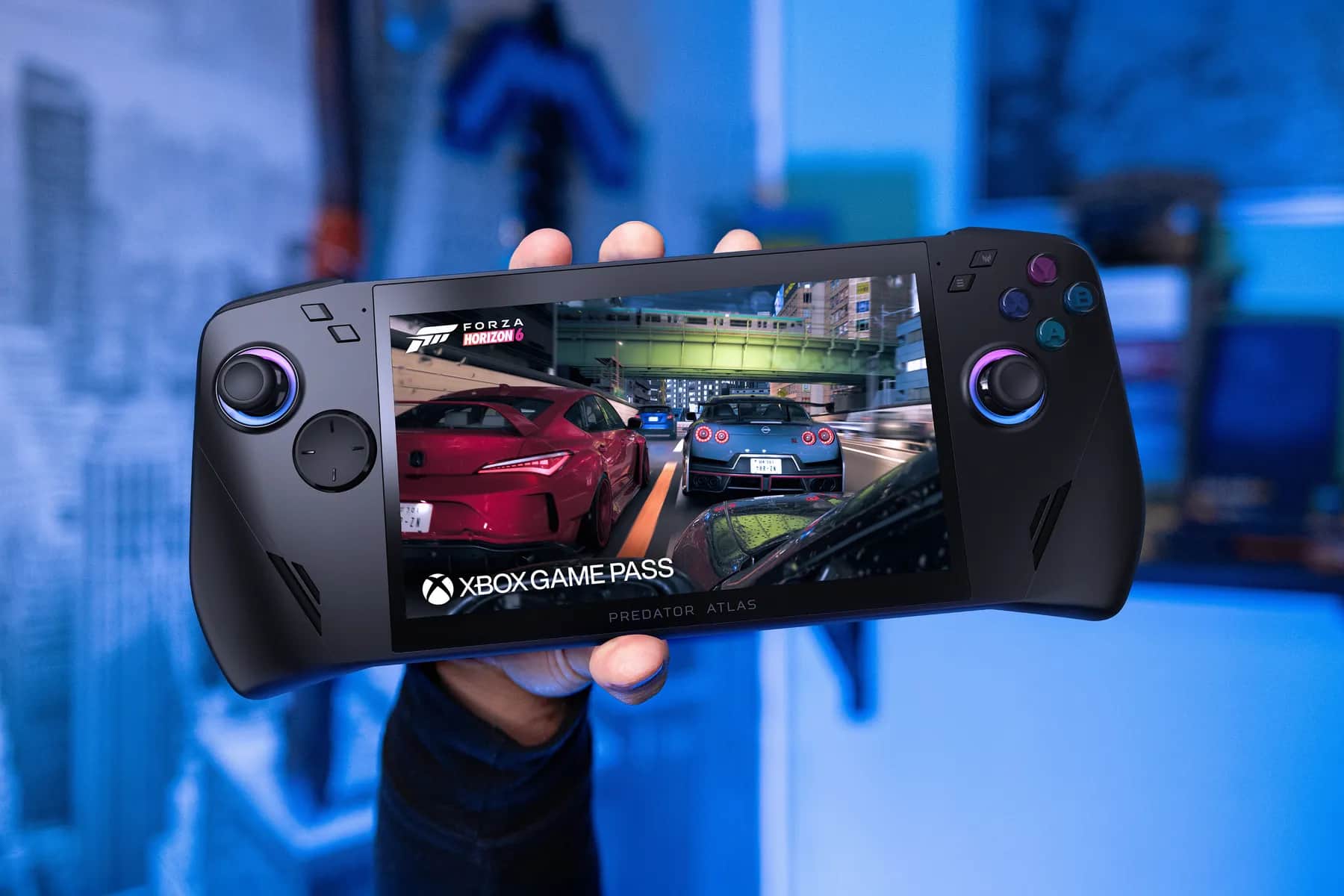
Image: Tech Critter
Acer announced and showed two different handheld PCs at IFA 2026: the Predator Atlas 7, a 7-inch Windows gaming handheld with Intel Arc graphics, and Project DualPlay Mini, a concept that adds a flip-and-swivel keyboard to turn a handheld into a small laptop.
The Atlas 7 is the shipping product. Acer is shrinking the recently shown 8-inch Atlas design without shrinking its battery: the new model carries an 80Wh pack, the same capacity previously associated with the larger Atlas 8. US availability is expected in fall 2026, but Acer hasn’t announced a price.
The smaller chassis has a 7-inch, 1,920-by-1,080 touchscreen with a 120Hz maximum refresh rate, variable refresh rate support and a 16:9 aspect ratio. Acer covers it with Corning Gorilla Glass Victus and a DXC coating intended to reduce glare and improve scratch resistance. Peak brightness is rated at 500 nits.
Two Arc configurations, one 80Wh battery
Acer plans two Atlas 7 configurations. The lower version uses Intel Arc G3, while the higher-end model uses Intel Arc G3 Extreme. The top configuration is described as pairing the Arc G3 Extreme processor with Intel Arc B390 graphics. Both can be configured with up to 24GB of LPDDR5X memory and 1TB of storage, although the supplied specifications don’t identify the memory and storage options for each processor tier.
Recommended reading
Xbox Project Helix could launch as a device family
Gaming & Internet Desk • • 4 min read
| Atlas 7 configuration | Graphics platform | Maximum memory | Maximum storage |
|---|---|---|---|
| Standard | Intel Arc G3 | 24GB LPDDR5X | 1TB |
| Higher-end | Intel Arc G3 Extreme with Intel Arc B390 graphics | 24GB LPDDR5X | 1TB |
That battery is unusually large on paper for a device with a 7-inch display. The smaller panel could reduce display power demand compared with the 8-inch Atlas, but Acer has not supplied battery-life figures, runtime tests or a weight for the Atlas 7. The 80Wh capacity alone doesn’t establish how long it will last under gaming loads.
Cooling uses two fans. One is Acer’s metal Predator AeroBlade design, with 89 blades that are each 0.1mm thick; Acer claims the design can provide up to a 10% airflow increase. A second plastic fan works with Vortex Flow channels, which use angled internal passages to move heated air out of the chassis under sustained load.
The available reporting gives an early indication of the performance trade-off, but not a final benchmark. A preproduction Atlas 7 ran Forza Horizon 6 without noticeable lag or major interruptions at its default settings during an IFA demonstration. At maximum graphics settings, the demonstration unit showed dropped frames and occasional stuttering. Acer has not said whether those results came from the Arc G3 or Arc G3 Extreme configuration, and the hardware and software were not final.
The product’s processor branding and cooling hardware suggest a performance-focused handheld, but there are no published frame-rate results, power limits, thermal measurements or battery tests to show how the two Arc versions differ in actual games.
Ports, controls and Windows features
The Atlas 7 has two Thunderbolt 4 ports, a UHS-II microSD card slot and a 3.5mm headphone jack. Wireless connectivity includes Wi-Fi 7 and Bluetooth 5.4. Acer also includes a fingerprint reader in the power button for Windows Hello authentication.
The controls are more configurable than a basic handheld layout. Buyers can choose TMR joysticks, which Acer describes as providing drift-free operation and no dead zones, while Hall-effect analog triggers offer variable actuation for games that benefit from pressure-sensitive input. RGB lighting surrounds the joysticks, and the PredatorSense software exposes performance modes, lighting controls and system monitoring.
Acer’s physical design focuses on extended handheld use: the grips are contoured, the palm rest is enlarged and the surface has an anti-slip texture. Audio comes from two 2W speakers with DTS:X Ultra. The microphones use Acer PurifiedVoice for AI-assisted noise reduction during voice chat.
The 7-inch screen and the 80Wh battery are the main changes from the larger Atlas format. The move to a smaller display should make the device easier to hold, but the battery capacity also means the Atlas 7 may not be dramatically lighter than its larger sibling. Acer hasn’t published the finished product’s dimensions or weight, so the portability claim is still partly unresolved.
Acer previously showed the Atlas 7's 80Wh battery as one of the headline specifications in its broader IFA hardware announcement, alongside the Predator gaming handheld and other new PCs. The company still needs to provide the missing commercial details—especially price, weight, power limits and battery runtime—before the smaller screen can be assessed as an advantage rather than simply a change in form factor.
Project DualPlay Mini is still a concept
Project DualPlay Mini takes a different approach. Acer’s concept uses a flip-and-swivel design to convert between a traditional handheld and a mini-laptop form. A built-in backlit keyboard provides a laptop-style mode for productivity and keyboard-heavy games such as first-person shooters. The device can also connect to an external display for a larger work setup.
The concept is not a product announcement with a release date. Acer says it could become a commercial device if it attracts enough community interest, but the company has not provided a price, specifications, operating limits or a commitment to produce it.
A small anniversary detail is embedded in the design: the back cover contains “Acer 50 since 1976” in Morse code. The detail does not affect the hardware; it is part of the concept’s design.
Atlas 7 is a conventional Windows gaming handheld with a high-capacity battery, fast display and Intel Arc options. DualPlay Mini combines handheld controls, a physical keyboard and external-display support. Only the former has a stated US arrival window, and even it is still missing pricing and final performance data.
Frequently asked questions
When will the Acer Predator Atlas 7 launch in the US?+
Acer expects the Predator Atlas 7 to arrive in the United States in fall 2026. A specific release date has not been announced.
How much will the Predator Atlas 7 cost?+
Acer has not announced pricing for either Atlas 7 configuration.
What is Project DualPlay Mini?+
It is a concept handheld with a flip-and-swivel design, a built-in backlit keyboard, handheld and mini-laptop modes, and support for an external display.
What processors will the Atlas 7 use?+
The Atlas 7 will be offered with Intel Arc G3 or Intel Arc G3 Extreme. The higher-end version is described with Intel Arc B390 graphics.

Editor-in-Chief
Sergey Kuznetsov is Head of Product at iXBT.com, one of the largest Russian-language technology media outlets, and the founder of itzine.ru. He has spent over a decade building and running tech newsrooms. At for(geeks) he sets editorial standards and reviews what ships.