• 6 min read
GPU neoclouds are selling power before silicon
CoreWeave, Nebius, Lambda, Crusoe and Groq reveal a GPU-cloud market where pricing, power contracts and financing matter more than chip access.
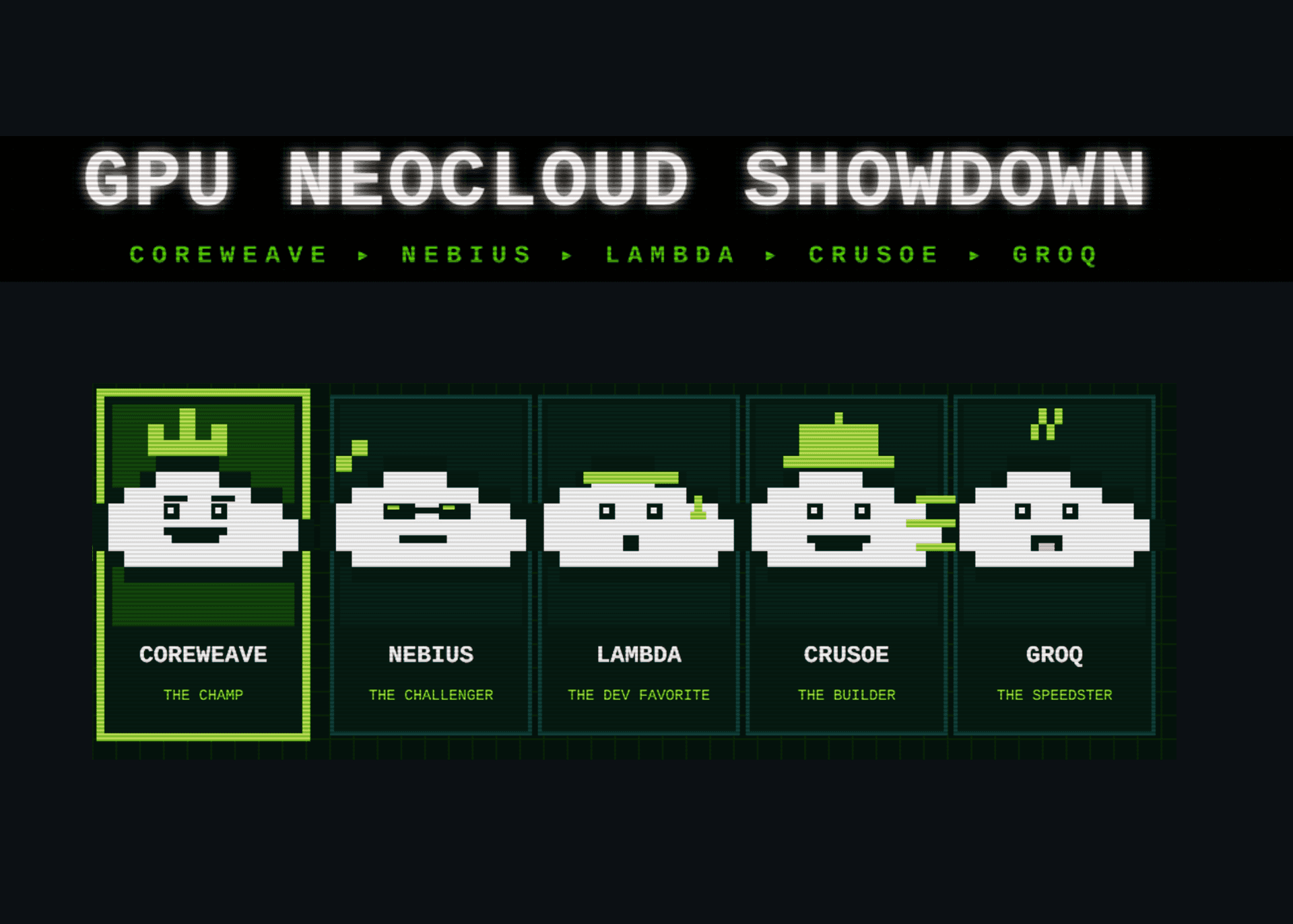
Image: MarkTechPost
The GPU neocloud market has stopped being a simple contest over who can rent the latest NVIDIA accelerator. In 2026, the scarce resource is the entire stack: megawatts, liquid-cooled buildings, networking, financing and customers willing to sign take-or-pay contracts before the hardware is fully deployed, first reported by MarkTechPost.
CoreWeave is the clearest example. It reported $2.575 billion in second-quarter 2026 revenue, up 112% year over year, but also posted a $626 million net loss. Net interest expense alone reached $640 million. The company now guides to $12.4–13.2 billion in 2026 revenue and $35–39 billion in capital expenditure, while expecting more than 1.85 GW of active power by the end of 2026. This isn’t a software-margin story. It’s an infrastructure balance sheet carrying enormous depreciation and interest costs.
CoreWeave says its revenue backlog stood at roughly $104 billion as of the second quarter, excluding more than $25 billion in commitments added in early Q3. Its reported contracted-power figure was about 3.7 GW on June 30; the company’s current data-center page states 4.2 GW+ across 51 data centers. That discrepancy is material, not cosmetic: contracted capacity can include future facilities and customer commitments, while active power represents infrastructure capable of serving workloads now.

Recommended reading
Lambda’s IPO case depends on contracts funding the GPUs
Sergey Kuznetsov • • 9 min read
CoreWeave’s second-quarter filing and results release also records the first bring-up and system-level validation of NVIDIA Vera Rubin NVL72 during Q2 2026. Nebius says it has received its first Rubin systems and is validating compute, networking and orchestration. Neither company has published Rubin pricing.
| Provider | Latest reported scale | Public pricing signal | Next-generation position | Main engineering risk |
|---|---|---|---|---|
| CoreWeave | 1.5 GW active; 4.2 GW+ contracted on current company page | H100 $6.16/GPU-hour; B200 $8.60 | First Vera Rubin NVL72 bring-up; GB300 and GB200 listed | Heavy capex and interest burden |
| Nebius | 5 GW contracted target by year-end 2026 | H100 $3.85; B200 $7.15; B300 $7.85 | Rubin systems received; only listed B300 on-demand price | Capacity is being sold ahead of deployment |
| Lambda | 15 US data centers; Kansas City site expanding from 24 MW to 100+ MW | B200 $6.69/GPU-hour; no spot tier | Microsoft deal includes GB300 NVL72 | Private-company disclosure and supply exposure |
| Crusoe | 4.9 GW contracted; pipeline above 40 GW | H100 $3.90; H200 $4.29; MI300X $3.45 | Vera CPU and Nemotron 3 support; AMD MI355X via sales | Project concentration and construction execution |
| Groq | 54 MW; 200+ MW planned in 2027 across 13 data centers | Per-token GroqCloud pricing; no public GPU-hour rate | LPU remains its inference engine; NVIDIA GPU capacity planned | Product transition after licensing technology to NVIDIA |
The public rate cards show a second split: transparent commodity rental versus sales-led infrastructure. Prices below were read from provider pricing pages on August 21, 2026. CoreWeave publishes node prices and the per-GPU equivalents are derived by dividing by GPU count; its North American spot rates vary by region.
| Accelerator | CoreWeave | Nebius | Lambda | Crusoe | Buyer takeaway |
|---|---|---|---|---|---|
| NVIDIA HGX H100 | $6.16 | $3.85 | $3.99 | $3.90 | CoreWeave carries a substantial list-price premium |
| NVIDIA HGX H200 | $6.31; spot $2.62 | $4.50; preemptible $2.45 | — | $4.29 | Crusoe has the lowest published on-demand rate |
| NVIDIA HGX B200 | $8.60; spot $4.26 | $7.15; preemptible $3.95 | $6.69 | Contact sales | Lambda has the lowest public B200 rate |
| NVIDIA HGX B300 | Contact sales; spot $4.48 | $7.85; preemptible $4.30 | — | — | Nebius is the only provider with B300 on-demand pricing |
| AMD MI300X | — | — | — | $3.45 | Crusoe is the only provider with this public option |
| Network egress | Free | Free; object storage egress $0.015/GiB | Free | Free | Egress isn’t the differentiator on published terms |
The cheap number is often the least useful number. Nebius reports that its Q2 2026 deals averaged more than $20 million in annual contract value per megawatt. Its 2026 base pricing is near $12 million per MW, while short-term Q3 capacity deals have cleared above $40 million per MW. Four Q2 deals averaged more than $1 billion each, and 70% were prepaid. This is a market for guaranteed power and delivery, not a normal cloud spot market.
Nebius' growth figures explain why buyers are accepting that structure. Second-quarter group revenue reached $582.3 million, up 454% year over year. AI-cloud revenue was $574.9 million, up 514%, with a $3.0 billion annualized run rate and a 49.7% adjusted EBITDA margin. The company raised its year-end 2026 contracted-power target to 5 GW and plans to deploy more than 1 GW annually from 2027. It also raised $5.0 billion in convertible financing priced on August 19, 2026, after earlier convertible and secured-financing transactions.
The SEC filing covering Nebius' Meta agreement describes the model: anchor customers are effectively underwriting construction. Meta’s agreement is valued at $3 billion, with capacity potentially reaching roughly $27 billion. Microsoft is reported to have contracted more than 100,000 GB300 chips from Nebius. The upside is rapid utilization; the failure mode is obvious—capital gets committed to facilities and accelerators before customer workloads arrive or remain economically attractive.
Lambda occupies the lower end of the published B200 market, listing $6.69 per GPU-hour and offering 1-Click Clusters from 16 to more than 2,000 GPUs. But cluster convenience carries a surcharge: B200 pricing is $9.86 per hour at 16 GPUs, $9.36 at 64 GPUs and $8.87 at 256 or more. Lambda has no spot tier, so customers can’t trade interruption risk for lower rates. Its multibillion-dollar Microsoft agreement covers tens of thousands of NVIDIA GPUs, including GB300 NVL72 systems. The company appointed Michel Combes CEO in May 2026 and is reportedly targeting an IPO in the second half of 2026, although no public S-1 existed as of August 21, 2026.
Crusoe offers an alternative to an NVIDIA-only procurement strategy. It lists AMD MI300X at $3.45 per GPU-hour and offers MI355X through sales, while publishing a $4.29 H200 rate and $3.90 H100 rate. Its contracted AI infrastructure reached 4.9 GW across five US campuses and Crusoe Cloud on June 9, 2026, with a development pipeline above 40 GW. The Abilene buildout includes a 1.2 GW Oracle and OpenAI campus and a separate 900 MW Microsoft campus. Those figures also carry an operational risk: a 40 GW pipeline is a claim about development capacity, not energized compute available to customers.
Groq is selling a different abstraction entirely. Its GroqCloud service prices inference per token around the company’s LPU architecture, avoiding direct GPU-hour comparison. After NVIDIA licensed Groq’s inference technology in December 2025 in a transaction reported at approximately $20 billion, Groq remained independent while founders and staff joined NVIDIA. It has raised $650 million in June 2026 and another $350 million Series A in August 2026 at a $3.5 billion valuation, with planned NVIDIA participation.
Groq now operates 13 data centers and expects to expand from 54 MW to more than 200 MW in 2027. On August 12, 2026, it joined the NVIDIA Cloud Partner program and said it plans to bring NVIDIA accelerated computing online “in the future.”
Groq’s GPU service is not yet a published product, so the company is currently a specialized inference API provider, not a directly comparable general-purpose GPU neocloud. NVIDIA gets Groq’s architecture and a future distribution channel; Groq gets access to NVIDIA’s ecosystem while trying to preserve a differentiated token-serving business.
The competitive winners will be providers that can convert power contracts into usable clusters without destroying their financing economics. CoreWeave has the strongest published enterprise position and the only Platinum rating in SemiAnalysis ClusterMAX 2.0, but its premium pricing and debt load are inseparable from that lead. Nebius is more aggressive on Blackwell pricing and has the strongest disclosed growth rate, but its model depends on turning contracted megawatts into production capacity at extraordinary speed. Lambda offers the lowest public B200 rate, while Crusoe gives buyers a rare commodity in this market: a credible AMD alternative.
The bottleneck is no longer whether a provider can announce Rubin, Blackwell Ultra or a new campus. It is whether the provider can energize, finance and fill that campus before the hardware depreciates and before customers renegotiate the contracts that made its construction possible.
A section byline, not a person: stories filed here by for(geeks) are held to the same editorial policy as every story we run.