• 5 min read
IFA 2026: Xiaomi CyberOne, 18 Fold and SU7 Ultra, plus three more
Xiaomi used its first IFA to show CyberOne’s 98% factory task rate, the XRING O3-powered 18 Fold and its connected EV ecosystem.
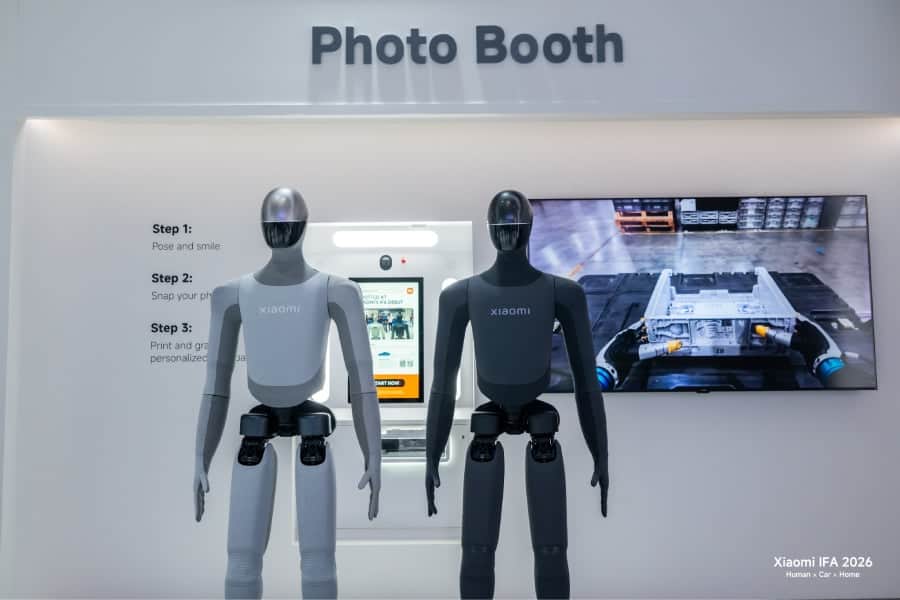
Image: TechRepublic
Xiaomi announced and showed its CyberOne humanoid robot, 18 Fold smartphone and electric-vehicle lineup at IFA 2026 in Berlin. At the company’s first appearance at the trade show, it presented a connected hardware-and-software strategy. The key demonstration was not the robot’s finger-heart gesture on the show floor, but its performance on a narrowly defined task inside Xiaomi’s EV manufacturing operation.
CyberOne has been deployed on a nut-fastening process at one of Xiaomi’s electric-vehicle factories. After approximately four months, Xiaomi says the robot’s success rate on that task rose from about 90% to 98%. The result applies to one task in a controlled environment and does not show that the humanoid can reliably perform a broad set of industrial jobs. Xiaomi disclosed no cost or cross-task reliability data.
The company is using its own factories to train and validate CyberOne’s perception, control and task-execution systems. Its robotics work is also tied to proprietary models including MiMo-V2.5-Pro, Xiaomi Miloco and Xiaomi Miclaw, while Xiaomi’s HyperOS is intended to connect the robot’s manufacturing environment with smartphones, home devices and vehicles.
“This year’s IFA participation marks an important milestone in Xiaomi’s global journey.”
“Xiaomi’s business and technology capabilities are being connected as one through the 'Human × Car × Home' smart ecosystem.”
CyberOne is a factory experiment, not a general-purpose product
At IFA, CyberOne’s public role was limited. It interacted with visitors using gestures such as finger hearts and thumbs-up. The factory trial is where Xiaomi is testing practical uses for the robot, applying it to repetitive work rather than presenting it as a consumer device.
The reported improvement from 90% to 98% measures task success, not throughput, operating cost, downtime, safety or the amount of human intervention required. Xiaomi also has not disclosed how many fastening operations were included in the measurement, how success was defined, or whether the 98% result was independently audited. Those details matter more to a factory buyer than a trade-show demonstration.
Recommended reading
Surface Laptop Ultra is a CUDA workstation that happens to travel
Sergey Kuznetsov • • 13 min read
Xiaomi is combining robotics with its own AI models, semiconductor designs, operating system and manufacturing infrastructure rather than selling a standalone humanoid. It says it plans to invest more than 200 billion yuan, approximately $29.8 billion, from 2026 through 2030 in research and development spanning AI, operating systems, semiconductors, electric vehicles, robotics and smart manufacturing.
XRING O3 moves Xiaomi deeper into custom silicon
The second major announcement was the Xiaomi 18 Fold, described at IFA as the company’s first flagship foldable powered by the next-generation XRING O3 processor. Our earlier IFA coverage identified the chip as a 3nm deca-core design and recorded a China launch date of September 7, 2026; US availability remains unconfirmed.
The chip reporting adds several details that were not part of the show-floor pitch. TSMC is expected to manufacture the O3 on its 3nm process, and shipments of the O3-powered foldable were targeted at 200,000 to 300,000 units. Xiaomi says the O3 has entered mass production. The company also says devices using its XRING chips have passed 1 million cumulative shipments across smartphones, tablets and watches, although only about 150,000 of those were smartphones.
A few hundred thousand premium foldables can provide a controlled outlet for a new processor, but they do not establish that XRING can replace outside suppliers across Xiaomi’s much larger device business. Xiaomi restarted development of large in-house chips in 2021, has pledged at least 50 billion yuan, or $7 billion, over a decade to the effort, and has already invested more than 20 billion yuan in XRING development. Its semiconductor design team has grown to more than 3,000 people.
The chip program also faces a weaker smartphone market. Xiaomi sold 65 million smartphones in the first half of 2026, down from 84 million in the same period of 2025, even as its average selling price increased. IDC expects global smartphone shipments to fall 14% this year, while leading-edge manufacturing remains expensive when initial volumes are measured in hundreds of thousands rather than millions.
XRING is intended to extend beyond the foldable:
| Chip | Intended role | Manufacturing and status |
|---|---|---|
| XRING O3 | Flagship foldable processor for the Xiaomi 18 Fold | Expected TSMC 3nm; mass production |
| XRING O100 | Neural processing unit for Xiaomi’s MiMo large language model on consumer devices | TSMC 6nm expected; development complete, deployment scheduled for 2027 |
| XRING D100 | Autonomous-driving processor | TSMC 3nm expected; development complete, deployment scheduled for 2027 |
A premium foldable gives Xiaomi more room to absorb the cost and risk of a new chip, but the longer-term test is whether O100 and D100 can turn XRING into a platform spanning phones, AI devices and vehicles. That expansion would also give Xiaomi more control over how its hardware and software interact and more leverage in negotiations with external chip suppliers.
Three EVs in the Human × Car × Home pitch
Xiaomi’s exhibition centered on the Human × Car × Home concept: smartphones, smart-home devices and EVs communicating through AI and HyperOS. The vehicles on display were the Xiaomi Vision Gran Turismo concept, the Xiaomi SU7 and the high-performance Xiaomi SU7 Ultra.
| Product shown at IFA 2026 | Xiaomi’s stated role or status | Availability detail in the supplied material |
|---|---|---|
| CyberOne | Humanoid robot being validated on a factory nut-fastening task | Factory trial in progress; no consumer availability stated |
| Xiaomi 18 Fold | Flagship foldable using the XRING O3 | China launch recorded for September 7, 2026; US availability unconfirmed |
| Xiaomi Vision Gran Turismo | Futuristic electric-vehicle concept | Shown at IFA; no production or sales date stated |
| Xiaomi SU7 | Electric vehicle in Xiaomi’s current lineup | Shown at IFA; European entry planned by 2027 |
| Xiaomi SU7 Ultra | High-performance flagship EV | Shown at IFA; European availability details not stated |
| Mijia ecosystem | Smart-home brand spanning more than 130 categories and over 2,000 products | Shown at IFA; US availability details not stated |
Xiaomi says it has delivered more than 700,000 EVs in mainland China since beginning deliveries in 2024. It plans to enter European markets, including Germany, in 2027. That is a stated expansion plan, not a current US or European launch, and the supplied material does not provide pricing, homologation details or a US sales date for any of the vehicles.
Xiaomi occupied approximately 3,300 square meters and displayed more than 380 products and technologies, according to the company. The exhibition connected personal devices, Mijia smart-home products, EVs and AI services rather than treating the 18 Fold, CyberOne and SU7 line as unrelated announcements.
The ecosystem appeared as a large trade-show demonstration, alongside Xiaomi’s EV deliveries and a defined 2027 European target. CyberOne has one narrow factory metric, while XRING O3's business case depends on whether Xiaomi can move beyond a 200,000-to-300,000-unit flagship experiment without losing control of cost and performance.
Frequently asked questions
Is the Xiaomi 18 Fold coming to the US?+
US availability remains unconfirmed. The supplied coverage records a China launch date of September 7, 2026.
What task is Xiaomi’s CyberOne robot performing?+
CyberOne is being tested on a nut-fastening process at a Xiaomi EV factory. Xiaomi says its success rate rose from about 90% to 98% after approximately four months.
When will Xiaomi sell EVs in Europe?+
Xiaomi plans to enter European markets, including Germany, by 2027. Pricing and specific vehicle launch dates were not provided.
What other XRING chips is Xiaomi developing?+
The 6nm O100 NPU is intended for MiMo on consumer devices, while the 3nm D100 is intended for autonomous driving. Both are scheduled for deployment in 2027.

Editor-in-Chief
Sergey Kuznetsov is Head of Product at iXBT.com, one of the largest Russian-language technology media outlets, and the founder of itzine.ru. He has spent over a decade building and running tech newsrooms. At for(geeks) he sets editorial standards and reviews what ships.