• Updated • 11 min read
realme P4 vs Tecno Pova 7 Neo: Which budget battery giant actually wins?
Two 7000mAh battery monsters with 45W charging and 120Hz screens face off: two weeks of real-world testing to see where realme P4 and Tecno Pova 7 Neo actually diverge.
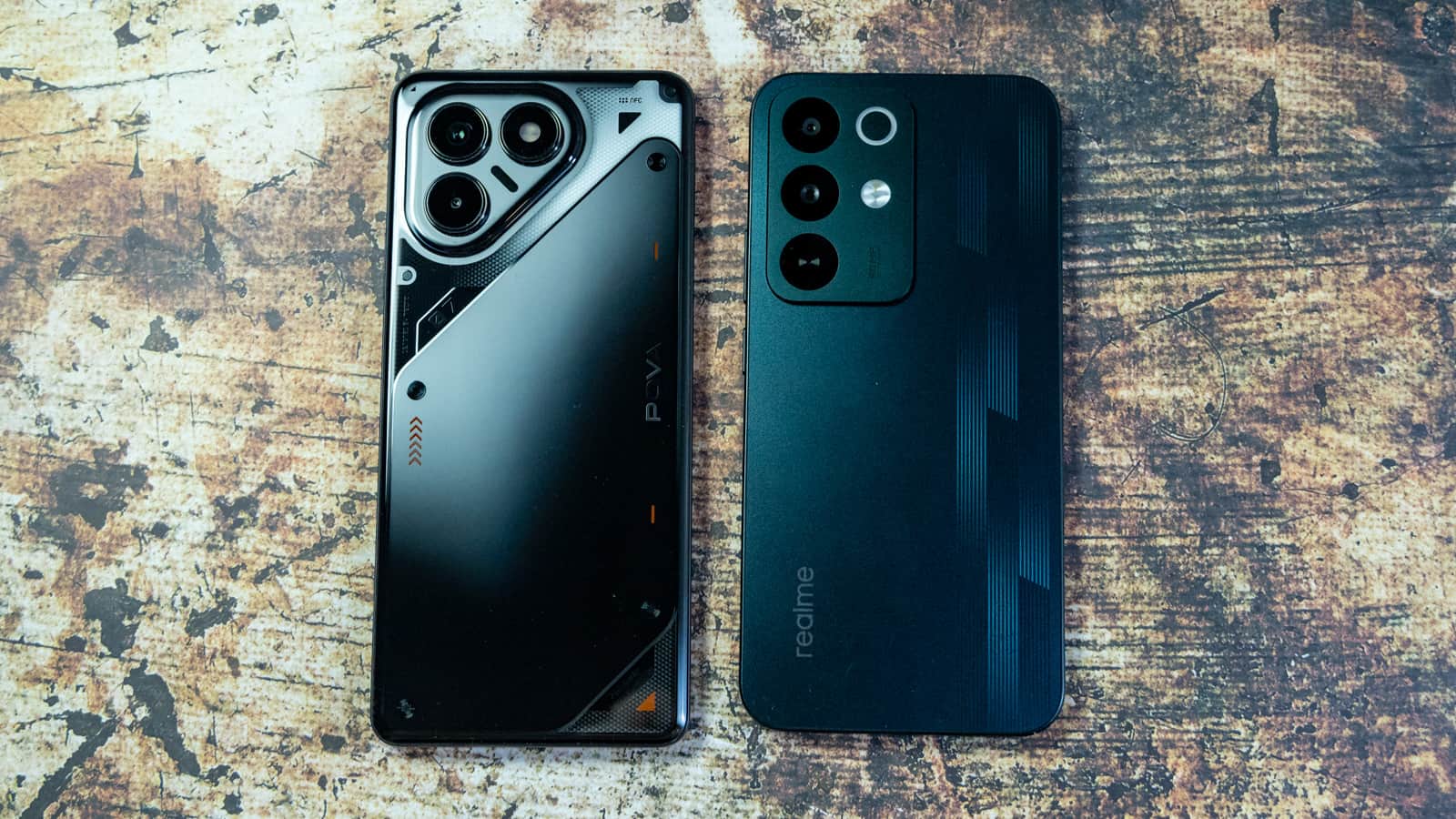
Two phones with nearly identical spec sheets rarely make for an easy buying decision — and that’s exactly the trap realme P4 and Tecno Pova 7 Neo set for shoppers in 2026. Same 7000mAh battery, same 45W charging with 10W reverse charge, same 6.8-inch 120Hz display class, same 4G-only connectivity, same NFC, same microSD support, and prices within a couple thousand rubles of each other. On paper, they’re twins.
We spent two weeks running both phones side by side, same apps, same conditions, to find out where they actually diverge.
| Metric / Feature | realme P4 | Tecno Pova 7 Neo | Real-World Advantage |
|---|---|---|---|
| Display Panel | 6.8“ AMOLED 120Hz (up to 4000 nits) | 6.78” IPS 120Hz (600 nits) | realme (brighter, deeper blacks) |
| Processor | Qualcomm Snapdragon 685 (6nm) | MediaTek Helio G100 (6nm) | Tecno (+110% GPU, +32% CPU synthetic) |
| Storage Tech | eMMC 5.1 | UFS | Tecno (faster app loading) |
| Main Camera | 50MP f/1.8 + 2MP depth | 108MP 1/1.52" + 2MP | realme (daylight & portrait blur) |
| Battery / Charging | 7000mAh (45W wired, 10W reverse) | 7000mAh (45W wired, 10W reverse) | Tie (~2 days battery life) |
| Protection / Build | IP65, ArmorShell, 209.2g | IP64, Glossy finish, 225.6g | realme (lighter, matte, IP65) |
| SIM / MicroSD | Hybrid (Dual SIM or SIM + SD) | Triple slot (Dual SIM + SD) | Tecno (dedicated SD slot) |
| Price (Russia) | from 16,999 RUB (6/128GB) | ~16,500 - 20,990 RUB (8/256GB) | Price parity |
What These Phones Are For
realme P4 sits at the top of realme’s sub-lineup for the market, above the P4x (8000mAh battery, IPS screen, Unisoc T7250) and the stripped-down P4 Lite (15W charging only). One caveat worth knowing: the Indian realme P4 5G is a completely different device, built on MediaTek Dimensity 7400 with a 144Hz screen and 5G support. The version sold here runs Qualcomm Snapdragon 685, tops out at 120Hz, and has no 5G at all.
Tecno Pova 7 Neo is the entry point into the Pova 7 family, sitting below the 5G and Pro 5G variants (Dimensity 7300 Ultimate, 6000mAh, wireless charging) and the range-topping Ultra 5G (Dimensity 8350 Ultimate). The Neo trades 5G for a bigger 7000mAh battery while keeping the series' signature ten-layer cooling system and HyperEngine gaming optimizations. Retailers list it under model code LJ6 — worth checking against LJ7 (the 5G version) before buying.
Both phones target the same buyer: someone who wants a phone that survives a full day and a half without a charger, scrolls smoothly, and doesn’t need to be a flagship camera or gaming device.
Build and Design
realme P4 (tested in Racing Green) uses a matte plastic back that genuinely feels more expensive than its price tag suggests — reviewers on our team initially assumed it was metal. It resists fingerprints and dust well and catches light nicely at an angle. Internally, an ArmorShell frame with shock-absorbing inserts backs up its MIL-STD-810H certification and IP65 rating. Measured weight came in at 209.2g against a claimed 205g, and thickness measured 8.47mm at its slimmest point (over 10mm around the camera bump).
The standout design touch is Pulse Light, a ring light around the camera module that cycles through nine colors and five pulse speeds, reacting to notifications, charging status, and even syncing with music or games — an unusual feature for a phone in this price bracket. The fingerprint sensor is optical and under-display.
Tecno Pova 7 Neo goes for a glossy plastic back with geometric lines meant to evoke a cyberpunk, mechanical look. In practice, the glossy finish picks up fingerprints and dust almost immediately — even with a case on. The bottom bezel is noticeably thicker than on the P4, which hurts the first impression further. Weight measured 225.6g (claimed 225g), and thickness hits nearly 12.5mm around the camera housing — a real difference in hand versus the realme. Its IP64 rating is a step down from the P4's IP65. The fingerprint sensor is side-mounted in the power button — a matter of preference more than a flaw.
Overall build quality clearly favors realme P4.
Display
This is where the gap is most obvious. realme P4 uses a 6.8-inch AMOLED panel (2344×1080, 120Hz) built on Samsung OLED material, with 100% DCI-P3 coverage and a claimed peak brightness of 4000 nits (1200 nits for everyday use). Tecno Pova 7 Neo uses a 6.78-inch IPS panel (2460×1080, also 120Hz) with a claimed peak brightness of around 600 nits.
Side by side at max brightness under the same light source, the difference is stark: the realme’s AMOLED panel looks noticeably brighter and more saturated, while the Tecno’s IPS panel looks washed out by comparison, almost like viewing it through a thin white film. Black levels are similarly deep on both. Neither phone showed dropped frames or stutter in games, and neither exhibited visible PWM flicker, though IPS technology is theoretically gentler on flicker-sensitive users. AMOLED also gives realme a battery-life edge in dark mode that IPS simply can’t match.
Cameras
realme P4 keeps things simple: a single working 50MP main sensor (f/1.8, phase-detection autofocus) paired with a 2MP depth sensor. No optical stabilization, no ultrawide, no telephoto — 2x zoom is a digital crop. The front camera is 8MP, f/2.0, roughly 80-degree field of view.
Tecno Pova 7 Neo pairs a 108MP Samsung ISOCELL HM2 sensor (1/1.52-inch, notably larger than realme’s) with 9-in-1 pixel binning outputting 12MP shots, plus a 2MP auxiliary sensor. Its 8MP front camera adds a flash that realme’s lacks.
In daylight, realme P4 consistently produces sharper, brighter shots with better fine detail despite the much lower megapixel count. In low light, Tecno’s larger sensor takes a modest lead — but the gap in Tecno’s favor after dark is far smaller than the gap in realme’s favor during the day.
Portrait mode is where the difference becomes obvious to anyone, not just reviewers. realme P4 renders natural, gradual background blur with clean edges around hair. Tecno Pova 7 Neo instead tries to algorithmically cut the subject out of a blurred background — which works fine against a plain wall, but falls apart against foliage or a fence, leaving sharp, in-focus patches where the blur should be, giving portraits a messy, unfinished look.
Performance
realme P4 runs Qualcomm Snapdragon 685 (Adreno 610 graphics), a chip tracing its lineage back to the 2021-era Snapdragon 680. Tecno Pova 7 Neo runs MediaTek Helio G100 (marketed by retailers as “Ultimate”): two Cortex-A76 cores at 2.2GHz, six Cortex-A55 efficiency cores, and Mali-G57 MC2 graphics.
In 3DMark Wild Life, Tecno scored 1358 points against realme’s 646 — more than double. In Geekbench 7, Tecno posted 652 single-core / 2045 multi-core versus realme’s 493 / 1688 — roughly 32% and 21% advantages respectively.
None of that shows up in daily use. App switching, browsing with a dozen tabs, camera, maps, messaging — both phones feel equally responsive, and in a blind test we couldn’t tell them apart. Gaming was the same story: no stutter, no dropped frames on either device. The explanation is simple — 3DMark Wild Life is designed to stress hardware well beyond what these chips, or these use cases, will ever encounter. Both phones sit below the threshold where the difference between “handles it” and “doesn’t” actually matters; at the settings both phones can realistically run, frame rate is capped by the 120Hz panel, not chip power. realme itself lists an average of 59.6fps and a stable 60fps in shooter games in its own lab data — a ceiling, not a chip limitation.
Storage is one area where realme P4 falls behind: it uses eMMC 5.1 instead of UFS, resulting in brief hitches when switching apps or searching the system. Thermally, both phones stay remarkably cool under load — 32–42°C on the surface in either case — thanks to realme’s efficient 6nm Snapdragon 685 paired with a 15,292mm² cooling system (5300mm² vapor chamber), and Tecno’s ten-layer cooling keeping the Helio G100 from throttling even after 30 minutes of sustained load.
Battery and Charging
Both phones share a 7000mAh battery (realme’s uses silicon-carbon “Titan” cell chemistry) and 45W wired charging with 10W reverse charging, plus bypass charging while gaming. In two weeks of testing, realme P4 delivered about two days on moderate use and roughly a day and a half under heavy gaming/video use, charging fully in just over an hour. Tecno Pova 7 Neo landed in the same range — around two days moderate use — with charging times between 75 and 90 minutes depending on the run.
Neither phone left us hunting for an outlet mid-day. realme’s AMOLED panel should theoretically save more power in dark mode, but Tecno’s more efficient chip closes that gap. Call it a tie.
Connectivity and Software
Neither phone supports 5G — both are 4G LTE only, with NFC on both. Tecno Pova 7 Neo adds Bluetooth 5.3, Wi-Fi 802.11ac, full GNSS support (GPS, GLONASS, BeiDou, Galileo) with PinPoint Nav 2.0, an LTE Cat.13 modem (~100Mbps), an infrared port for use as a universal remote, and Corning Gorilla Glass — plus a 3.5mm headphone jack. It also has a novelty feature called FreeLink, letting two Tecno phones maintain voice calls over Bluetooth at up to 800 meters with no cellular network.
realme P4 counters with built-in Yandex Alisa voice assistant integration, more directly useful for most users in this market than FreeLink.
Both support virtual RAM expansion (realme up to 24GB total, Tecno adding 8GB virtual on top of 8GB physical). Audio: realme uses standard stereo speakers; Tecno adds Dolby Atmos processing. Software-wise, realme P4 runs realme UI 6.0 on Android 15, while Tecno Pova 7 Neo runs HiOS 15 on Android 15 with the Ella assistant.
Verdict
realme P4 is the stronger all-rounder here, and the reasoning is simple: the one place Tecno Pova 7 Neo wins decisively — raw benchmark numbers — never actually shows up on screen. App switching, browsing, camera performance, and gaming all feel identical in practice. But the display difference is visible in two seconds, the fingerprint-magnet back is obvious the moment you pick the phone up, and the portrait-mode gap shows up in any photo that isn’t shot against a blank wall.
realme P4's case: Brighter AMOLED display, fingerprint-resistant matte back, 16 grams lighter, IP65 vs IP64, the Pulse Light feature that actually works, better daylight photos despite fewer megapixels, and more natural portrait blur. Its weaknesses: a combined SIM/SD slot forcing a tradeoff, a single-camera setup with no ultrawide or stabilization, slower eMMC storage causing occasional hitches, and an aging Snapdragon 685 platform.
Tecno Pova 7 Neo’s case: A dedicated microSD slot alongside dual SIM, Dolby Atmos audio, a more cohesive HiOS skin with Ella and DeepSeek integration, the FreeLink novelty, and meaningfully more raw performance headroom for the future. Its weaknesses: a glossy back that smudges within a minute of handling, extra weight, a thicker bottom bezel, a noticeably dimmer screen, and a portrait mode that regularly tears the subject mask around hair.
Bottom line: If you want a phone built to last several years and want performance headroom, Tecno Pova 7 Neo is the more rational pick. If display quality, camera results, and day-to-day polish matter more to you at essentially the same price, realme P4 is the better everyday phone.
FAQ
Which phone is more powerful? Tecno Pova 7 Neo wins on synthetic benchmarks — 1358 vs 646 in 3DMark Wild Life, and 652/2045 vs 493/1688 in Geekbench 7's single/multi-core tests. In real-world use, the difference is not noticeable.
Does that performance gap show up in gaming? No. Both chips sit below the threshold where demanding games run at high settings, so at settings both phones can actually handle, frame rate is limited by the screen and frame stability rather than chip power.
Do either support 5G? No — both are 4G LTE only in their regional market versions. (A separate realme P4 5G exists for the Indian market with a different chipset.)
Which has the better screen? realme P4's AMOLED panel (claimed up to 4000 nits peak) is visibly brighter and more saturated than Tecno’s IPS panel (around 600 nits peak).
Which has the better camera? realme P4 shoots sharper, more detailed daylight photos despite fewer megapixels. Tecno Pova 7 Neo has a slight edge in low light due to its larger sensor. realme’s portrait mode produces noticeably more natural background blur.
What do they cost? realme P4 is priced at 16,999 rubles (6/128GB) and 20,999 rubles (8/256GB). Tecno Pova 7 Neo officially costs 20,990 rubles (8/256GB), though it’s commonly found around 16,500 rubles on marketplaces.
Do both support microSD? Yes, but differently — realme P4 uses a combined slot (SD card or second SIM, not both), while Tecno Pova 7 Neo has a dedicated slot allowing dual SIM plus microSD simultaneously.

Editor-in-Chief
Sergey Kuznetsov is Head of Product at iXBT.com, one of the largest Russian-language technology media outlets, and the founder of itzine.ru. He has spent over a decade building and running tech newsrooms. At for(geeks) he sets editorial standards and reviews what ships.