• 5 min read
IFA 2026: Lenovo’s Swan laptop rolls from 14 to 17 inches
Lenovo showed Project Swan at IFA 2026, a rollable ThinkBook that expands from 14 to 17 inches, alongside new laptops, desktops and monitors.
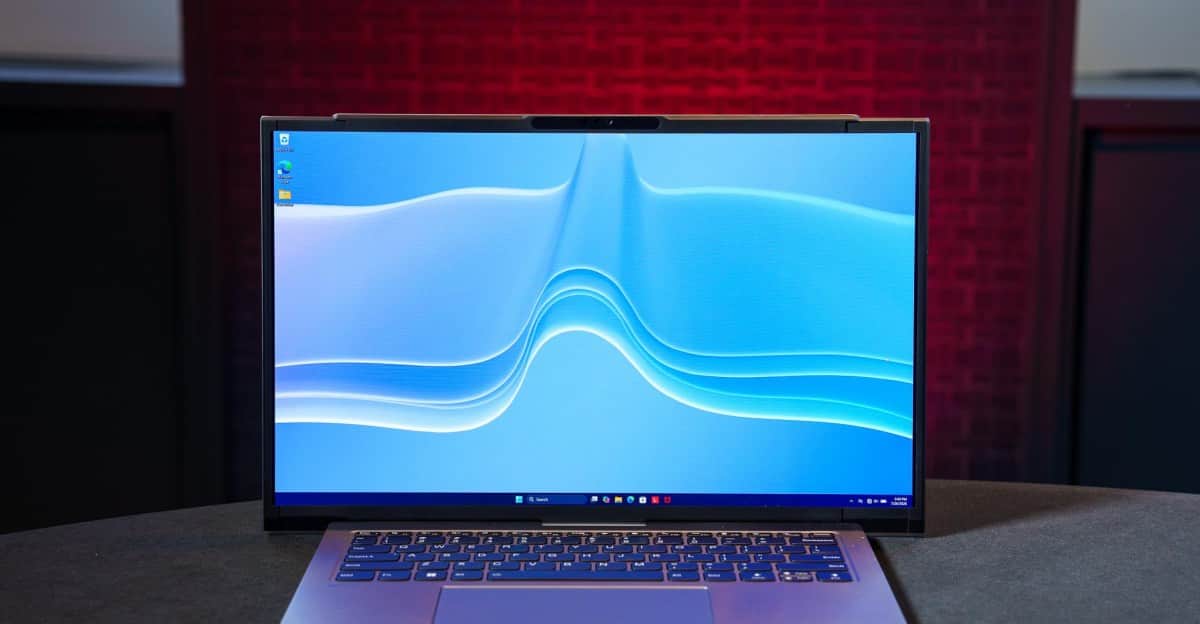
Image: The Verge
Lenovo showed Project Swan at IFA 2026, a business-oriented ThinkBook concept whose flexible OLED display rolls horizontally from a conventional 14-inch laptop into a 17-inch, 16:9 workspace. The company also announced a fanless laptop concept, new ThinkBooks, ThinkCentre desktops and its first inkjet-printed OLED monitor for commercial release.
The concept starts at an effective 2,258×1,672 pixels and extends to 2,850×1,672 pixels, according to details presented at the show. Lenovo described the larger mode as “almost” 4K, but that needs qualification: the displayed resolution is about 57 percent of the pixel count of a 3,840×2,160 4K panel. Lenovo has not said whether the production version would use IPS or OLED, although its earlier Legion Pro Rollable gaming concept used OLED.
A larger screen without a 17-inch chassis
Project Swan is 0.7 inches (17.9mm) thick and weighs 3.5 pounds (1.6kg). That makes it thicker and heavier than a typical 14-inch laptop, but substantially more compact than a conventional 17-inch machine. The display expands through controls at the top of the keyboard, using technology related to Lenovo’s earlier rollable concepts.
Recommended reading
Surface Laptop Ultra is a CUDA workstation that happens to travel
Sergey Kuznetsov • • 13 min read
| Lenovo rollable | Starting display | Expanded display | Intended use |
|---|---|---|---|
| Project Swan | 2,258×1,672 | 2,850×1,672 | Productivity laptop |
| ThinkBook Plus Rollable | 14 inches | 16.7 inches | Productivity laptop |
| Legion Pro Rollable | 16 inches | 21.5 inches, then 23.8 inches | Gaming laptop |
The mechanical layout creates a clear trade-off. The rolling screen, motor and related hardware sit in the lid, leaving it unusually thick and heavy. That weight limits how far the display can be tilted back, and the small hinge raises a long-term durability concern. A visible ripple appears where the flexible panel rolls; it is less obvious in normal lighting, but the concept still has to survive repeated expansion and closure before Lenovo can turn the design into a product.
The company is positioning Swan as a more practical alternative to the gaming-focused Legion Pro Rollable shown at CES 2026. The Legion expanded in two stages, from 16 inches to 21.5 inches and then to 23.8 inches, while Project Swan uses a single horizontal expansion and a more familiar work-laptop format. Lenovo has not disclosed Swan’s price, processor configuration, operating-system details, display technology or shipping date.
The prototype uses an Intel Lunar Lake chip, but Lenovo has indicated that any commercial model would be expected to use newer Intel silicon. That makes the current processor less a product specification than a statement about the concept’s platform. The company has not committed to production.
AeroBlade targets laptop fan noise
Lenovo’s second concept at IFA 2026 is Project AeroBlade, a 14-inch ultraportable built around a ventless cooling design. Rather than using conventional fans, it uses ultrasonic-vibration modules called AirJet to move air through the chassis. A single vent along the hinge lets outside air enter and circulate through the internal thermal system.
“A bike pump rather than a leaf blower.”
The design is intended to avoid the high-pitched fan noise and concentrated hot-air exhaust associated with conventional laptops. Lenovo says it can preserve computing performance without a major compromise, but the available information does not provide thermal measurements, sustained power limits, noise levels or benchmark results. Those figures will matter more than the ventless label: a cooling system can be quiet while still reducing the processor’s long-term performance if it cannot move enough heat.
Lenovo’s IFA 2026 products have prices and dates
Unlike Swan and AeroBlade, several of the conventional products shown at the event have announced US pricing and availability. Lenovo’s first commercially available inkjet-printed OLED monitor, the ThinkVision P27UL-40, is a 27-inch 3,840×2,160 display with a refresh rate of up to 120Hz. It is scheduled for March 2027 starting at $1,300.
Inkjet printing deposits organic display material onto glass, and industry analysts cited in the reporting estimate that the manufacturing method could reduce production costs by up to 20 percent. That estimate is not a Lenovo performance guarantee, and the monitor’s $1,300 starting price remains well above ordinary LCD pricing. Lenovo’s model also isn’t the first consumer IJP OLED monitor: MSI announced the 27-inch, 4K, 120Hz PRO MAX OLED 271UPJW12 on August 2, 2026, with 164 pixels per inch, 99 percent DCI-P3 coverage, Delta E ≤ 2 accuracy and peak brightness of up to 1,000 nits, as documented in MSI’s official announcement. Lenovo’s release is therefore a company product milestone, not the first IJP OLED monitor overall.
| Product | Display or processor | Availability | Starting price |
|---|---|---|---|
| ThinkVision P27UL-40 | 27-inch, 3,840×2,160 IJP OLED, up to 120Hz | March 2027 | $1,300 |
| ThinkVision T32WD-4v | 32-inch IPS, 3,840×2,160, up to 120Hz | February 2027 | $900 |
| ThinkVision T34WD-4v | 34-inch VA, 3,440×1,440, up to 120Hz | January 2027 | $1,000 |
| ThinkCentre X Ultra | Up to Ryzen AI Max Plus Pro 495; up to 128GB RAM, 8TB storage | November 2026 | $3,700 |
| ThinkCentre M75q Gen 6 | Up to Ryzen AI 7 Pro 450GE; up to 64GB RAM, 4TB storage | September 2026 | $1,380 |
| ThinkCentre M75s Gen 6 | Up to Ryzen AI 7 Pro 450G; 64GB RAM, 4TB storage | October 2026 | $1,490 |
The ThinkCentre X Ultra is a 4.4-pound desktop with integrated graphics, two expansion slots for additional SSDs, up to 128GB of memory and up to 8TB of system storage. Its $3,700 starting price places it in a different category from Lenovo’s compact business desktops. The 2.6-pound ThinkCentre M75q Gen 6 uses integrated Radeon 860M graphics, while the 10.6-pound M75s Gen 6 can be configured with integrated Radeon 860M or a Radeon RX 6400 with 8GB of memory.
Two ThinkBooks fill the near-term gap
Lenovo also showed two conventional 14-inch laptops with clearer paths to market. The ThinkBook 14 Gen 9 weighs 2.8 pounds and combines a 14-inch, 1,920×1,200 display with a Qualcomm Snapdragon X2 Plus processor, Qualcomm Adreno graphics, up to 32GB of LPDDR5x memory and a 1TB SSD. It can accept a second SSD and is scheduled for release in October 2026 starting at $1,300.
The lighter ThinkBook 14x Gen 2 weighs just under 2.2 pounds and uses Intel Core 7 Series 3 silicon with integrated graphics, up to 32GB of LPDDR5x memory and up to 2TB of storage. An optional 2.8K OLED display is available, and the laptop is scheduled for early 2027 starting at $1,000.
Lenovo has previously put a rollable ThinkBook Plus on sale for $3,299, while another report listed its launch price as $3,500 before later memory-cost increases. The discrepancy applies to the earlier model’s reported price, not to Project Swan, whose price remains undisclosed. Swan’s simpler horizontal mechanism may be easier to manufacture than a vertically expanding design, but the thick motorized lid and flexible OLED still leave durability and cost unresolved.
Frequently asked questions
What is Lenovo Project Swan?+
Project Swan is a ThinkBook concept laptop shown at IFA 2026. Its flexible display expands horizontally from 14 inches to 17 inches in a 16:9 format.
How much does Project Swan cost?+
Lenovo has not announced a price for Project Swan. The laptop is still a concept, and its configuration and shipping date are also unknown.
When do Lenovo’s new IFA laptops ship?+
The ThinkBook 14 Gen 9 is scheduled for October 2026, while the ThinkBook 14x Gen 2 is planned for early 2027. Project Swan has no announced ship date.
What is Lenovo’s IJP OLED monitor?+
The ThinkVision P27UL-40 is a 27-inch 3,840×2,160 inkjet-printed OLED monitor with up to a 120Hz refresh rate. It is scheduled for March 2027 starting at $1,300.
A section byline, not a person: stories filed here by for(geeks) are held to the same editorial policy as every story we run.