• Updated • 19 min read
Godox iT32 and X5 review: one flash across all camera brands
Godox iT32 is a 169-gram TTL flash with no hot shoe of its own. A swappable magnetic X5 module connects it to the camera and doubles as a radio trigger. Godox announced the kit in November 2025. It costs about $99 in the US and starts at 7,500 rubles in Russia and the CIS. The Godox iT32 suits photographers with two camera systems and anyone who often moves the flash off camera. Its weak point is power: GN 18 on paper, GN 13 in lab tests. Buy it if compact size matters more to you than reach.
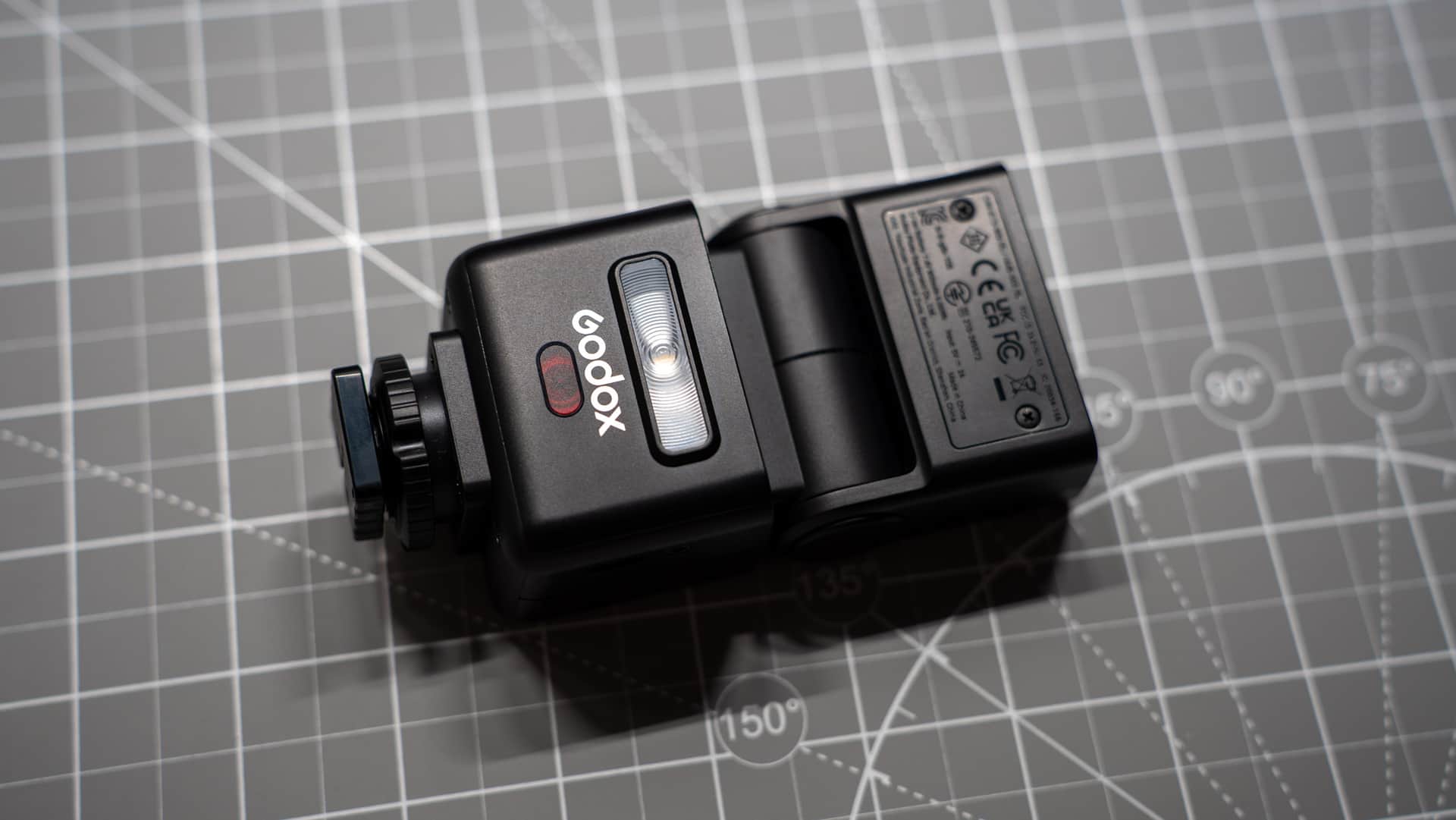
Godox iT32 is a small TTL flash with no hot shoe of its own. Godox moved the mount and the radio into a separate X5 module, which attaches to the bottom of the flash with magnets. Put the two together and you get an ordinary on-camera flash. Pull the big unit off, and the flash instantly switches to receiver mode, while the X5 stays in the camera’s hot shoe and becomes a transmitter.
The core numbers of the Godox iT32 are simple. Guide number 18 at ISO 100, 169 grams, USB-C charging and about 510 flashes at full power. The iT32 + X5 kit costs about $99. In Russia and the CIS the set sells from 7,500 rubles and up. Godox announced the system in November 2025, according to launch coverage by RedShark News.
The purchase makes sense in a few cases. You shoot with two cameras. You often move the flash off the camera and back. Or you simply want a modern compact flash that you can take off, put on a stand or hold in your hand to change the lighting.
What the Godox iT32 is and who it’s for
Everything tied to the camera brand lives in the X5, a module the size of a large button. That includes the hot shoe contacts, the protocol and the transmitter. So an X5 for Sony won’t fit a Canon, and vice versa. Everything else sits in the flash body: the flash tube, the battery, the screen and the electronics. None of it depends on the camera brand. Hence the main idea of the Godox iT32: one flash, many modules.
Modules exist for Canon, Nikon, Sony, Fujifilm, OM System and Leica. Godox has also promised an X5 Cm version for Canon cameras with a multi-function shoe that lacks the center contact, such as the EOS R50. For other Canon cameras with the multi-function shoe, the maker recommends an adapter. The compatible cameras section on the Godox website has the details.
The math behind this kit is simple. Adding another camera system costs one module, not a new flash. In the CIS that means roughly 1,890 rubles for the X5 C, X5 N and X5 F, 2,390 rubles for the X5 S and X5 O, and 4,390 rubles for the Leica X5 L. Globally a module costs $19 to $25, and the flash alone costs $79. Digital Camera World lists the kit at £89 in the UK and AU$179 in Australia, and notes that the Sony versions cost slightly more. A branded flash of the same class costs several times as much. And it works with only one system.
So who needs it? Event and news shooters with two bodies from different brands. Product photographers, where power doesn’t decide the result. People who carry a camera in a city bag and won’t haul a 400-gram brick. The Godox iT32 also makes a good first off-camera light. The entry cost is low, and the whole Godox X lineup connects to the same radio system later. However, if you need to bounce light off a four-meter ceiling at a wedding, look at the bigger models. This one lacks the power.
Design and ergonomics Godox iT32
The dimensions are tiny: 56 × 101 × 39 mm and 169 grams with the battery. The X5 module weighs 23 grams. Together that’s under 200 grams. As a result, the flash stops being something you pack on purpose. It becomes a gadget that simply lives in your backpack.
The joint is magnetic, with no rings, latches or screws. It holds very well. I turned the assembled unit upside down and shook it, and the flash stayed on. There is some vertical play, about 0.5 mm. Still, it doesn’t affect the contact: TTL keeps working and no frames get skipped. The unit comes apart with one upward motion. Putting it back doesn’t always work on the first try. Sometimes I had to nudge it along the guides, though I blame my hands more than the design.
The head tilts from minus 7 to 90 degrees. So you can dip it slightly and point it straight up. You can’t flip it backward. Rotation is asymmetric: 180 degrees to the right and only 90 to the left. On a full-size flash this would be a serious drawback, because you often need to bounce off the wall behind you. Here the off-camera scenario saves the day. And the stand with a tripod mount helps a lot.
That setup is the one I liked best. You take the unit off the camera and put it on the included magnetic stand, which has a tripod thread underneath. Or you just hold the flash in your hand and light from wherever you need. Nothing needs pairing. The flash switches to receiver mode the moment you separate it. By the way, the stand is double. The flash sits on it magnetically, and there is also a shoe for the X5 itself, in case you’d rather mount the module.
Godox rates the operating range at minus 10 to plus 45 degrees Celsius. A winter street is already the edge. In the cold, the lithium battery drains faster than the spec suggests, and 510 flashes turn into far fewer. On top of that, a touchscreen is no fun in gloves. Summer brings the opposite problem. A small body heats up faster than a big one, so full-power bursts are better broken up with pauses.
Screen, controls and interface Godox iT32
The back carries a color touchscreen with MENU and SET buttons beside it. A dial sits on the right side. The controls follow smartphone logic. Swipe down to open the menu, swipe up to go back. A slider sets the power, and plus and minus move it in thirds of a stop. The dial duplicates all of this and helps when tapping with a finger is awkward. Frankly, the touchscreen feels unnecessary here, because the dial and buttons are more than enough. At first I didn’t even realize the screen was touch-sensitive, until I accidentally swiped it.
The screen is very sensitive. In a pocket or on a strap it’s easy to change the power by accident. That’s why the menu has a lock. Hold the screen or the SET button for a couple of seconds, and the display freezes. A separate setting decides whether the screen locks right at power-on. It’s a useful option: you turn it on once and forget about it.
The menu has two languages, English and Chinese. Not everyone finds the switch right away. At first I myself decided the flash spoke only Chinese. In fact the option sits in the settings, next to the factory reset and the device info. You switch it once, and that’s it.
What else is in the menu? Standby and auto-off timers, screen brightness, boot behavior, reset, and the model and firmware version. The same place holds settings for the S1 and S2 optical slave modes. The Canon version also has a Sender Flash option. It decides whether the flash on the camera fires while it controls the other lights.
The most useful line in the menu is TCM. It works like this. You take a shot in TTL, press TCM, and the flash converts the automatic power into a manual value. After that the whole series stays consistent, with no exposure drift from frame to frame. This is the classic way to combine the speed of automation with the predictability of manual mode. For product shots and portraits it saves a lot of post-processing time.
Kit and filters Godox iT32
The Godox iT32 box contains the flash, a USB-C cable, a small plastic diffuser, a stand, two magnetic CTO filters rated 1/2 and 1/1, a fabric pouch and a quick guide. The X5 ships separately in a blister pack, with nothing else included.
I liked the Godox iT32 package. It’s a rare case where $100 gets you more than a bare body and a cable. Still, there are no color filters, and that’s a letdown. Formally the box does include filters, but both are warm conversion filters. Their job is different: they match the flash to the color of incandescent bulbs, so the flash doesn’t stand out as a blue spot in warm indoor light. The 1/1 filter lowers the color temperature more, the 1/2 filter more gently, and you can combine them.
Creative color is missing entirely. No blue, no magenta, no green, nothing to tint a background. For those you need to buy the separate Godox magnetic accessory set. Since the mount is magnetic, adding filters would have cost pennies, so the decision looks odd. Then again, the same set also includes a wide-angle panel and other attachments, so there is room to grow.
The head hides two more things. A pull-out white card adds catchlights in the eyes when you bounce off the ceiling. A flip-down wide-angle diffuser spreads the light. For a body this size the set is rich, and all of it fits easily in the pouch together with the flash.
Godox iT32 light output, power and battery life
The rated guide number is 18 meters at ISO 100. The head has no zoom. The beam is fixed and wide, roughly like a regular flash at the 28 mm setting. That’s why you can’t compare this figure directly with full-size models. Those claim GN 40 and higher, but they measure at the long end of the zoom, where the beam is narrow and dense. At the wide end the gap shrinks several times over.
Then comes the unpleasant part. In Digital Camera World lab tests, a Sekonic flash meter at one meter measured a maximum of GN 13 instead of the claimed 18. By power step, the picture looks like this: GN 1.2 at 1/128, GN 1.7 at 1/64, GN 2.4 at 1/32, GN 3.3 at 1/16, GN 4.8 at 1/8, GN 6.7 at 1/4 and GN 13 at full power. That’s almost a full stop short, and you should factor it into your calculations, especially when bouncing off the ceiling. Digital Camera World also found that the iT32 at full power roughly equals a quarter of the output of a full-size Godox V860III at its 24 mm zoom setting. The same review rated TTL metering as accurate and consistent with Nikon and Sony cameras.
What does this mean in practice? In a room with a white ceiling 2.5 meters high, the flash does its job, but you’ll need to raise ISO to 400 or 800. In a hall with a high or dark ceiling, bounce light is almost useless. It’s easier to move the flash closer to the subject. Direct flash at two meters, f/4 and ISO 100 works with headroom to spare.
Recycling, on the other hand, is honest. It takes about a second and a half after a full-power flash, which matches both the spec and the measurements. At 1/8 and below the flash is ready almost instantly. So in real work you rarely wait, because indoors you seldom need full power.
The 7.4-volt, 900 mAh flash battery gives about 510 full-power flashes. At low power the count runs into thousands, so a full shooting day is covered without question. Everything charges over USB-C. You don’t need a separate charger or spare batteries. On the other hand, you can’t swap the battery on the go. For a long shift it makes sense to carry a power bank.
The X5 module has its own 3.8-volt, 100 mAh battery. It lasts about 16 hours and charges from the flash in about three hours. The module has no port of its own, so the only way to charge it is to attach it to the iT32. It has no power button either, so a module lying on its own simply drains by itself. A firmware update taught the flash to show the module’s charge right on its screen, and that noticeably eases the worry.
The modeling LED with smooth brightness control deserves a separate mention. It shows the light pattern before the shot. That helps most when the flash stands off to the side and the result isn’t obvious. Its second purpose is autofocus. Mirrorless cameras can’t use the old red AF-assist beam, while a plain white LED lights up the scene and helps the camera lock focus in the dark.
Connectivity, sync and firmware Godox iT32
The radio is standard for Godox: the X system at 2.4 GHz, 32 channels, IDs from 1 to 99 and four slave groups. The master groups depend on the module. The S, N, F, O and L versions use M, A, B and C, while the Canon version uses A, B, C and D. In practice the pair can control any Godox flash or monolight, from the V860III to the AD200 and AD600.
Range is rated at up to 80 meters when assembled and up to 20 meters when the X5 works on its own. The fourfold gap comes down to physics. A button-sized module has a weaker antenna and less power. Indoors you won’t notice the difference. But when you shoot across a courtyard or hide the flash around a corner, twenty meters becomes a real limit.
Sync works through the hot shoe or through a 2.5 mm cable, and the socket sits right on the flash, next to the USB-C port. So the pair will also work with a film camera or an older camera without a protocol, although only in manual mode. There is an S1 and S2 optical slave mode, so another flash can fire the unit, with S2 ignoring the pre-flash.
The modes on board include HSS up to 1/8000 s, first- and second-curtain sync and a stroboscopic mode. The iT32 with the X5 S module also supports sync with the Sony global shutter up to 1/80,000 s. The other modules don’t have this feature at all. For A9 III owners, it’s the only reason to pay extra for the Sony version.
The strobe mode is rated at up to one hundred flashes at 100 Hz. On my unit, the power scale in this mode bottoms out at 1/128 and goes no lower. For a sequence on a long exposure that’s enough. The weaker each flash, the more flashes fit into one frame without turning the subject into a white blob. Firmware updates run over USB-C through the Godox G3 utility, version 1.1 or later. The X5 module updates itself. You attach it to the switched-off flash, turn the power on, and the rest happens without your involvement.
The main limit of the system lies in the interface, not the radio. The X5 has no screen, just two buttons and an indicator. While the flash sits on the module, you control the whole setup from the touchscreen, and that’s convenient. Once you split the kit, you have nothing to set up groups with. For a single off-camera flash that’s fine. For a three-light setup it’s already awkward, and then it makes more sense to buy a proper trigger. Digital Camera World names the Godox XPro and the touchscreen X3 and X3 Pro as such options.
Where it works
The first and most obvious case is two cameras from different systems on one shoot. Each hot shoe holds its own X5. The flash moves between them in a second, and TTL stays native for each brand. This used to take two flashes. Now it takes one flash and a module.
The second case is quick off-camera light. You take the unit off and set it to the side on a table, a shelf or a light stand. Instead of flat frontal light you get side light. Speed is the key here. Since the switch requires no settings and no pairing, you start trying off-camera light in places where you would have been too lazy before. That changes habits more than any spec does.
The third case is fill flash in sunlight. HSS up to 1/8000 lets you open the aperture and light a face against the sun without blowing out the sky. The power covers about one and a half to two meters, beyond that the flash gives up. That’s fine for a single portrait, but not for a group of five.
The fourth case is product and macro work. Here low power suddenly becomes a plus. You don’t need to throttle the flash to its minimum and fight flash duration. Godox specs list a flash duration of 1/1000 to 1/30,000 s. You can hold the flash right above the subject, the stand lets you set it at any angle, and the modeling light shows reflections before you press the shutter.
The fifth case is less obvious. The pair works as a transmitter for the whole Godox X system. So you can use the iT32 with X5 as a trigger to control studio monolights and still keep a backup light at hand. For a location shoot where you don’t want to carry a separate trigger, the setup works.
Competitors and alternatives
The closest relative in the lineup is the Godox iT30Pro. It’s lighter, 120 grams at 65 × 47 × 46 mm, promises about 560 flashes and also has a color touchscreen. However, its guide number is lower, GN 15, and its hot shoe is permanently tied to one system. In Digital Camera World tests the iT30Pro delivered GN 11 instead of the claimed 15, so its gap from the spec has exactly the same nature. The choice between the two is simple. One camera and every gram counts: take the iT30Pro. Several systems or plans for off-camera work: take the Godox iT32.
Below them sit the Godox iM20 and iM22. They are very simple, with no modularity and no screen. They cost less, but they can do far less. That’s the level of a replacement for a built-in flash, not a tool.
If power is your limit, look in the other direction. The Godox Ving V860III costs about $229, the Godox V100 about $349. Both have a zoom head and a GN above 40. They are heavier and bigger and need a separate trigger for off-camera work. In return, they can bounce off the ceiling of any hall. For studio or location off-camera light with no camera-mounted flash, the right answer is the AD100Pro.
Outside Godox you have options too. Viltrox released a compact flash with a similar idea of compactness, but without a swappable shoe. Digital Camera World reviewed it as the Vintage Z1 Pro, sold in separate versions for Canon, Nikon, Sony and Fujifilm. Honestly, though, the ecosystem decides. If you already own even one Godox light, the whole radio system comes together under one trigger. That’s a stronger argument than a couple of guide number points.
One last comparison, the most honest one. The real alternative to the Godox iT32 isn’t another flash. It’s no flash at all. Most people don’t carry light with them precisely because of the size. Here size stops being an excuse.
Verdict about Godox iT32+X5
Godox iT32 does exactly what it promises. Modularity saves both money and space. The magnets hold firmly, the touchscreen is clear, and the battery lasts a full shift. On top of that you get a modeling light, a strobe mode, TCM, an optical slave mode, a sync cable socket and a generous box that includes a stand, a diffuser and a pouch.
There are downsides. The power is modest, and lab measurements show the flash falls almost a stop short of the rated 18. There is no zoom. The box has no color filters, only warm ones. Range drops fourfold when the kit is split. Small things like a millimeter of play in the joint and the module not seating on the first try don’t affect the results.
The Godox iT32 is worth buying if your scenario matches. That means several camera systems, regular switching between on-camera and off-camera light, and compactness ranked above power. If you need one powerful light for one camera, put the money into a bigger model.
Frequently asked questions
How much does the Godox iT32 cost?+
About $99 for the flash with one X5 module in the US, $79 for the flash alone and $19 to $25 per extra module. In Russia and the CIS the kit starts at 7,500 rubles.
Which cameras does the Godox iT32 work with?+
Canon, Nikon, Sony, Fujifilm, OM System and Leica, each through its own X5 module. Godox has promised an X5 Cm for Canon bodies like the EOS R50.
Is the Godox iT32 powerful enough for weddings?+
Not for bouncing off high ceilings in large halls. Digital Camera World measured GN 13 against the claimed GN 18.
Can the Godox iT32 work off camera?+
Yes. Pull the flash off the X5 and it becomes a receiver, while the X5 in the hot shoe becomes a transmitter. No pairing needed.

Editor-in-Chief
Sergey Kuznetsov is Head of Product at iXBT.com, one of the largest Russian-language technology media outlets, and the founder of itzine.ru. He has spent over a decade building and running tech newsrooms. At for(geeks) he sets editorial standards and reviews what ships.