• Updated • 5 min read
Flock’s police AI can track drivers by behavior
Flock’s OS Investigate uses camera networks, police files and commercial data to identify drivers and map their associations, WIRED reports.
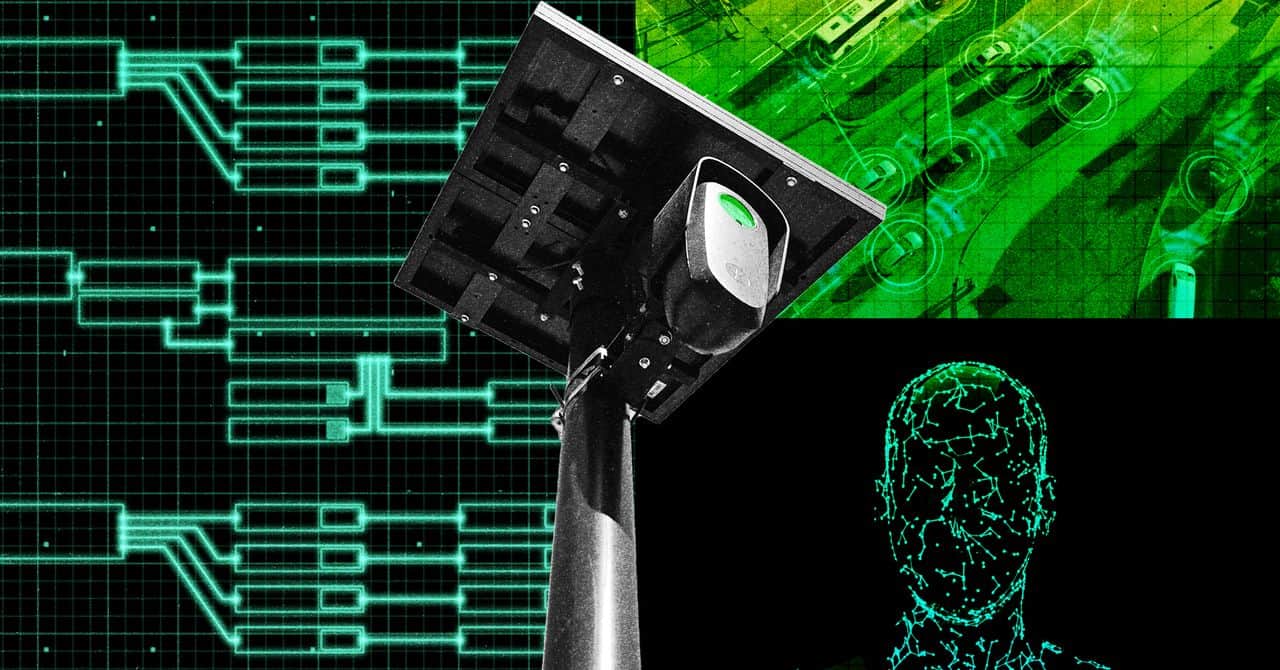
Image: Wired
Flock Safety’s next-generation police software can identify drivers and infer their relationships from vehicle-movement patterns—not just check license plates. The findings were published on August 19, 2026, when WIRED reconstructed Flock’s OS Investigate system from code served through the company’s login portals.
Flock has long told the public that its cameras “cannot recognize, identify, or track individuals.” OS Investigate, formerly called Nightshift, appears to go much further. It can search vehicle movements across a network covering more than 6,000 communities, then connect plates to names, addresses and relatives through police case files, 911 dispatch logs and commercial identity databases.
The system includes 69 prewritten prompts and access to 45 tools, according to the code WIRED examined. Those tools can apparently query plate scans and camera metadata alongside arrest records, case files, dispatch logs, ballistics results and commercial records containing Social Security numbers, dates of birth, phone numbers, email addresses, relatives and associates.
One suggested prompt asks officers to find vehicles seen most often in a neighborhood during a specified 14-day period and daily time window. Another searches for people arrested more than twice in two years, maps their homes and calls for service, then asks the system to create a “workup” on three individuals selected by the software. In Flock’s terminology, a workup can return vehicles, prior suspect listings, relatives, phone numbers and online accounts.

Recommended reading
Google’s €403M location case gives it six months to comply
Sergey Kuznetsov • • 4 min read
Other prompts look for behavior without requiring a plate, name or known incident. They can identify vehicles that visited several retail locations, banks or gas stations, made repeated trips between cities, or moved through three areas in sequence. A filter excludes buses, semi trucks, work vans and trailers, meaning an ordinary driver making the same trips could be surfaced while some commercial vehicles are removed.
The software can also identify a vehicle’s apparent associates. The code says it ranks other plates by how often they appear at the same cameras within a default two-minute window, reporting vehicles seen alongside the target at least three times when they meet a default confidence threshold of 0.75. An officer can provide one plate, and the system can return up to 20 associated vehicles.
“I think that most people imagine that license plate readers are checking license plates and they’re looking if a vehicle is wanted. And if it’s not wanted, the police will move along. But we’re increasingly seeing the aggressive deployment of AI by Flock. And in some ways, like China, very little space between what can be done and what is being done.”
Flock says OS Investigate is a separate product from its license-plate-reader technology and is intended to help investigators work across data their agencies already can access. Spokesperson Paris Lewbel said the product is being tested with a small group of law-enforcement partners, remains in development and may change significantly before a broader release. Flock did not dispute the capabilities described in WIRED’s reporting.
The code also shows a default search-justification field. Officers must enter a reason, but the interface appears not to require a particular format or minimum length. If a department requires a case number, the form checks only that it contains at least three characters. WIRED could not determine whether Flock’s servers impose additional checks after submission.
The company’s public claims and the system’s apparent scope are now colliding with existing scrutiny. Flock has faced reports of officers misusing its platform, bipartisan political pressure and a nationwide protest movement in which at least 33 cameras across 23 states were damaged, as we reported in July. Privacy and legal experts told WIRED that broad, potentially warrantless access to movement records raises constitutional concerns.
Flock’s scale makes the issue consequential: the company says it logs 20 billion plate scans per month, has roughly 140,000 monthly active users and was valued at $7.5 billion in its most recent funding round. But WIRED’s code review cannot establish how the underlying model responds to requests, what Flock’s servers return, or whether the production system rejects some commands. Those controls—or their absence—remain outside what the exposed interface can show.
Update, 24 September 2026 — Senate hearing puts Flock under scrutiny
The Verge reports that the Senate Judiciary Committee’s crime and counterterrorism subcommittee held a hearing on what it called an “AI Surveillance Network,” bringing Flock’s use of automated license plate readers into a federal forum. Flock CEO Garrett Langley and the CEOs of Axon, Motorola Solutions and Verkada declined to testify, according to subcommittee chair Sen. Josh Hawley (R-MO).
Witnesses included cybersecurity and legal experts, a sheriff whose department ended its Flock contract, and a Florida woman who said she spent 13 days in jail after Flock cameras incorrectly linked her car to a crime scene. Senators from both parties raised concerns about data security, police access to vehicle-location records, possible indirect searches by federal immigration authorities, and tracking connected to abortion care or gun ownership. Hawley said compelling the executives to appear would require a full committee vote.

Editor-in-Chief
Sergey Kuznetsov is Head of Product at iXBT.com, one of the largest Russian-language technology media outlets, and the founder of itzine.ru. He has spent over a decade building and running tech newsrooms. At for(geeks) he sets editorial standards and reviews what ships.