• 5 min read
Google’s TimesFM-3 forecasts entire multivariate horizons
TimesFM-3 adds multivariate forecasting, covariates and one-pass horizon prediction to Google’s 330M-parameter time-series model.
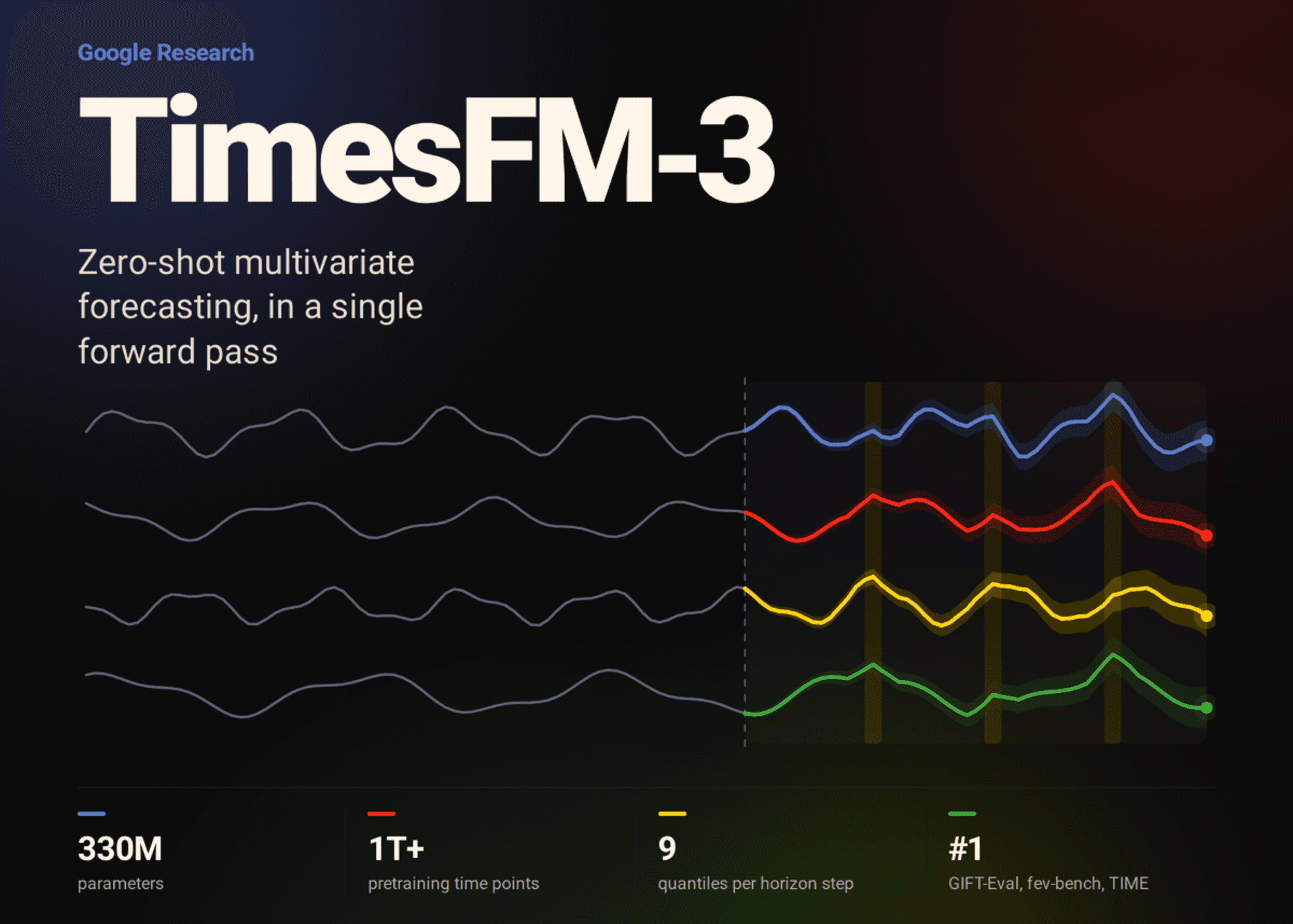
Image: https://research.google/blog/timesfm-3-a-zero-shot-foundatio
Google’s TimesFM-3 is a 330 million-parameter foundation model for time-series forecasting. It can forecast multiple related series together, incorporate covariates, and generate an entire forecast horizon in one forward pass.
That moves TimesFM beyond the univariate design used through version 2.5. Earlier checkpoints forecast one series from its own history. TimesFM-3 can jointly model targets such as several product categories while using historical foot traffic, weather or sales data, and future-known signals such as promotion calendars.
The model was pretrained on more than 1 trillion real and synthetic time points. Google says it achieved the top average rank among pretrained foundation models on GIFT-Eval, fev-bench and the TIME leaderboard for both point and probabilistic forecasting metrics. The repository records more specific results: rank No. 1 overall across 100 real-world tasks on fev-bench, rank No. 1 across 50 domain datasets and 98 evaluation tasks on TIME, and rank No. 1 among foundation models on GIFT-Eval.
Recommended reading
Open weights give Mistral control, not frontier parity
Sergey Kuznetsov • • 9 min read
TimesFM-3 changes the forecasting path
The published implementation is a decoder-only transformer, but it organizes inputs differently from a conventional token sequence. It groups contiguous time points into 32-step patches and normalizes each series independently, preventing high-magnitude channels from dominating lower-scale ones.
Target values and past-only covariates are represented in a shared patch. For past-and-future covariates, the model uses a lookahead arrangement: the current patch is combined with future patches so scheduled information can reach the forecast without exposing future target values.
Those tokens are arranged in a two-dimensional grid and processed by alternating attention types. Causal temporal attention moves across time within a series and is restricted to earlier tokens, which prevents leakage from the forecast horizon. Full variate attention moves across series at a given time step, allowing the model to learn relationships among channels.
The model produces a joint forecast rather than a collection of separate univariate calls. Google’s implementation supports point predictions and nine quantiles—the 10th through 90th percentiles—for every target and horizon step.
| Capability | TimesFM 2.5 | TimesFM-3.0 |
|---|---|---|
| Parameters | 200M | 330M |
| Native forecasting mode | Univariate | Univariate and multivariate |
| Context length | Up to 16k | Not stated in the supplied documentation |
| Covariates | XReg support added later | Past-only and past-and-future covariates natively |
| Quantile output | Optional 30M quantile head, up to 1k horizon | 9 quantiles per forecast step |
| Forecast generation | Earlier patch-by-patch decoding | Whole horizon through Contiguous Patch Masking |
The table’s 2.5 figures come from the TimesFM repository’s archived release notes; the 3.0 architecture details come from the official PyTorch model documentation. Google does not state a TimesFM-3 context-length limit in that documentation, so the 16k figure must not be read as a specification for the new checkpoint.
Contiguous Patch Masking removes repeated decoding
Earlier TimesFM versions decoded one patch at a time. That approach can add latency and compute cost, while errors in an early patch can influence later predictions. TimesFM-3 instead uses Contiguous Patch Masking, a training strategy introduced with TiRex.
During forecasting, placeholder tokens are appended for the full requested horizon. Future target values and past-only covariates are masked, while known future covariates remain visible. The alternating temporal and variate attention layers then fill the masked horizon patches simultaneously.
The official repository includes concrete PyTorch examples. A univariate batch can contain series with different context lengths—for example, arrays of 100 and 72 steps—with a requested horizon of 12. In multivariate mode, the example passes three target channels with a 128-step context and a 24-step horizon, one past-only covariate channel, and two past-and-future covariate channels covering 152 steps of context plus horizon. The resulting point forecast has shape (3, 24), while the quantile output has shape (3, 24, 9).
The model configuration exposed in the official TimesFM repository uses a 1,280-dimensional model, 16 attention heads and 20 transformer layers. The checkpoint documentation describes the architecture as a Stacked Mixing Transformer with Variate Attention and CPM Iterative RevIN, with a 32-step context patch and a 64-step forecast-horizon patch. The repository’s code examples initialize the PyTorch checkpoint with a CUDA device and per-core batch sizes of 32 for univariate inference and 16 for the multivariate example.
Open weights do not mean production-ready licensing
The code and the model have different licenses. The TimesFM source code is Apache-2.0 licensed, and checkpoints through version 2.5 remain Apache-2.0. TimesFM-3's pretrained weights, however, are distributed under the separate TimesFM Non-Commercial License v1.0.
That license restricts the default TimesFM-3 weights to non-commercial, non-production use. Developers can download the official TimesFM 3.0 PyTorch weights for research, evaluation and benchmarking, but the supplied material does not permit using those weights to operate a commercial forecasting API or production service.
For teams that need an Apache-2.0 option, the repository identifies TimesFM 2.5 as the latest version whose weights retain that license. The older, smaller model is therefore the deployable choice under the stated terms, despite TimesFM-3's broader input support and benchmark results.
Google also lists TimesFM integrations in BigQuery ML, Google Sheets and Vertex Model Garden, but the repository describes this open version as not an officially supported Google product. The documentation does not establish whether those first-party products use TimesFM-3's newly released weights or carry the same licensing terms.
The benchmark rankings provide evidence of research performance, not of a ready-to-buy forecasting service. The supplied results do not include latency, hardware, memory use, per-task scores or independent reproduction details, leaving deployment cost and behavior on a particular business dataset unresolved.
Frequently asked questions
Can TimesFM-3 be used in production?+
Not with the default pretrained weights. They are restricted to non-commercial, non-production use under the TimesFM Non-Commercial License v1.0.
What does TimesFM-3 forecast?+
It supports univariate and multivariate time series, plus past-only and past-and-future covariates, without task-specific fine-tuning.
How many quantiles does TimesFM-3 output?+
It produces nine quantiles, from the 10th through the 90th percentile, for each target and horizon step.
Which TimesFM version has Apache-2.0 weights?+
The repository says TimesFM weights through version 2.5 remain Apache-2.0 licensed. TimesFM-3.0 weights use a separate non-commercial license.
A section byline, not a person: stories filed here by for(geeks) are held to the same editorial policy as every story we run.